Through the Eyes of Travellers (Perceptions of Society) – History Class 12 Notes
Part-II | Chapter – 5
Through the Eyes of Travellers
(Perceptions of Society (c. 10th – 17th centuries))
1. Introduction
Travellers from other lands came to India for trade, pilgrimage, adventure or as part of armies, and wrote about what they saw. Their accounts are valuable because they described everyday life that local writers often took for granted. But since they came from different cultures, they often noticed what seemed unusual and compared India with their own lands.
2. Al-Biruni and the Kitab-ul-Hind
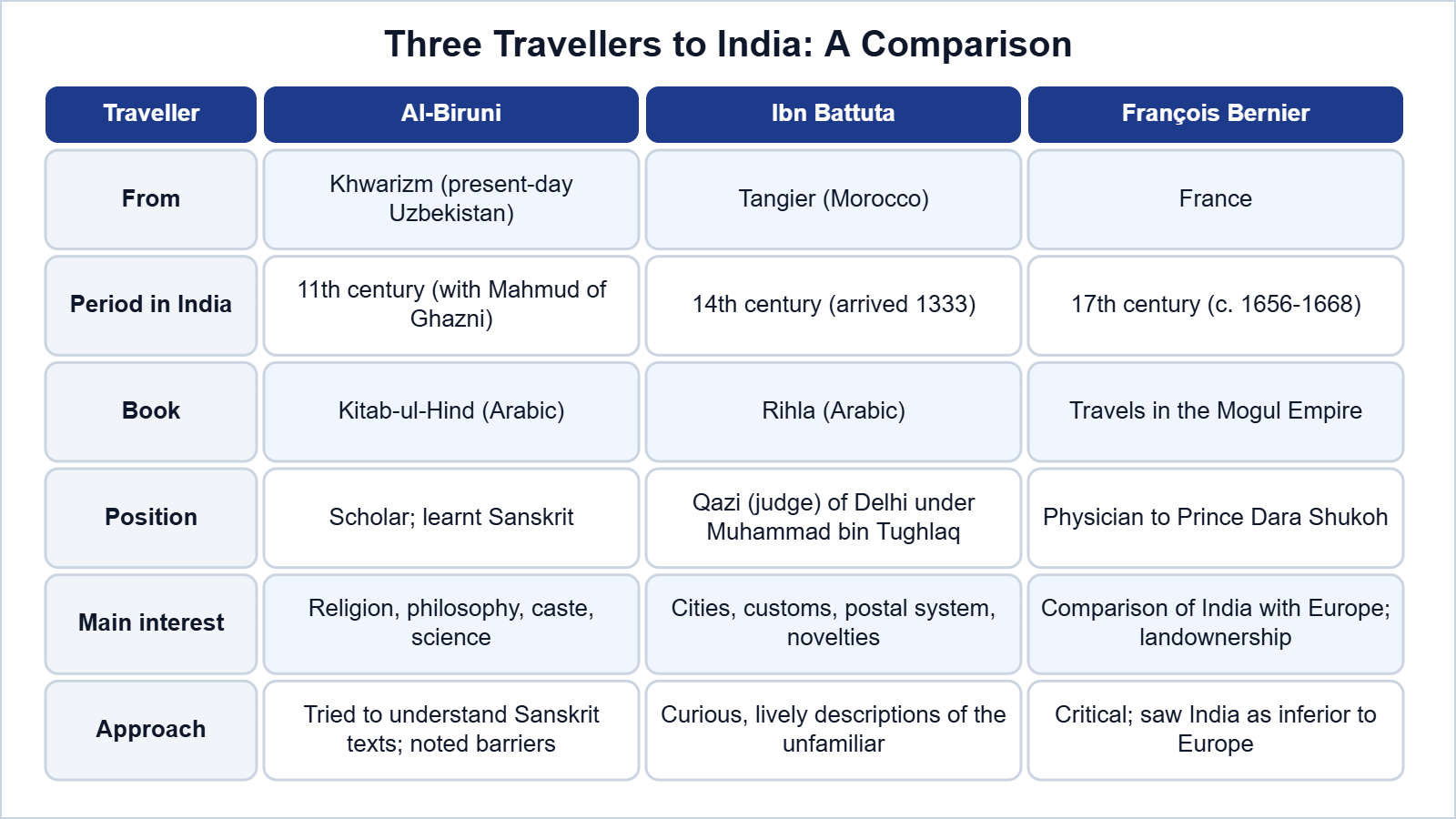
Al-Biruni was born in Khwarizm (present-day Uzbekistan) in 973. He was a scholar of many languages. When Sultan Mahmud of Ghazni invaded Khwarizm, he took al-Biruni to Ghazni, where he developed an interest in India. He learnt Sanskrit and studied religious and philosophical texts. His book Kitab-ul-Hind, written in Arabic, has 80 chapters on religion and philosophy, festivals, astronomy, alchemy, manners and customs, social life, weights and measures, iconography, laws and metrology. Each chapter begins with a question, followed by a description based on Sanskrit traditions, and ends with a comparison with other cultures.

The caste system: al-Biruni tried to explain the caste system by comparing it with ancient Persia’s four social categories. He pointed out that social divisions existed in other societies too, and he disapproved of the notion of pollution, arguing that everything that becomes impure strives to regain purity (e.g., the sun cleanses the air). His account of caste relied heavily on Sanskrit texts and was therefore closer to the brahmanical ideal than to actual practice.
3. Ibn Battuta’s Rihla
Ibn Battuta was born in Tangier (Morocco) into a family of Islamic legal scholars. He travelled widely, and reached Sind in 1333. Muhammad bin Tughlaq, the Sultan of Delhi, impressed by his learning, appointed him the qazi (judge) of Delhi. Later he was sent as the Sultan’s envoy to China. His travel account, the Rihla, was written in Arabic.
Coconut and paan: he described these unfamiliar things vividly. Cities: he found Indian cities, like Delhi and Daulatabad, densely populated and prosperous, with crowded bazaars that were centres of economic and social activity. Postal system: he admired the horse post (uluq) and the foot post (dawa), which carried messages quickly. Slavery: he noted that slaves were sold in markets and given as gifts.
4. François Bernier: A Different Intellectual Tradition
François Bernier, a French doctor, philosopher and historian, came to the Mughal empire in search of opportunities and stayed from about 1656 to 1668. He was a physician to Prince Dara Shukoh, and later an intellectual and scientist with a Mughal noble. His book, Travels in the Mogul Empire, constantly compared Mughal India with Europe, usually presenting India as inferior.
The question of landownership: Bernier believed that in Mughal India the emperor owned all land and there was no private property in land. He argued that this discouraged landholders from investing in or improving land, leading to the ruin of agriculture and the oppression of peasants. He used this picture to warn European rulers about the dangers of absolute power. Later scholars (such as Montesquieu, who developed the idea of “oriental despotism”, and Karl Marx, who wrote of the “Asiatic mode of production”) drew on such descriptions.
Remember: Bernier’s view was not accurate. Mughal sources show that peasants had rights in land and that there was a complex system of ownership and revenue.
5. Women, Slaves and Sati
Travellers noted the practice of sati (the immolation of widows); Bernier described a case in detail and expressed horror. They also mentioned the labour of women in agriculture and other work, and the presence of slaves, including female slaves employed in households and as spies.
6. Present State of Research
Historians today use travellers’ accounts carefully. They recognise that these writers often noticed what was strange to them and used their own cultural standards to judge. By comparing travellers’ accounts with local sources (court chronicles, revenue records, inscriptions), historians build a more balanced picture. Bernier’s claim of no private property, for example, is considered a misunderstanding.
7. How Historians Acquired This Knowledge
The accounts survived as manuscripts and were translated into various languages; Bernier’s work was widely published in Europe. Historians examine the background of each author, their purpose and audience, and check their statements against other evidence.
8. Primary Source and How Historians Use It
Ibn Battuta on the postal system (paraphrased). He explains that India had two kinds of post: the horse post, using royal horses stationed every few miles, and the foot post, in which runners carrying a bell-fitted rod were placed at short intervals so that each could pass letters to the next. He says this system brought news and goods, such as fruits from Khurasan, to the Sultan very quickly.
How historians use it: such descriptions show the efficiency of communication in the Delhi Sultanate and the importance rulers gave to information. Historians compare his account with Persian sources to confirm details and note that his enthusiasm may have led to some exaggeration.
Bernier on land (paraphrased): Bernier claims that because the king owns all land, peasants and landholders have no incentive to improve it, and so farming declines. Historians use this to understand European ideas of the time, while recognising that it does not match Mughal records.
9. Timeline
Date / Period | Event |
|---|---|
973 | Birth of al-Biruni in Khwarizm |
11th century | Al-Biruni writes Kitab-ul-Hind |
1304 | Birth of Ibn Battuta in Tangier |
1333 | Ibn Battuta reaches Sind; later appointed qazi of Delhi |
1342 | Ibn Battuta sent as envoy to China |
c. 1656-1668 | François Bernier in Mughal India |
10. Important Terms
Term | Meaning |
|---|---|
Rihla | Ibn Battuta’s travel account, written in Arabic |
Kitab-ul-Hind | Al-Biruni’s book on India, in Arabic |
Qazi | A judge |
Uluq / dawa | Horse post / foot post |
Sati | The burning of a widow on her husband’s funeral pyre |
Oriental despotism | A European idea that Asian rulers had absolute power over subjects |
11. Short Answer Questions
Q1. Where did al-Biruni come from and what was his book called?
Ans. Khwarizm (present-day Uzbekistan); Kitab-ul-Hind.
Q2. Name three barriers to understanding India identified by al-Biruni.
Ans. Language, religious differences and the self-absorption of local people.
Q3. Why did al-Biruni disapprove of the notion of pollution?
Ans. He argued that impure things become pure again, so permanent impurity was against the laws of nature.
Q4. Who appointed Ibn Battuta as qazi of Delhi?
Ans. Sultan Muhammad bin Tughlaq.
Q5. What two kinds of post did Ibn Battuta describe?
Ans. The horse post (uluq) and the foot post (dawa).
Q6. Whom did Bernier serve as physician?
Ans. Prince Dara Shukoh.
Q7. What was Bernier’s view on land ownership in Mughal India?
Ans. That the emperor owned all land and there was no private property in land.
Q8. How did travellers describe Indian cities?
Ans. As densely populated, prosperous and full of crowded bazaars.
12. Long Answer Questions
Q1. Compare the accounts of al-Biruni, Ibn Battuta and Bernier.
Ans. Al-Biruni, an 11th-century scholar, studied Sanskrit texts and gave a systematic account of religion, caste and science, though based on brahmanical ideals. Ibn Battuta, in the 14th century, described cities, customs, the postal system and slavery with curiosity and vivid detail. Bernier, in the 17th century, compared India with Europe and presented it as inferior, arguing that crown ownership of land led to decline. Together they show how outsiders saw India through their own backgrounds.
Q2. Critically examine Bernier’s description of land ownership.
Ans. Bernier held that the Mughal emperor owned all land, so landholders had no reason to invest, causing agricultural decline and peasant oppression. He used this to warn Europe against absolute monarchy. Mughal records, however, show that peasants and zamindars had rights in land, and agriculture was productive. Bernier’s view was shaped by his European background and political purpose, and influenced later theories like “oriental despotism”.
13. Source-based Questions
Q1. (Source) A traveller describes runners stationed at short distances who pass letters to one another, so that news reaches the ruler quickly. (a) Identify the traveller and the system. (b) What does this show about the state?
Ans. (a) Ibn Battuta; the foot post (dawa). (b) That the Sultanate valued quick communication and control.
Q2. (Source) A French traveller argues that because the king owns all land, nobody improves it and agriculture declines. (a) Who is he? (b) Is his view accepted by historians?
Ans. (a) François Bernier. (b) No; Mughal records show that peasants had rights and there was private property in land.
Easy Memory Trick: “B-B-B” = Biruni (Book of India), Battuta (Bazaars and post), Bernier (Bad comparison with Europe).
Conclusion: Travellers’ accounts provide vivid pictures of India, but they reflect the outlook of their authors. Read critically alongside other sources, they help historians understand social life across the centuries.