Mahatma Gandhi and the Nationalist Movement – History Class 12 Notes
Part-III | Chapter – 11
Mahatma Gandhi and the Nationalist Movement
(Civil Disobedience and Beyond)
1. Introduction
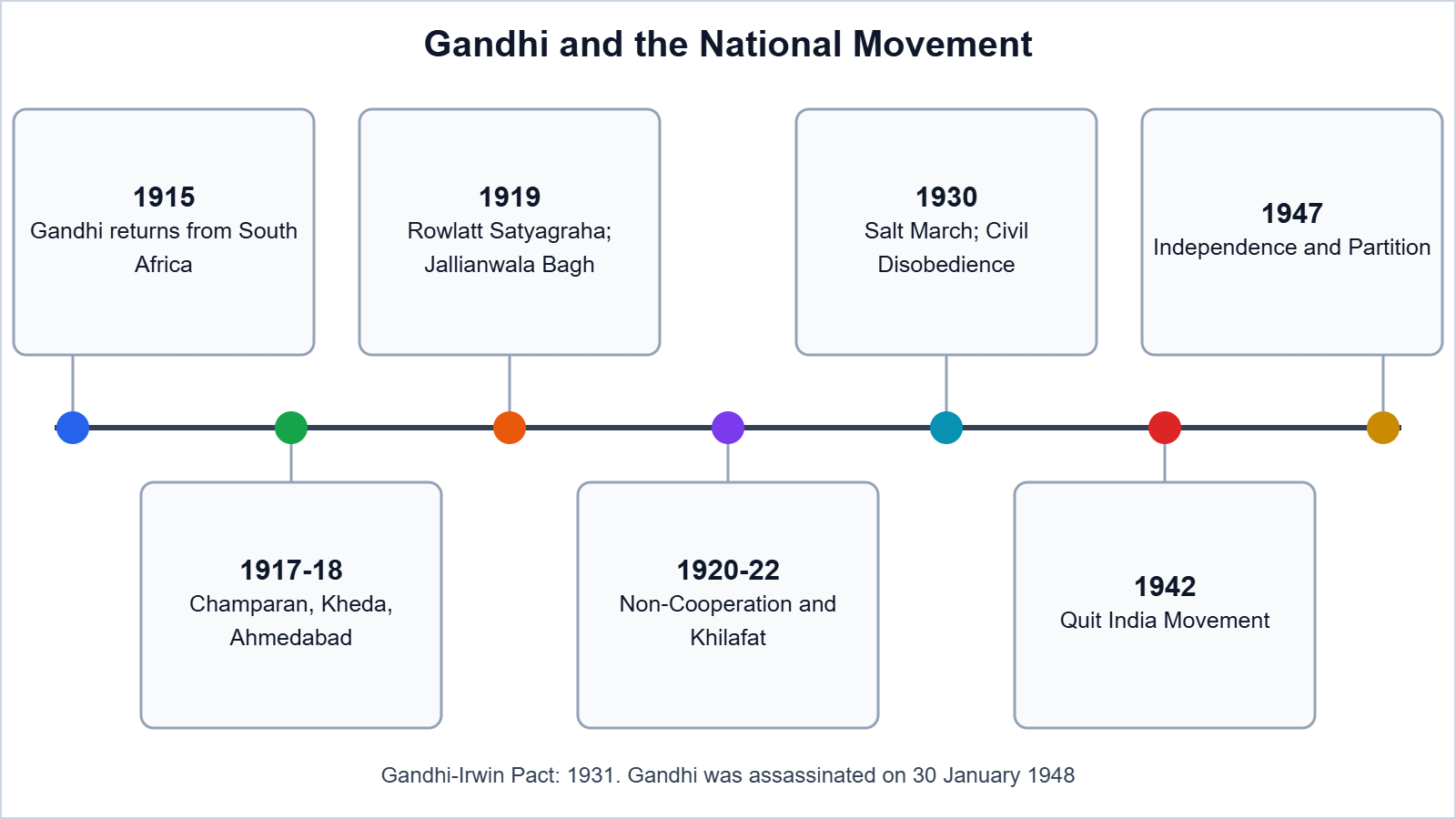
Mohandas Karamchand Gandhi returned to India in January 1915 after about two decades in South Africa, where he had first used the method of non-violent protest called satyagraha. Over the next three decades he transformed the Indian National Congress into a mass movement.
2. A Leader Announces Himself
In February 1916, at the opening of the Banaras Hindu University, Gandhi criticised the Indian elite for their lack of concern for the poor, arguing that the nationalist movement must represent the labouring masses. His first major campaigns in India were for peasants and workers: Champaran (Bihar, 1917) for indigo cultivators, Kheda (Gujarat, 1918) for peasants seeking remission of revenue, and Ahmedabad (1918) for mill workers.
3. The Making and Unmaking of Non-cooperation
In 1919 the British passed the Rowlatt Act, allowing detention without trial. Gandhi called a countrywide protest. On 13 April 1919, troops fired on a peaceful gathering at Jallianwala Bagh in Amritsar, killing hundreds.
In 1920 Gandhi launched the Non-Cooperation Movement, joined with the Khilafat Movement led by Muslims. People boycotted schools, colleges, law courts and foreign cloth; peasants and tribals joined in many places. After a crowd set fire to a police station at Chauri Chaura (Gorakhpur district) in February 1922, killing policemen, Gandhi called off the movement. He was arrested in March 1922 and sentenced to six years in prison, though he was released early on health grounds.
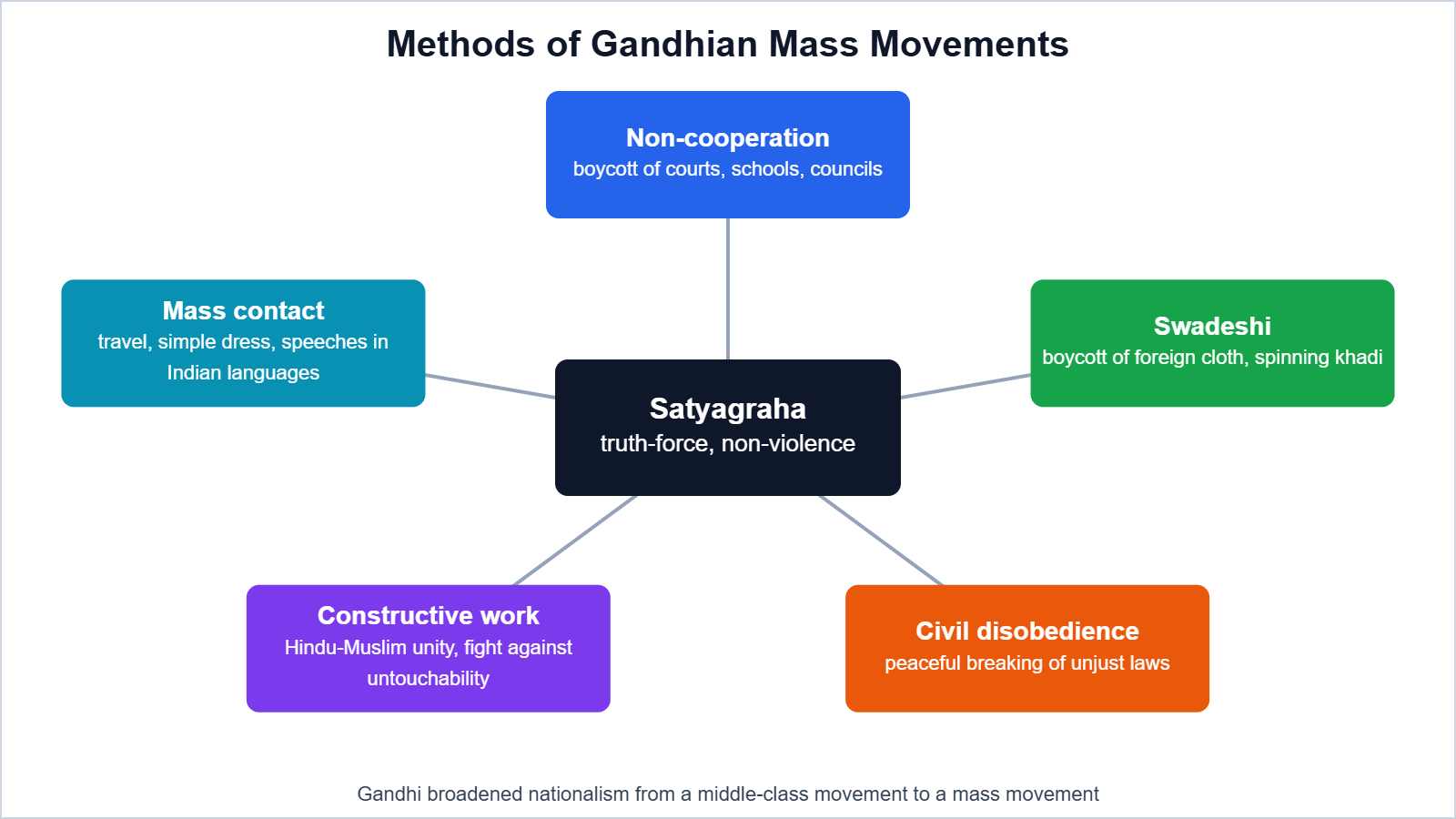
Making of a popular leader: Gandhi dressed simply like the poor, spoke in Indian languages and promoted spinning on the charkha. Rumours spread about his miraculous powers, showing how deeply ordinary people identified with him. New Congress branches were set up across India, and many young leaders from peasant and other backgrounds joined.
4. The Salt Satyagraha
At its Lahore session (December 1929), under Jawaharlal Nehru’s presidency, the Congress adopted Purna Swaraj (complete independence) as its goal, and 26 January 1930 was celebrated as Independence Day. Gandhi chose to break the salt law, which gave the state a monopoly over making and selling salt, a necessity for all.
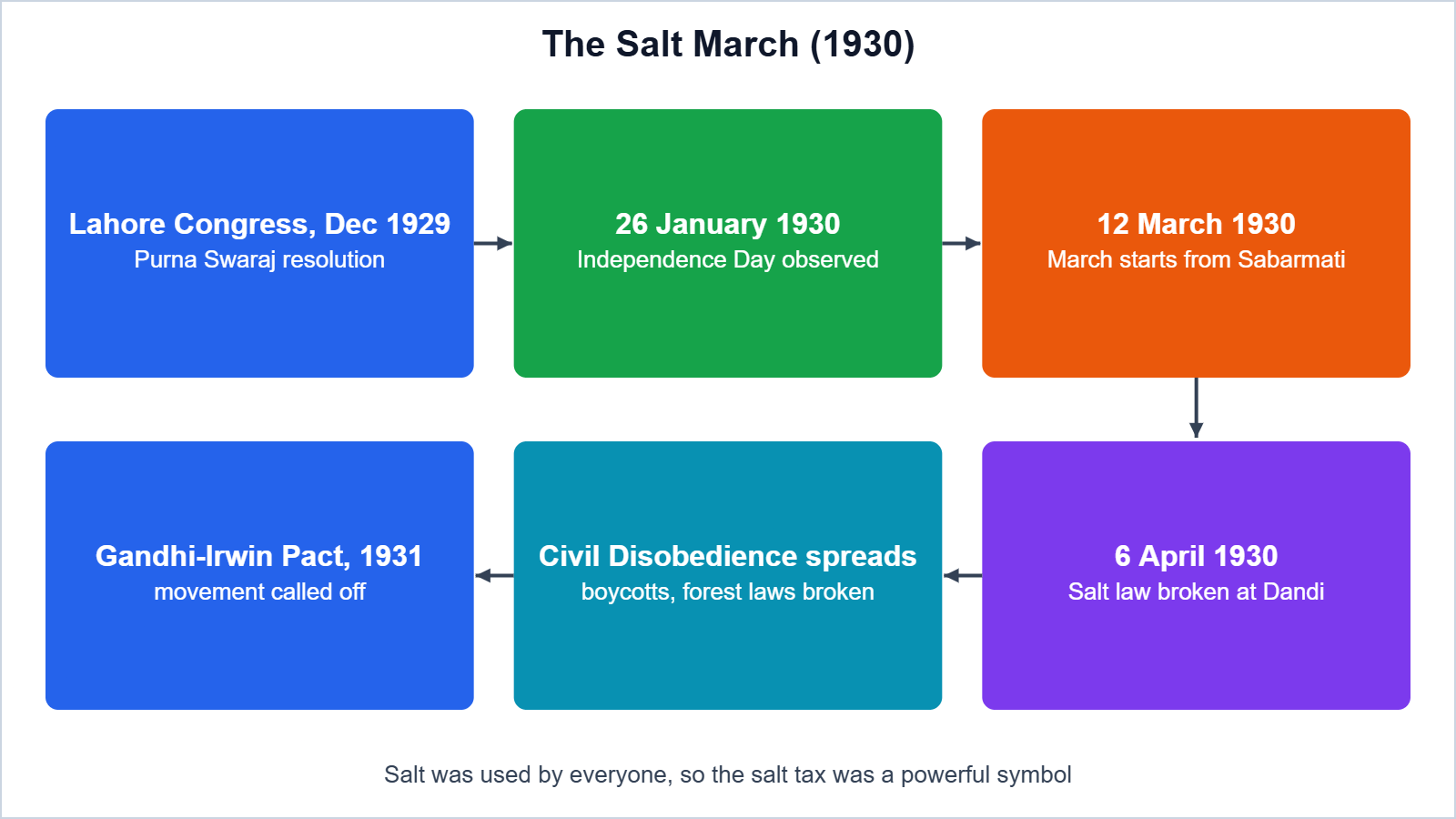
He set out from his Sabarmati ashram on 12 March 1930 and reached Dandi on the coast on 6 April, where he made salt. Civil disobedience spread across the country: people broke salt and forest laws and boycotted foreign goods. The movement brought Gandhi to world attention. The Gandhi-Irwin Pact (March 1931) ended it, and Gandhi attended the Second Round Table Conference in London later in 1931, which produced no agreement.
5. Quit India and the Last Heroic Days
Under the Government of India Act 1935, elections were held in 1937 and the Congress formed ministries in eight of the eleven provinces. When the Second World War began in 1939, the Congress ministries resigned in protest at India being made a party to the war without consultation.
On 8 August 1942 the Congress launched the Quit India Movement. Gandhi and other leaders were arrested at once, but young activists organised strikes and sabotage across the country, and in some places parallel governments were set up. India became independent on 15 August 1947, but was also partitioned. Gandhi spent those days working to restore peace in riot-hit areas such as Noakhali and Calcutta. He was assassinated on 30 January 1948 by Nathuram Godse.
6. Present State of Research
Historians debate how far Gandhi’s leadership shaped the movement and how far local leaders and ordinary people gave it their own meanings. Studies of peasants, workers, women and regions show that people often understood Gandhi in their own ways, sometimes going beyond what the Congress leadership intended.
7. How Historians Acquired This Knowledge
Historians use many kinds of sources: Gandhi’s own writings and speeches (collected in many volumes), his journals such as Young India and Harijan, private letters between leaders, government records such as the fortnightly reports sent by provincial governments, and newspapers in English and Indian languages. Each source has its own point of view.
8. Primary Source and How Historians Use It
Fortnightly reports. In simple terms, these were secret reports sent by provincial officials to the Home Department, describing the political situation, the strength of movements such as the Salt March, and the public mood. They often tried to show that a movement had little support or was coming under control.
How historians use them: they give detailed information on events in many areas, but historians recognise that officials had fears and prejudices and sometimes presented what their superiors wanted to hear. So the reports are compared with newspapers, letters and the leaders’ own writings.
9. Timeline
Date / Period | Event |
|---|---|
Jan 1915 | Gandhi returns to India |
Feb 1916 | Speech at Banaras Hindu University |
1917 | Champaran satyagraha |
1918 | Kheda satyagraha; Ahmedabad mill strike |
1919 | Rowlatt Satyagraha; Jallianwala Bagh (13 April) |
1920-22 | Non-Cooperation and Khilafat Movements |
Feb 1922 | Chauri Chaura; Non-Cooperation called off |
Dec 1929 | Lahore Congress: Purna Swaraj |
12 Mar-6 Apr 1930 | Salt March to Dandi |
Mar 1931 | Gandhi-Irwin Pact |
1937 | Congress ministries in eight provinces |
8 Aug 1942 | Quit India Movement launched |
15 Aug 1947 | Independence and Partition |
30 Jan 1948 | Gandhi assassinated |
10. Important Terms
Term | Meaning |
|---|---|
Satyagraha | Non-violent resistance based on truth |
Swadeshi | Use of goods made in one’s own country |
Khadi | Hand-spun, hand-woven cloth |
Purna Swaraj | Complete independence |
Charkha | Spinning wheel, symbol of self-reliance |
Harijan | Name used by Gandhi for the depressed castes; also his journal |
11. Short Answer Questions
Q1. When did Gandhi return to India from South Africa?
Ans. In January 1915.
Q2. What was the Champaran satyagraha about?
Ans. Securing better conditions for indigo cultivators in Bihar (1917).
Q3. Why was Non-Cooperation withdrawn?
Ans. Because of the violence at Chauri Chaura in February 1922.
Q4. What did the Lahore Congress of 1929 declare?
Ans. Purna Swaraj, complete independence, as the goal.
Q5. Why did Gandhi choose salt?
Ans. Salt was used by everyone and the state monopoly and tax on it hurt the poor, so it was a strong symbol.
Q6. When did the Salt March begin and end?
Ans. It began from Sabarmati on 12 March 1930 and reached Dandi on 6 April 1930.
Q7. When was the Quit India Movement launched?
Ans. On 8 August 1942.
Q8. Name two journals of Gandhi.
Ans. Young India and Harijan.
12. Long Answer Questions
Q1. How did Gandhi transform the nationalist movement?
Ans. He made it a mass movement by taking up the problems of peasants and workers, using non-violent satyagraha, dressing and living simply, speaking in Indian languages and promoting the charkha. Congress branches spread across India, and campaigns such as Non-Cooperation, the Salt March and Quit India drew in peasants, workers, women and students.
Q2. Why was the Salt March significant?
Ans. It brought Gandhi to world attention, involved women and people across India, and showed that a simple symbol could unite the masses. It also made the British realise that their rule could not last without Indian cooperation, leading to talks such as the Gandhi-Irwin Pact and the Round Table Conference.
13. Source-based Questions
Q1. (Source) A secret official report says that the Salt March is attracting few people and the situation is under control. (a) What type of source is this? (b) Why should historians use it carefully?
Ans. (a) A fortnightly report of the government. (b) Officials often played down movements or wrote what superiors wanted to hear.
Q2. (Source) In a 1916 speech at a new university, a leader criticises the elite for neglecting the poor. (a) Who is the speaker? (b) What does it show about his view of nationalism?
Ans. (a) Mahatma Gandhi, at Banaras Hindu University. (b) He believed nationalism must represent and include the poor masses.
Easy Memory Trick: “C-K-A, R-N-S-Q”: Champaran, Kheda, Ahmedabad; then Rowlatt, Non-Cooperation, Salt March, Quit India.
Conclusion: Gandhi made the freedom struggle a movement of the masses, using truth and non-violence. Historians draw on many sources – his own writings, letters, official reports and newspapers – to understand both the leader and the people who followed him.