CHAPTER 8
COMPOSITION & STRUCTURE OF ATMOSPHERE
1. Atmosphere
The atmosphere is the vast envelope of air that surrounds the Earth. It is held around the Earth by gravitational force and is an essential part of the Earth system.
The atmosphere is made up of different gases, water vapour and dust particles. Its composition, density and temperature change with height.
Broad Structure of the Atmosphere
On the basis of chemical composition, the atmosphere is broadly divided into:
- Homo sphere – lower region where gases are relatively well mixed.
- Hetero sphere – upper region where gases are arranged in layers according to their molecular weight.
2. Layers of the Atmosphere
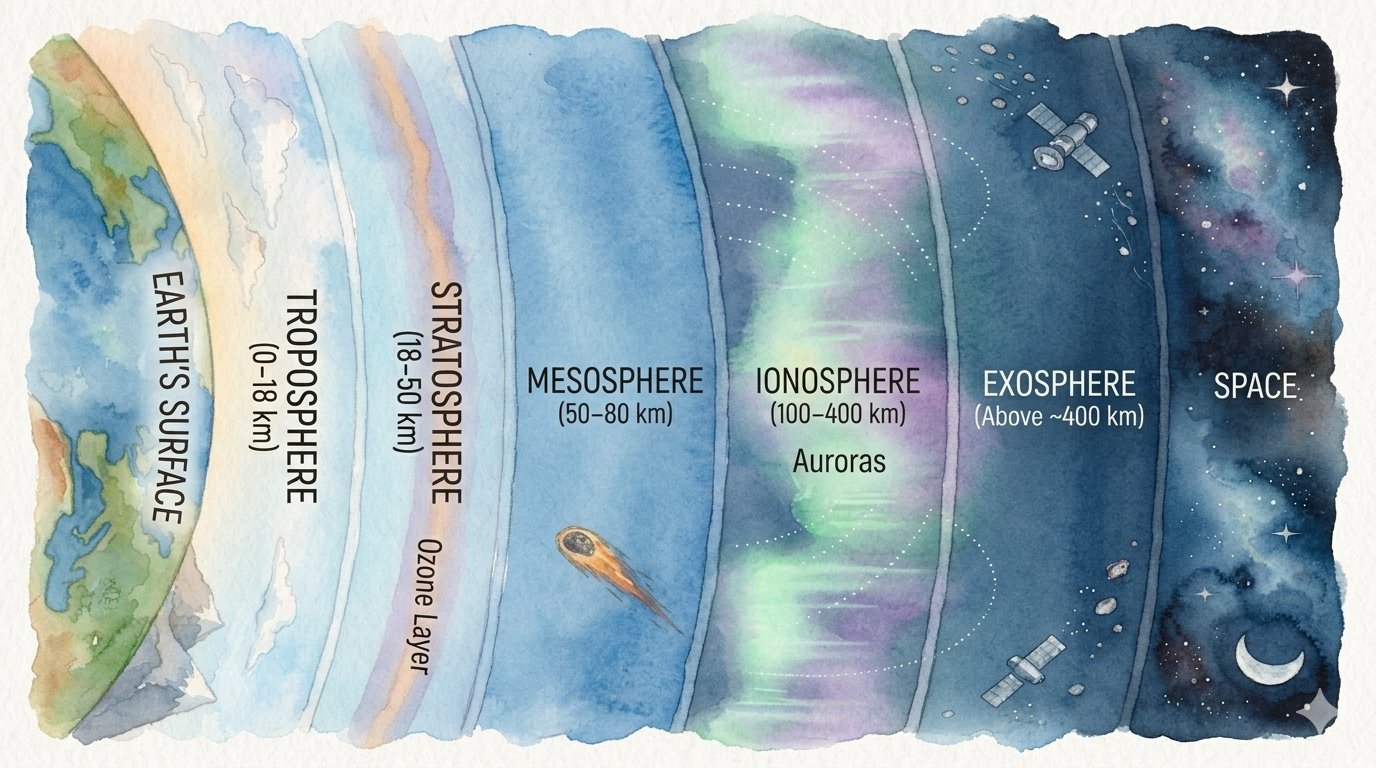
The atmosphere consists of several layers arranged one above another. They differ mainly in temperature, density and composition.
Simple Diagram of Atmospheric Layers
3. Troposphere
The troposphere is the lowest layer of the atmosphere and is the most important layer for human beings.
Important Features
- Its average height is about 16 km.
- It extends to about 10 km at the poles and up to about 18 km at the equator.
- It is thickest at the equator because of strong convection currents.
- Almost all major weather phenomena such as clouds, rainfall, storms and winds occur in this layer.
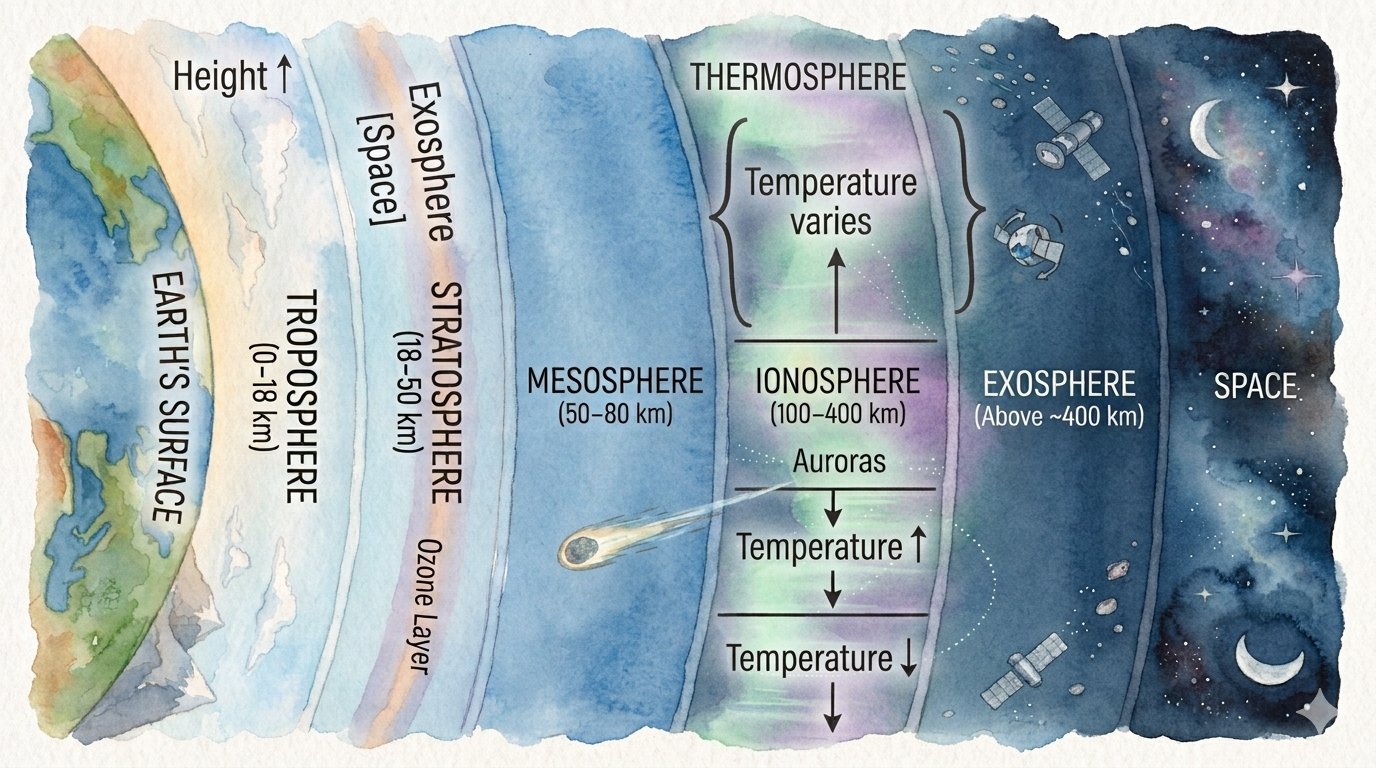
- Temperature generally decreases with increasing altitude.
- The normal lapse rate is about 6.5°C per 1,000 m of ascent.
Normal Lapse Rate
Normal lapse rate means the average decrease in temperature with increasing height in the troposphere.
Approx.: 1°C decrease for every 165 m of ascent
or 6.5°C decrease per 1,000 m.
4. Stratosphere
The stratosphere lies above the troposphere and extends up to about 50 km.
Important Features
- It is relatively stable compared with the troposphere.
- The lower part has nearly constant temperature up to about 20 km.
- Temperature gradually increases with height in the upper part.
- This increase is mainly associated with the ozone layer, which absorbs harmful ultraviolet radiation from the Sun.
- The layer is generally more suitable for aircraft flight because of relatively stable air and fewer weather disturbances.
5. Mesosphere
The mesosphere lies above the stratosphere and extends approximately from 50 km to 80 km.
Important Features
- Temperature again decreases with increasing height.
- It is one of the coldest regions of the atmosphere.
- The upper boundary of the mesosphere is called the mesopause.
- Many meteoroids burn up due to friction with atmospheric gases in this region.
6. Ionosphere
The ionosphere is a region containing a large number of electrically charged particles called ions.
According to the supplied material, it extends approximately from 100 km to 400 km.
Importance
- It contains ionized particles produced mainly by solar radiation.
- It plays an important role in radio communication.
- Certain radio waves can be reflected or refracted by ionized regions of the upper atmosphere.
- It is also associated with phenomena such as auroras.
7. Heterosphere
The heterosphere is the upper region of the atmosphere where gases are not uniformly mixed. Instead, gases become arranged in layers according to their molecular mass.
Main Gases
The major gases found in different parts of the heterosphere include:
- Nitrogen
- Oxygen
- Helium
- Hydrogen
The heterosphere forms part of the very high atmosphere and extends upward toward outer space.
8. Exosphere
The exosphere is the outermost layer of the atmosphere.
Important Features
- It lies above the ionosphere/upper atmosphere.
- It begins at roughly 400 km according to the supplied classification.
- The air is extremely thin.
- Gas particles are widely separated.
- It gradually merges with outer space.
- Hydrogen and helium are among the major gases present at these extreme heights.
9. Temperature Pattern of Atmospheric Layers
The temperature does not change uniformly with height. It alternately increases and decreases in different atmospheric layers.
10. Composition of the Atmosphere
The atmosphere is composed mainly of:
- Gases
- Water vapour
- Dust particles
The two most abundant gases are nitrogen and oxygen, which together make up more than 99% of the atmosphere by volume.
Major Atmospheric Gases
| Gas | Approx. Percentage |
|---|---|
| Nitrogen (N₂) | 78.08% |
| Oxygen (O₂) | 20.95% |
| Argon (Ar) | 0.93% |
| Carbon dioxide (CO₂) | 0.03% |
| Neon (Ne) | 0.002% |
| Helium (He) | 0.0005% |
| Ozone (O₃) | 0.00006% |
| Hydrogen (H₂) | 0.00005% |
11. Nitrogen
Nitrogen (N₂) is the most abundant gas in the atmosphere, making up about 78% of its volume.
Importance
- Essential for plant growth.
- Forms an important part of proteins and other biological compounds.
- Enters ecosystems mainly through the nitrogen cycle.
- Helps maintain the overall balance of atmospheric gases.
12. Oxygen
Oxygen (O₂) constitutes about 21% of the atmosphere.
Importance
- Essential for respiration in humans and most animals.
- Supports combustion.
- Required for many biological and chemical processes.
- It is one of the most important gases for life.
13. Carbon Dioxide
Carbon dioxide (CO₂) is present in a very small proportion compared with nitrogen and oxygen, but it is extremely important for the Earth system.
Importance
- Plants use CO₂ during photosynthesis.
- It absorbs outgoing terrestrial radiation.
- It is an important greenhouse gas.
- Changes in atmospheric CO₂ influence Earth’s climate.
Greenhouse Effect
Greenhouse gases allow much of the incoming solar energy to reach Earth but absorb part of the outgoing terrestrial radiation, contributing to warming of the lower atmosphere.
14. Ozone
Ozone (O₃) is a form of oxygen containing three oxygen atoms.
It is concentrated mainly in the stratosphere, where it forms the ozone layer.
Importance
- Absorbs much of the Sun’s harmful ultraviolet (UV) radiation.
- Protects living organisms from excessive UV exposure.
- Plays an important role in maintaining conditions suitable for life on Earth.
15. Water Vapour
Water vapour is the gaseous form of water present in the atmosphere.
It is an important component of the atmosphere and varies greatly from place to place.
Distribution
- It may reach around 4% in warm and humid tropical regions.
- It may be less than 1% in very cold and dry regions.
- Even very dry air contains some water vapour.
Importance
Water vapour is essential for:
- Formation of clouds
- Rainfall and other precipitation
- Humidity
- Weather processes
- Regulation of atmospheric temperature
- The water cycle
SHORT QUESTION & ANSWER
Ans: Atmosphere is the vast expanse of air which envelopes the earth all around. The air of the atmosphere has become an integral part of the earth due to the earth’s gravitational force.
Ans: The atmosphere is composed of a number of gases, water vapour, and dust particles. Nitrogen and Oxygen are the two main gases which form over 99% of the total volume of the atmosphere. The other gases are argon, carbon dioxide, neon, helium, ozone, hydrogen, methane, etc.
- Nitrogen (\(N_{2}\)): 78.08%
- Oxygen (\(O_{2}\)): 20.95%
- Argon (\(Ar\)): 0.93%
- Carbon dioxide (\(CO_{2}\)): 0.03%
- Neon (\(Ne\)): 0.002%
- Helium (\(He\)): 0.0005%
- Ozone (\(O_{3}\)): 0.00006%
- Hydrogen (\(H_{2}\)): 0.00005%
- Methane (\(CH_{4}\)): Trace
- Krypton (\(Kr\)): Trace
- Xenon (\(Xe\)): Trace
Multiple Choice Questions (M.C.Q.)
- a) Troposphere
- b) Stratosphere
- c) Mesosphere
- d) Exosphere
- Ans: a) Troposphere
- a) Oxygen
- b) Nitrogen
- c) Argon
- d) Carbon dioxide
- Ans: b) Nitrogen
- a) Oxygen
- b) Carbon dioxide
- c) Helium
- d) Hydrogen
- Ans: a) Oxygen
- a) Oxygen
- b) Nitrogen
- c) Helium
- d) Carbon dioxide
- Ans: d) Carbon dioxide
- a) Oxygen
- b) Nitrogen
- c) Ozone
- d) Carbon dioxide
- Ans: c) Ozone
- a) 98 km
- b) 120 km
- c) 100 km
- d) 150 km
- Ans: b) 120 km
- a) Nitrogen and oxygen
- b) Hydrogen and oxygen
- c) Oxygen and ozone
- d) Nitrogen and hydrogen
- Ans: a) Nitrogen and oxygen
- a) Gases
- b) Dust particles
- c) Water vapour
- d) Meteors
- Ans: b) Dust particles