CHAPTER 14
MOVEMENTS OF OCEAN WATER
Ocean Waves
Waves are movements of energy that travel across the surface of ocean water. Most ocean waves are produced by wind blowing over the water surface.
The water particles do not travel forward with the wave over a long distance. Instead, they move mainly up and down in a small circular motion, while the energy of the wave moves forward.
Factors Affecting the Height of Waves
The height of waves mainly depends on:
- Strength of the wind
- Duration for which the wind blows
- Distance over which the wind blows in one direction
Tides
Tides are the regular rise and fall of sea level. They are mainly caused by the gravitational attraction of the Moon and the Sun.
Tides may vary in their:
- Frequency
- Height
- Direction
- Movement
Forces Responsible for Tides
- Gravitational attraction of the Moon
- Gravitational attraction of the Sun
- Centrifugal force
Importance of Tides
- Tides help in making some rivers navigable.
- They help ships and boats enter and leave some coastal areas.
- They influence the movement of water along coasts.
Types of Tides
Tides can mainly be classified according to:
A. Frequency
- Semi-diurnal tides
- Diurnal tides
- Mixed tides
–> Semi-Diurnal Tides
These are the most common type of tides.
- There are two high tides and two low tides during a lunar day.
- The successive high tides are approximately of similar height.
- The successive low tides are also approximately of similar height.
Easy way to remember:
Semi-Diurnal = 2 High + 2 Low
–> Diurnal Tides
In this type:
- There is one high tide in a day.
- There is one low tide in a day.
- The successive high and low tides are approximately of similar height.
Easy way to remember:
Diurnal = 1 High + 1 Low
–> Mixed Tides
Mixed tides have different heights.
- Successive high tides may have different heights.
- Successive low tides may also have different heights.
- They are common along the west coast of North America and many islands of the Pacific Ocean.
Easy way to remember:
Mixed Tides = Different Heights
B. Position of the Sun, Moon and Earth
- Spring tides
- Neap tides
–> Spring Tides 🌊
Spring tides occur when the Sun, Moon and Earth are nearly in a straight line.
At this time, the gravitational effects of the Sun and Moon work together and produce a larger tidal range.
Main Features
- Tidal range is high.
- They occur around the Full Moon and New Moon.
- They occur approximately twice a month.
- High tides are higher and low tides are lower than usual.
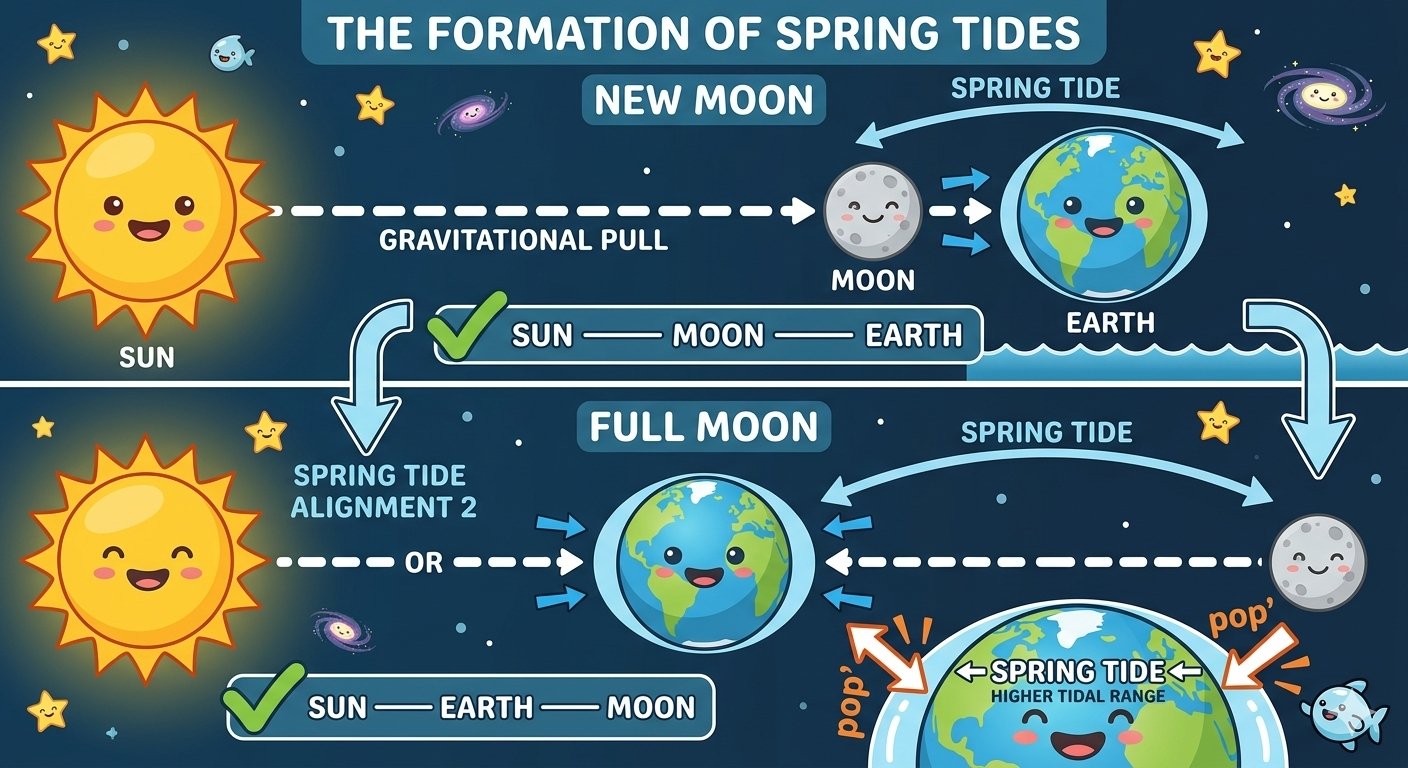
Remember:
Straight Line → Stronger Combined Pull → Spring Tide
–> Neap Tides 🌊
Neap tides occur when the Sun and Moon are approximately at right angles to each other with respect to Earth.
Their gravitational effects partly counteract each other, resulting in a smaller tidal range.
Main Features
- Tidal range is low.
- High tides are lower than during spring tides.
- Low tides are higher than during spring tides.
- They occur approximately twice a month, around the first and third quarter Moon.
Tides During a Day
The Earth rotates while the Moon’s gravitational force affects ocean water. Because of this, coastal areas generally experience repeated high and low tides.
A lunar day is approximately 24 hours 50 minutes.
In many coastal areas:
- There are about two high tides
- There are about two low tides
- The average interval between successive high tides is about 12 hours 25 minutes
Ocean Currents
Ocean currents are large-scale movements of ocean water in a regular direction and definite path.
They can be compared with rivers flowing through the oceans.
Ocean currents are caused and influenced by different forces. These forces are divided into:
1. Primary Forces
These forces start or initiate the movement of ocean water.
2. Secondary Forces
These forces influence the direction and movement of ocean currents.
1. Primary Forces Causing Ocean Currents
–> Heating by Solar Energy ☀️
The Sun heats ocean water unevenly.
- Warm water expands.
- The water level near the Equator becomes slightly higher.
- This creates a small difference in water level.
- Water tends to flow from areas of higher level towards areas of lower level.
Thus, solar heating helps in producing ocean-water movement.
–> Wind 🌬️
Wind is an important cause of ocean currents.
- Wind blows over the ocean surface.
- Friction between wind and water pushes the surface water.
- Strong and continuous winds can move large amounts of water.
- Winds also influence the direction of surface currents.
Simple Flow:
Wind → Pushes surface water → Ocean current
–> Gravity
Gravity acts on ocean water and pulls it downward.
It helps water move from areas of higher water level towards lower water level.
Therefore, gravity plays an important role in maintaining the movement of ocean water.
–> Coriolis Force
The Coriolis force is related to the rotation of the Earth.
It changes the direction of moving ocean water:
- In the Northern Hemisphere, water is deflected towards the right.
- In the Southern Hemisphere, water is deflected towards the left.
The movement of large amounts of ocean water in circular patterns forms gyres.
Remember:
Northern Hemisphere → Right ↗️
Southern Hemisphere → Left ↖️
Gyres
A gyre is a large circular system of ocean currents.
Gyres are formed due to the combined effects of:
- Winds
- Coriolis force
- Ocean basin shape
- Other forces affecting ocean water
Large circular current systems occur in major ocean basins.
2. Secondary Forces Causing Ocean Currents
–> Difference in Water Density
Water density affects the movement of ocean water.
- Dense water → Sinks
- Less dense water → Rises
This vertical movement helps in the circulation of ocean water.
–> Difference in Salinity
Salinity affects the density of seawater.
- Water with higher salinity is generally denser.
- Dense water tends to sink.
- Less salty water is relatively lighter.
- Differences in salinity therefore help create water movement and currents.
–> Shape of Coastlines
The shape of coastlines can change the direction and path of ocean currents.
When currents reach a coast, they may be diverted or redirected according to the shape of the land.
–> Change of Seasons
Seasonal changes affect:
- Wind direction
- Temperature
- Water movement
Therefore, changes in seasons can also influence ocean currents.
Ocean Currents of the Atlantic Ocean
The currents of the Atlantic Ocean can broadly be studied as:
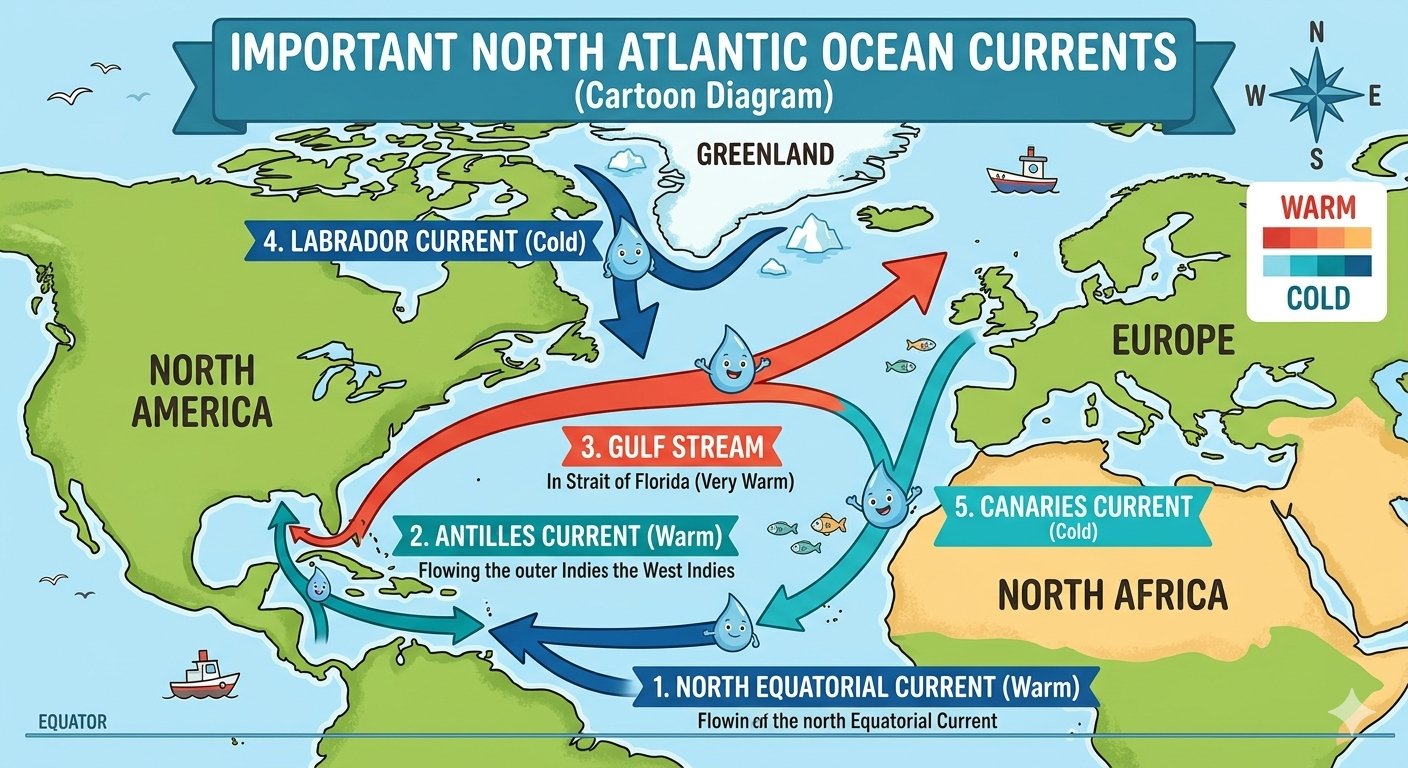
North Atlantic Currents
- North Equatorial Current
- Gulf Stream
- Canaries Current
- Labrador Current
- Antilles Current
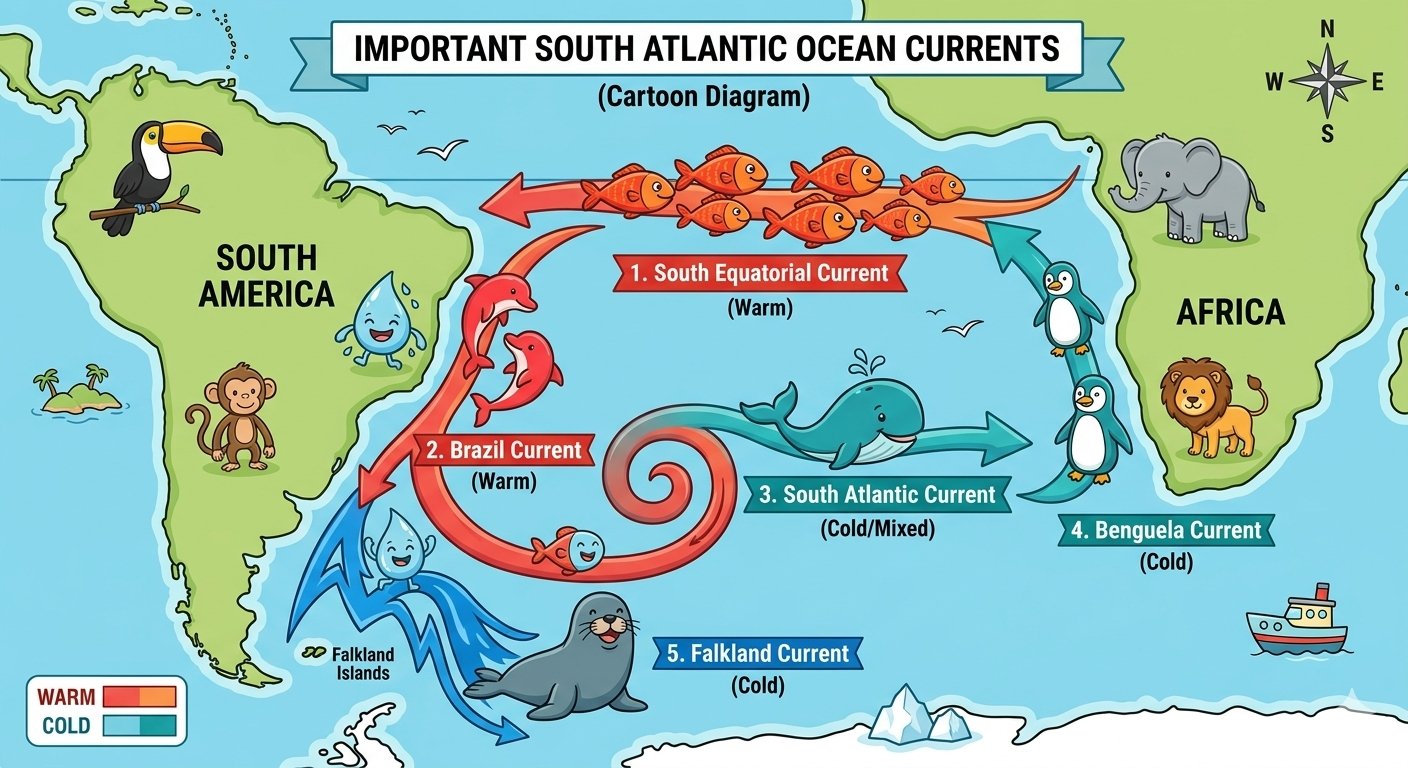
South Atlantic Currents
- South Equatorial Current
- Brazil Current
- Benguela Current
- Falkland Current
- South Atlantic Current
North Equatorial Current
The North Equatorial Current:
- Flows generally from east to west.
- Moves from the coast of Africa towards the West Indies.
- Flows approximately parallel to the Equator.
- Is mainly influenced by the trade winds.
- Near the eastern coast of South America, it divides into branches.
One branch moves along the West Indies as the Antilles Current, while another branch enters the Caribbean Sea.
South Equatorial Current
The South Equatorial Current:
- Lies to the south of the Equator.
- Flows generally from east to west.
- Near Cape de São Roque, it divides into branches.
- The northern branch turns northward and joins the North Equatorial Current.
- The southern branch turns southward along the coast of South America and forms the Brazil Current.
Short Type Questions and Answers
Q1. What are waves?
Ans: Waves are the movements of ocean water in which water particles move mainly up and down while the wave energy travels forward. Most ocean waves are caused by wind blowing over the surface of water. The height of a wave depends on the strength of the wind, the time for which it blows and the distance over which it blows. Gravity also affects waves by pulling the wave crest downward. Water particles generally move in small circular movements as a wave passes.
Q2. What are tides?
Ans: Tides are the regular or periodic rise and fall of sea level. They are mainly caused by the gravitational attraction of the Moon and the Sun. The centrifugal force also plays a role in producing tides. Tides vary in their height, direction and timing from place to place. They are important for navigation because high tides can increase the depth of water in some rivers and coastal areas, allowing ocean-going vessels to travel more easily.
Q3. What are spring tides?
Ans: Spring tides occur when the Sun, Moon and Earth are approximately in a straight line. At this time, the gravitational forces of the Sun and Moon work together and produce a greater tidal range. Spring tides have higher high tides and lower low tides than normal tides. They occur about twice a month, around the time of the new moon and full moon. The term “spring” refers to the greater rise and fall of water, not to the season of spring.
Q4. What are neap tides?
Ans: Neap tides occur when the Sun and Moon are approximately at right angles to each other with respect to the Earth. At this time, the gravitational forces of the Sun and Moon partly oppose each other. Therefore, the difference between high tide and low tide becomes smaller. Neap tides generally occur about seven days after a spring tide. They occur twice during the lunar cycle. Thus, spring tides have a greater tidal range, while neap tides have a smaller tidal range.
Q5. What are the different types of tides based on frequency?
Ans: Tides based on frequency are divided into three types: semi-diurnal, diurnal and mixed tides. A semi-diurnal tide has two high tides and two low tides in a day, with nearly equal successive tides. A diurnal tide has one high tide and one low tide during a day. A mixed tide has two high and two low tides, but their heights are unequal. These tidal patterns vary according to the geographical location of coastal areas.
Q6. Why do tides occur regularly?
Ans: Tides occur regularly mainly because the Earth rotates while the Moon exerts gravitational attraction on the Earth’s oceans. This produces tidal bulges in the ocean. As the Earth rotates through these bulges, coastal areas experience changes in sea level. Generally, coastal regions experience two high tides and two low tides during a lunar day. A lunar day is about 24 hours and 50 minutes long. Therefore, the interval between successive high tides is approximately 12 hours and 25 minutes.
Q7. What are ocean currents?
Ans: Ocean currents are the continuous movement of large amounts of ocean water in a definite direction and along a particular path. They are similar to rivers flowing through the oceans. Ocean currents may be warm or cold depending on their origin and direction of movement. They are influenced by several forces, including solar heating, winds, gravity, the Coriolis force, differences in water density and salinity, the shape of coastlines and seasonal changes.
Q8. What are the primary forces causing ocean currents?
Ans: The primary forces that initiate ocean currents are solar heating, wind, gravity and the Coriolis force. Solar heating causes ocean water to expand and creates differences in water level. Winds push surface water and produce movement. Gravity pulls water down from higher levels and helps create water movement. The Coriolis force, caused by Earth’s rotation, changes the direction of moving water. These forces together play an important role in producing and controlling ocean currents.
Q9. What are the secondary forces affecting ocean currents?
Ans: Secondary forces influence the direction and movement of ocean currents. Important secondary forces include differences in water density, differences in salinity, the shape of coastlines and seasonal changes. Dense water tends to sink, while lighter water tends to rise. Highly saline water is generally heavier and tends to sink. The shape of coastlines can redirect currents, while seasonal changes can alter their direction and strength. These factors work along with the primary forces to influence ocean circulation.
Q10. What is the Coriolis force?
Ans: The Coriolis force is an apparent force produced because of the rotation of the Earth. It affects the movement of ocean water and winds. Due to this force, moving water is deflected towards the right in the Northern Hemisphere and towards the left in the Southern Hemisphere. The Coriolis force helps produce large circular systems of ocean currents called gyres. It is therefore an important factor in determining the direction and circulation of ocean currents.
Multiple Choice Questions (MCQs)
1. What are waves?
A. Permanent movements of land
B. Movements of ocean water
C. Movements of clouds
D. Movements of rocks
Answer: B. Movements of ocean water
2. Most ocean waves are caused by:
A. Earthquakes
B. Gravity only
C. Wind
D. Rainfall
Answer: C. Wind
3. Waves mainly carry:
A. Soil
B. Rocks
C. Energy
D. Salt
Answer: C. Energy
4. The height of waves mainly depends on:
A. Wind strength and duration
B. Colour of water
C. Shape of fish
D. Ocean temperature only
Answer: A. Wind strength and duration
5. What are tides?
A. Permanent ocean currents
B. Periodic rise and fall of sea level
C. Movement of clouds
D. Movement of sand
Answer: B. Periodic rise and fall of sea level
6. The main cause of tides is:
A. Rainfall
B. Gravitational attraction of the Moon and Sun
C. Ocean temperature
D. Earthquakes
Answer: B. Gravitational attraction of the Moon and Sun
7. Which celestial body has the greatest influence on tides?
A. Mars
B. Moon
C. Jupiter
D. Venus
Answer: B. Moon
8. Which force also contributes to the formation of tides?
A. Magnetic force
B. Centrifugal force
C. Frictional force
D. Nuclear force
Answer: B. Centrifugal force
9. How many high tides generally occur in a day in a semi-diurnal tidal pattern?
A. One
B. Two
C. Three
D. Four
Answer: B. Two
10. A semi-diurnal tide has:
A. One high and one low tide
B. Two high and two low tides
C. Three high tides
D. Four high tides only
Answer: B. Two high and two low tides
11. A diurnal tide has:
A. One high tide and one low tide
B. Two high tides and two low tides
C. Three high tides
D. No low tide
Answer: A. One high tide and one low tide