CHAPTER 6
GEOGRAPHIC PROCESSES
Landform-Changing Processes
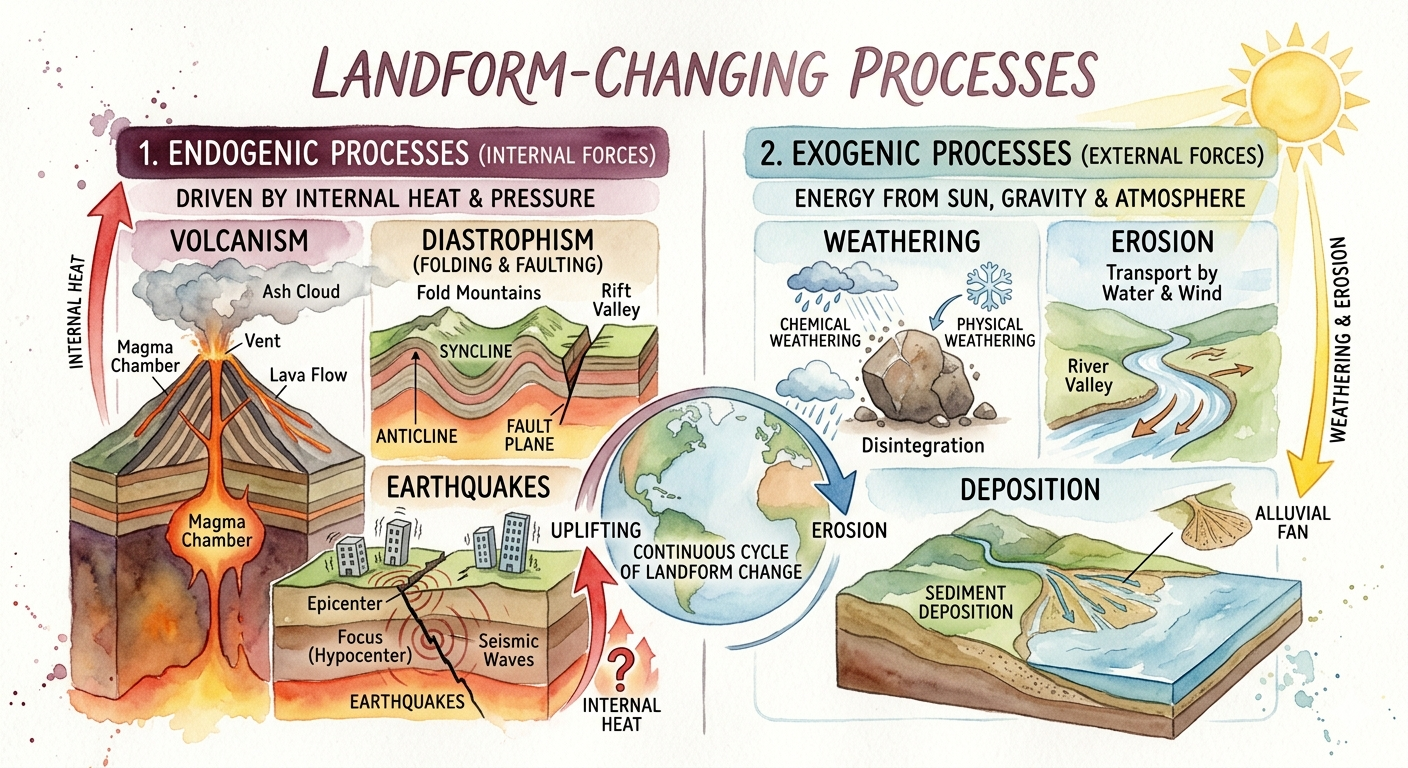
The Earth’s surface is dynamic and continuously changes due to the action of natural forces. These forces are responsible for the formation and modification of landforms. They are broadly classified into Endogenic Processes and Exogenic Processes.
1. Endogenic Processes (Internal Forces)
Endogenic processes originate inside the Earth and are driven by internal heat and pressure. These forces create new landforms by uplifting, folding, faulting, volcanic eruptions, and earthquakes.
Examples:
- Volcanism
- Diastrophism (folding and faulting)
- Earthquakes
2. Exogenic Processes (External Forces)
Exogenic processes operate on the Earth’s surface. They obtain energy from the Sun, gravity, and atmospheric conditions. These processes wear down existing landforms and reshape the landscape.
Examples:
- Weathering
- Erosion
- Deposition
Soil
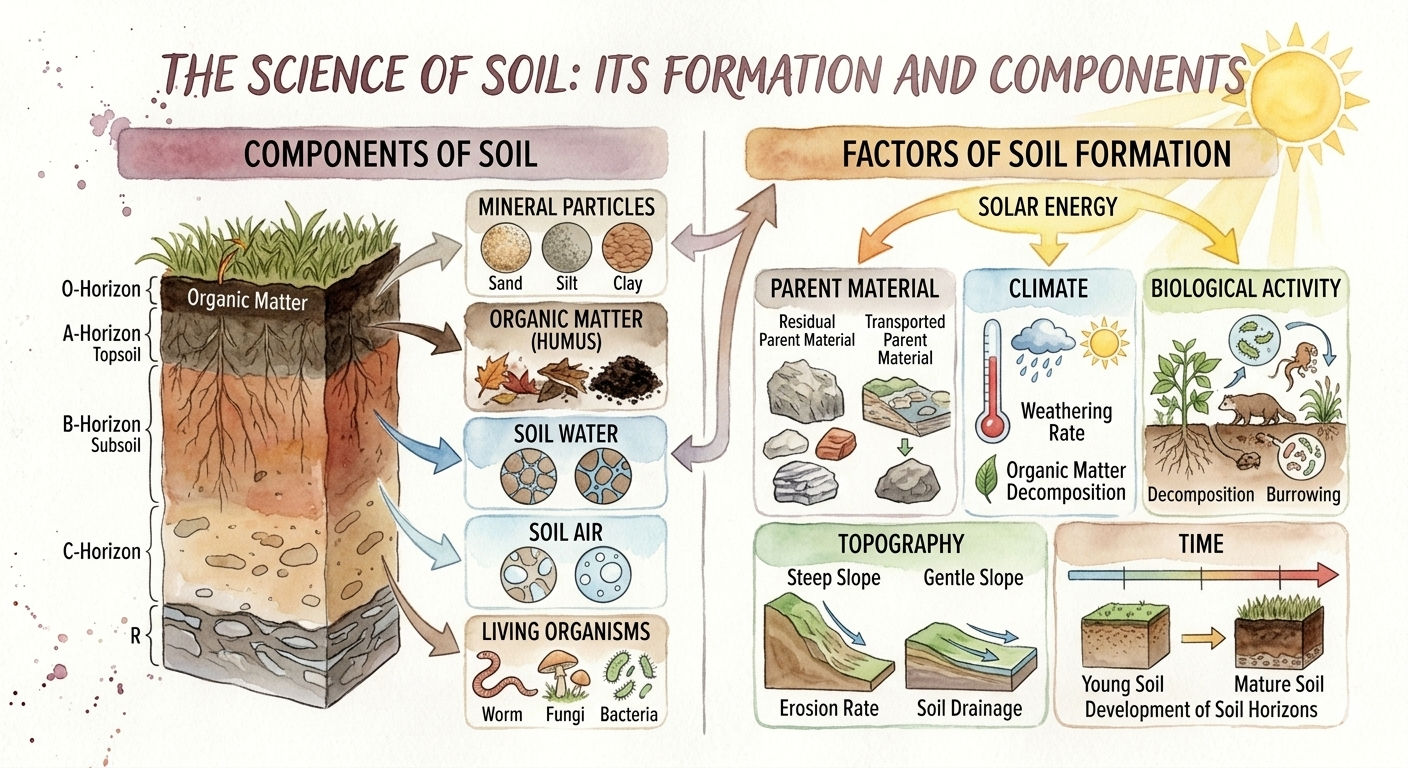
Soil is the thin upper layer of the Earth’s crust formed from weathered rock particles mixed with organic matter, water, air, and living organisms. It provides nutrients and support for plant growth and is essential for agriculture.
Components of Soil
- Mineral particles
- Organic matter (Humus)
- Soil water
- Soil air
- Living organisms
Factors of Soil Formation
The formation of soil is controlled by five major factors.
1. Parent Material
The type of rock from which soil is formed determines its texture, colour, and mineral content.
2. Climate
Temperature and rainfall influence the rate of weathering and soil formation.
3. Biological Activity
Plants, animals, microorganisms, and humans contribute organic matter and help in soil development.
4. Topography
Slope and relief affect drainage, erosion, and soil thickness.
5. Time
Soil formation is a slow process. Mature soils require thousands of years to develop.
Weathering
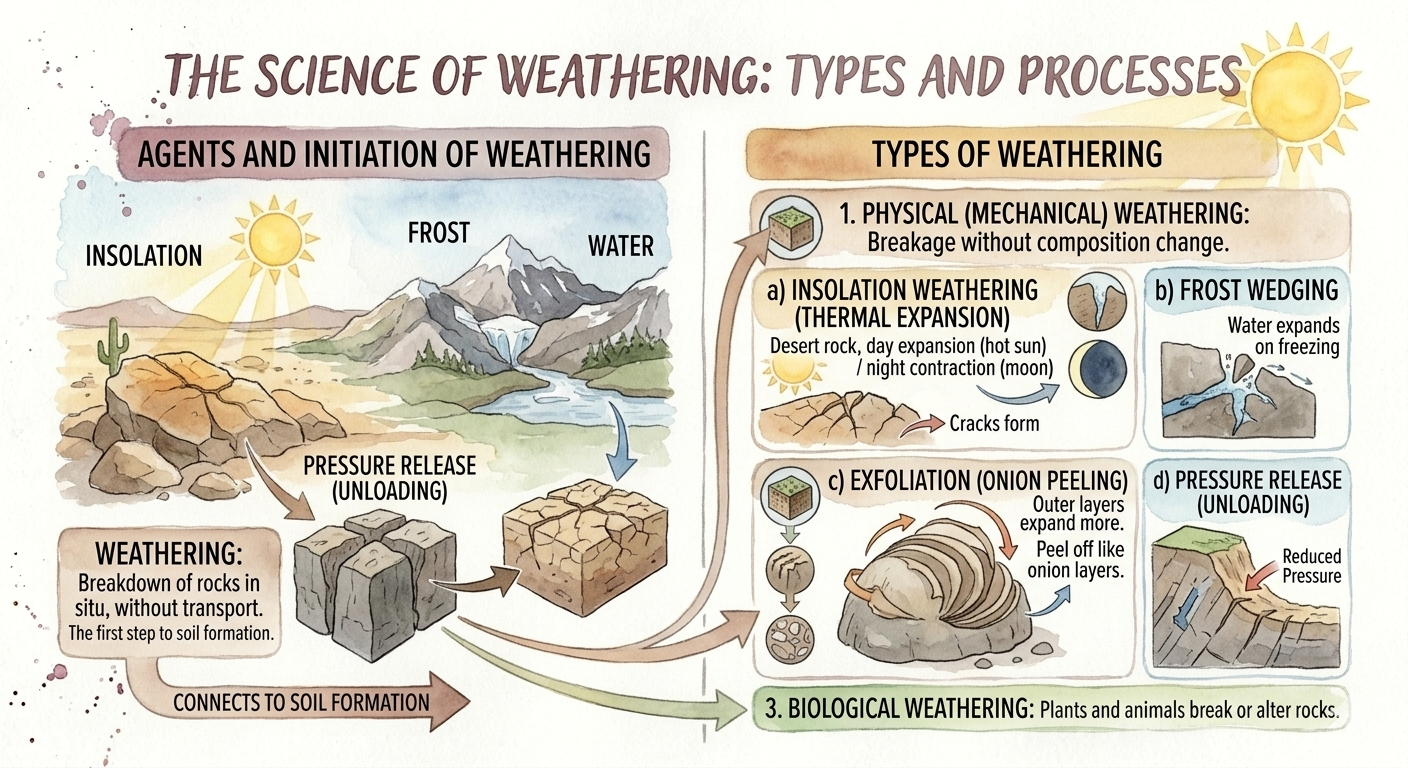
Weathering is the breaking down, disintegration, and decomposition of rocks at or near the Earth’s surface without transporting the broken materials. It is the first step in soil formation.
Unlike erosion, weathering occurs at the same place (in situ).
Agents of Weathering
Weathering is caused by several natural agents:
- Sunlight (Insolation)
- Frost (Ice)
- Pressure Release
- Water
- Atmospheric gases
- Plants, animals, and human activities
Types of Weathering
Weathering is divided into three main types.
1. Physical (Mechanical) Weathering
Physical weathering breaks rocks into smaller pieces without changing their chemical composition.
Main Processes
a) Insolation Weathering (Thermal Expansion)
In hot desert regions, rocks expand during the day due to heat and contract at night due to cooling. Repeated expansion and contraction create cracks that eventually break the rocks.
b) Frost Wedging
Water enters cracks in rocks and freezes during cold weather. As water expands on freezing, it exerts pressure on the rocks, causing them to crack and split.
c) Exfoliation (Onion Peeling)
The outer layers of rocks expand more rapidly than the inner layers. Over time, these outer layers peel off like the layers of an onion.
d) Pressure Release (Unloading)
Deep underground rocks form under high pressure. When the overlying rocks are removed by erosion, the pressure decreases, causing the rocks to expand and crack.
Chemical Weathering
Chemical weathering is the decomposition and alteration of rocks through chemical reactions with water and atmospheric gases. It is most active in hot and humid climates.
Main Processes
1. Oxidation
Oxygen reacts with minerals, especially iron, forming rust-like compounds that weaken rocks.
2. Carbonation
Carbon dioxide mixes with rainwater to form carbonic acid, which dissolves limestone, marble, and other carbonate rocks.
3. Hydration
Water combines chemically with minerals, causing them to expand and change into new minerals. For example, feldspar changes into clay (kaolin).
4. Solution
Some minerals such as rock salt and gypsum dissolve directly in water and are carried away.
Biological Weathering
Biological weathering is caused by the activities of plants, animals, microorganisms, and humans. These living organisms help break rocks into smaller pieces and contribute to soil formation.
Major Contributors
Animals and Insects
Burrowing animals such as rabbits, rats, termites, and earthworms loosen and break the soil and rocks while digging.
Plants
Plant roots grow into cracks in rocks. As the roots expand, they exert pressure that splits the rocks apart.
Human Activities
Mining, quarrying, construction, road building, and deforestation accelerate the breaking of rocks and increase weathering.
Erosion
Erosion is the wearing away and transportation of weathered rock materials from one place to another by natural agents.
Unlike weathering, erosion always involves movement of materials.
Main Agents of Erosion
- Running water
- Wind
- Glaciers (moving ice)
- Sea waves
Soil Erosion
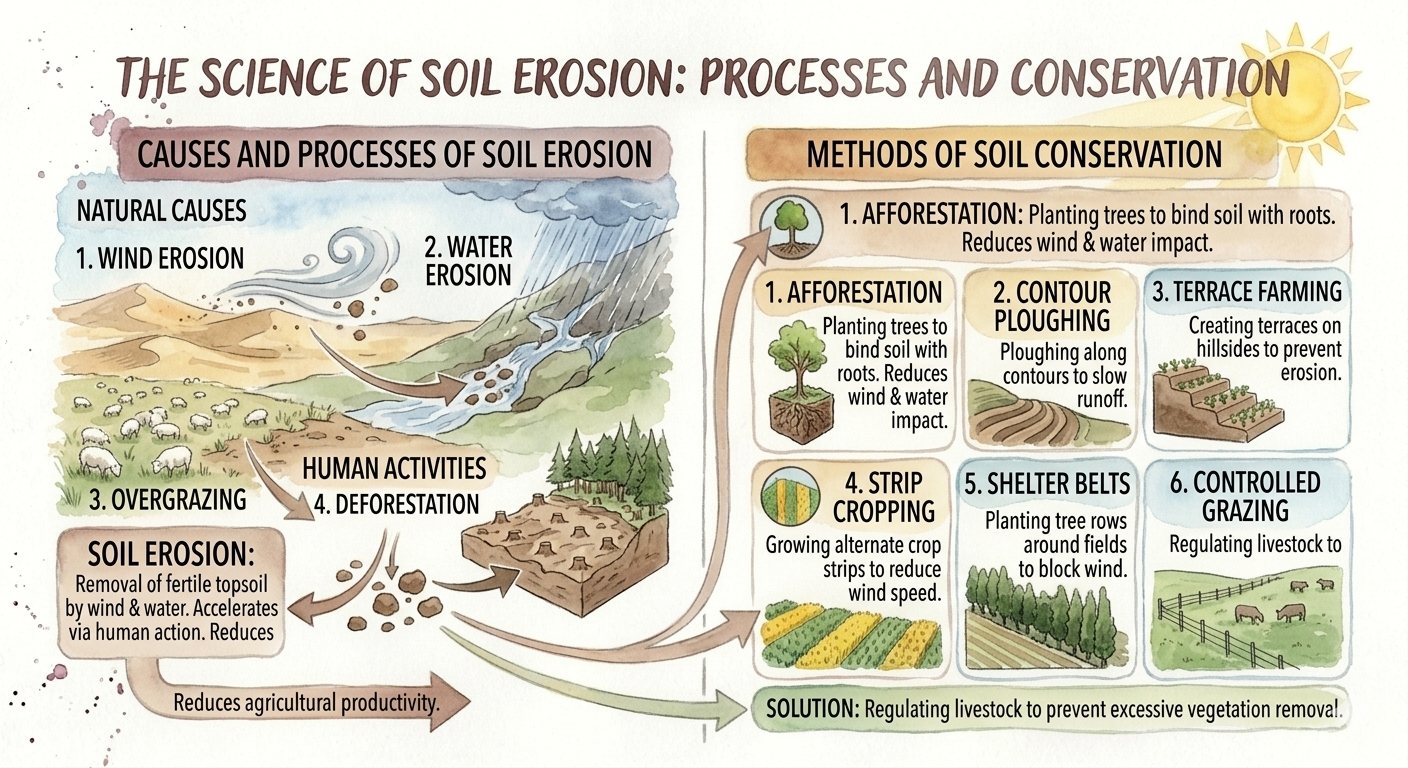
Soil erosion is the removal of the fertile top layer of soil by natural agents such as water and wind. Human activities often accelerate this process, reducing soil fertility and agricultural productivity.
Causes of Soil Erosion
1. Wind Erosion
Strong winds remove loose soil from dry and barren regions.
2. Water Erosion
Heavy rainfall washes away fertile topsoil, especially on steep slopes.
3. Overgrazing
Excessive grazing removes grasses and exposes the soil to erosion.
4. Deforestation
Cutting down forests removes tree roots that bind the soil, making it more vulnerable to erosion.
Soil Conservation
Soil conservation refers to the protection and proper management of soil to prevent erosion and maintain its fertility.
Methods of Soil Conservation
1. Afforestation
Planting trees helps bind the soil with roots and reduces erosion caused by wind and water.
2. Contour Ploughing
Ploughing along contour lines on hill slopes slows down water flow and reduces soil loss.
3. Terrace Farming
Step-like terraces are made on hillsides to reduce runoff and prevent erosion.
4. Strip Cropping
Different crops are grown in alternate strips to reduce wind speed and protect soil.
5. Shelter Belts
Rows of trees are planted around fields to reduce the speed of strong winds.
6. Controlled Grazing
Regulating livestock grazing prevents excessive removal of vegetation and protects the soil.
Difference Between Weathering and Erosion
| Weathering | Erosion |
|---|---|
| Breakdown of rocks at the same place (in situ). | Wearing away and transportation of rock materials. |
| No movement of materials. | Involves movement of materials. |
| Leads to soil formation. | Leads to removal of soil and sediments. |
| Caused by heat, water, frost, gases, and organisms. | Caused by water, wind, glaciers, and waves. |
Short Answer Questions
- Endogenic Processes (Internal Forces): Processes occurring due to the action of forces deep within the Earth. Example: Volcanism, diastrophism.
- Exogenic Processes (External Forces): Processes that derive their energy from the atmosphere (determined by ultimate solar energy) as well as gravity and gradients created by tectonic factors. Example: Weathering, erosion.
- Factors of Soil Formation: The five major factors regulating soil development are:
- Parent Material (Bedrock)
- Climate
- Biological Activity
- Topography
- Time
- Main Agents of Weathering:
- Insolation (Sunlight/Heat)
- Frost
- Pressure Release
- Gases (Oxidation, Carbonation)
- Water (Hydration, Solution)
- Biological Organisms (Animals, insects, vegetation, and man)
Long Answer Questions
- Physical or Mechanical Weathering
- Chemical Weathering
- Biological Weathering
- Insolation Weathering (Thermal Expansion): Highly prevalent in hot desert areas experiencing severe diurnal (daily) temperature variations. During the scorching day, rocks absorb heat and expand. At night, temperatures plummet, causing rapid contraction. This alternate expansion and contraction builds up immense internal tension, creating cracks and splitting joints.
- Frost Wedging: An active mechanical force in cold climates, high altitudes, and high latitudes. Water accumulates inside rock fractures during the day. At night, temperatures drop below freezing, turning water into ice. Because water expands by 9% when it freezes, it exerts massive outward pressure against the fracture walls, splitting the rock apart.
- Exfoliation (Onion Peeling): Because rocks are poor conductors of heat, thermal expansion and contraction are heavily concentrated in the outermost layers compared to the interior core. Consequently, the outer layers flake or peel away from the main rock mass in concentric shells, resembling the peeling of an onion layer.
- Pressure Release (Unloading): Deep intrusive igneous and metamorphic rocks form under intense pressure. When overlying rock layers are removed over millions of years by erosion, the underlying rocks expand outward due to the sudden release of confinement pressure. This expansion produces structural cracks that trigger mechanical disintegration.
- Oxidation: Occurs when atmospheric oxygen dissolved in water reacts with minerals inside rocks, particularly iron compounds. This triggers decomposition, causing the rock to crumble while shifting its surface color to distinct rusty red, yellow, or brown hues.
- Carbonation: Occurs when atmospheric carbon dioxide mixes with rainwater to create weak carbonic acid. This acidic solution reacts with and dissolves calcareous elements inside rocks like limestone, marble, and gypsum, carving out large-scale underground karst systems.
- Hydration: The chemical addition of water molecules to the mineral structure. Certain minerals expand in volume, place mechanical stress on surrounding crystals, and alter their composition. For example, Feldspar mechanically degrades into Kaolin (clay) via hydration.
- Solution: Rainwater directly dissolves highly soluble rock minerals (such as rock salt/halite and gypsum) and leaches them down into lower soil horizons.
- Animals and Insects: Burrowing fauna like rabbits, rats, earthworms, and termites move massive volumes of rock and soil matrix to build habitats or scavenge food. This shifts and structurally undermines the rock framework.
- Vegetation: Plant root systems work down into small bedrock joints. As shrubs and trees grow, their expanding roots act as mechanical wedges, applying immense force that cracks open and dislodges massive blocks from cliffs.
- Anthropogenic Factors (Man): Human activities like open-pit quarrying, underground mining, rapid deforestation, and reckless land cultivation structurally break up massive bedrock formations on an unprecedented scale.
- Wind Erosion: Strong winds lift up and carry away loose topsoil and organic particles. This occurs primarily in arid and semi-arid desert landscapes where the ground lacks protective vegetative cover.
- Water Erosion: Intense rainfall on hilly slopes washes loose surface soil downward. This sediment blocks riverbeds downstream, altering river courses over time, triggering flash floods, and stripping agricultural lands of their productivity.
- Overgrazing: Repeatedly grazing cattle on the same pasture fields causes them to strip away all available grasses, including the root networks. This leaves the topsoil vulnerable to sudden wind and surface water runoff.
- Deforestation: Large-scale clearing of forests for farming, urbanization, and industrial corridors removes the protective tree cover. Tree root structures act as natural anchors that hold soil matrices together; removing them leaves the land exposed to rapid degradation.
- Soil Conservation: The comprehensive prevention of accelerated topsoil loss through structured environmental and land management.
- Afforestation: The most effective conservation methodology involving planting new tree belts and ground vegetation. Forests form the foundation of global ecosystems; because tree root matrices hold soil in place and reduce wind velocity, proactive replanting programs are vital to safeguarding global topsoil resources.
Multiple Choice Questions
- a) Erosion
- b) Volcanism (Correct Answer)
- c) Deposition
- d) Gradation
- a) Orogenic processes
- b) Plate tectonics
- c) Epeirogenic processes
- d) Gradation (Correct Answer)
- a) Deposition
- b) Volcanism
- c) Diastrophism
- d) Erosion (Correct Answer)
- a) Running Water
- b) Wind
- c) Glacier
- d) Earthquake (Correct Answer)
- a) Block disintegration
- b) Granular disintegration
- c) Carbonation (Correct Answer – It is a chemical weathering process)
- d) Exfoliation
- a) Granite
- b) Quartz
- c) Clay (Correct Answer)
- d) Salts
- a) Landslide
- b) Rapid flow mass movement (Correct Answer)
- c) Slow flow mass movement
- d) Subsidence