Chapter 8: Sources of Business Finance
Chapter 8
Sources of Business Finance
1. Meaning of Business Finance
Business finance means the funds required to start, operate and expand a business.
A business needs money to purchase assets, buy materials, pay employees and meet other expenses.
Example: A bakery needs funds to buy an oven, purchase ingredients, pay wages and meet electricity bills.
2. Nature of Business Finance
1. Required by Every Business
Every business needs finance, whether it is a small shop or a large manufacturing company.
2. Needed at Different Stages
Finance is required when starting a business, running its daily activities, expanding operations and replacing old equipment.
3. Required for Different Periods
Some needs are temporary, while others require funds for several years.
Example: Purchasing seasonal stock is a short-term need; constructing a factory is a long-term need.
4. Comes from Different Sources
Funds may come from owners, retained profits, lenders, suppliers and other permitted sources.
5. Involves Cost and Risk
Different sources carry different costs, repayment obligations and effects on ownership.
6. Requires Planning
A business must estimate how much finance it needs, when it needs it and how it will repay any borrowing.
3. Significance of Business Finance
1. Starting a Business
Funds are needed for premises, equipment, registrations and initial operating expenses.
2. Purchasing Fixed Assets
Finance helps purchase assets used for a long period.
Examples: Buildings, machinery, furniture and vehicles.
3. Meeting Daily Expenses
Funds are required for stock, salaries, rent, transport and utilities.
4. Expansion and Diversification
Finance supports new branches, increased production and entry into new product lines.
5. Modernisation
Businesses need funds to replace outdated machinery and adopt better technology.
6. Meeting Unexpected Needs
Financial reserves or suitable funding arrangements help businesses handle delays, repairs and other unexpected expenses.
7. Using Business Opportunities
Readily available finance can help a business respond to a useful opportunity.
Example: Purchasing additional stock when demand is expected to rise.
4. Fixed Capital and Working Capital
| Basis | Fixed Capital | Working Capital |
|---|---|---|
| Meaning | Funds invested in long-term assets | Funds needed to support day-to-day operations |
| Purpose | Establishes operating capacity | Keeps routine business activities running |
| Examples | Machinery, buildings and equipment | Inventory, wages and other operating needs |
| Period | Generally long-term | Generally linked to the operating cycle |
Remember: A business needs both. Machinery cannot operate successfully without funds for materials, workers and other running costs.
5. Classification of Sources of Finance
A. On the Basis of Ownership
- Owner’s funds: Funds provided by owners and profits retained in the business.
- Borrowed funds: Funds obtained from outside parties with repayment obligations.
B. On the Basis of Generation
| Type | Meaning | Example |
|---|---|---|
| Internal sources | Generated within the business | Retained profits |
| External sources | Obtained from outside the business | Share issues, bank loans and trade credit |
C. On the Basis of Period
- Short-term finance: Generally required for up to one year.
- Medium-term finance: Generally required for more than one year and up to five years.
- Long-term finance: Generally required for more than five years.
These are common textbook classifications; actual financing periods depend on the arrangement.
6. Owner’s Funds
Owner’s funds are the funds provided by the owners of a business, together with profits retained in it.
For a company, these mainly include share capital and retained earnings.
Features
- Represent the owners’ investment in the business.
- Generally provide a long-term financial base.
- Bear the residual risk of the business.
- Do not normally require repayment like an ordinary loan.
- Returns depend on the nature of the ownership instrument and business performance.
Main Sources
- Equity shares.
- Preference shares.
- Retained profits.
Note: Preference shares form part of share capital, but they have special rights and may be redeemable according to their terms.
7. Borrowed Funds
Borrowed funds are funds obtained from lenders or creditors that must be repaid according to agreed terms.
Features
- Usually involve interest or another financing cost.
- Must be repaid according to the agreement.
- May require security.
- Create financial obligations even when profits are low.
- Generally do not give lenders ordinary ownership voting rights.
Main Sources
- Debentures and bonds.
- Public deposits.
- Loans from financial institutions.
- Loans from commercial banks.
- Trade credit.
Owner’s Funds and Borrowed Funds: Differences
| Basis | Owner’s Funds | Borrowed Funds |
|---|---|---|
| Providers | Owners or shareholders; also retained business profits | Lenders and creditors |
| Position | Ownership interest | Creditor’s claim |
| Return | Dividends or growth in ownership value | Interest or other agreed financing return |
| Repayment | Generally not repayable like a loan; exceptions depend on the instrument | Repayable according to agreed terms |
| Control | Equity ownership generally carries voting rights | Usually no ordinary ownership voting rights |
| Security | No collateral is normally provided to shareholders | May be secured or unsecured |
| Risk to business | Usually fewer compulsory payment obligations | Interest and repayment create financial pressure |
| Claim on winding up | Paid after creditors | Creditors generally rank ahead of shareholders |
8. Equity Shares
Equity shares represent ownership capital carrying the residual rights in a company.
Equity shareholders receive what remains after the company meets prior claims, including the applicable rights of preference shareholders.
They are commonly called the owners of the company.
Features
- Ownership interest: Equity shareholders own a stake in the company.
- Voting rights: They generally have the right to vote on company matters.
- Variable dividend: Dividend is not fixed or guaranteed.
- Residual claim: They bear the final risk and receive the remaining benefits.
- Long-term capital: Equity capital generally remains available without a fixed repayment date.
- Potential for capital gain or loss: The value of shares may rise or fall.
Merits to the Company
- No compulsory dividend: A dividend is not a fixed debt payment.
- Stable capital base: Funds support long-term activities.
- No collateral required: Assets need not normally be pledged.
- Improves borrowing capacity: A strong equity base can support further finance.
Suitable for uncertain earnings: There is no fixed interest obligation.
Limitations
- Dilution of control: Issuing new equity may reduce existing shareholders’ voting proportion.
- Sharing of future profits: More shareholders participate in future returns.
- Issue costs: Raising equity can involve significant expenses.
- Higher expected return: Investors may expect substantial returns because they bear greater risk.
- Market conditions matter: Raising funds may be difficult when investor confidence is weak.
Example: An investor owns 100 out of 1,000 identical equity shares and therefore holds 10% of that equity share capital.
9. Preference Shares
Preference shares are shares that carry preferential rights over equity shares regarding dividend and repayment of capital on winding up.
Their priority is over equity shareholders, not over creditors.
Features
- Generally carry a stated dividend rate.
- Receive dividend preference over equity shares.
- Have priority over equity capital on winding up.
- Usually have restricted voting rights.
- May be redeemable or convertible according to their terms.
- Dividend is not an interest payment and is not automatically guaranteed.
Main Types
| Type | Meaning |
|---|---|
| Cumulative | Unpaid preference dividends accumulate according to the terms |
| Non-cumulative | Unpaid dividends do not accumulate |
| Participating | May share in additional profits or surplus according to the terms |
| Non-participating | Normally receive only the specified preferential benefits |
| Convertible | Can be converted into equity shares according to the terms |
| Non-convertible | Cannot be converted into equity shares |
| Redeemable | Capital is repaid according to specified terms and applicable requirements |
Merits to the Company
- Limited dilution of voting control: Preference shareholders generally have restricted voting rights.
- No ordinary loan-style interest obligation: Preference dividends differ from debt interest.
- Flexible financing terms: Features can be designed for different investors.
- No usual collateral requirement: Preference shares normally do not require assets to be pledged.
Limitations
- Dividend preference reduces the amount available to equity shareholders.
- Redemption requires financial planning.
- Investors may find limited voting rights unattractive.
- Preference dividends generally do not provide the tax treatment associated with deductible borrowing costs.
Equity and Preference Shares: Differences
| Basis | Equity Shares | Preference Shares |
|---|---|---|
| Dividend | Variable and not guaranteed | Generally at a stated rate, subject to applicable conditions |
| Dividend priority | After preference shareholders | Before equity shareholders |
| Voting rights | Generally available | Usually restricted |
| Risk | Higher residual risk | Generally lower than equity, but still involves investment risk |
| Capital repayment priority | After preference capital | Before equity capital, but after creditors |
| Growth participation | Usually greater | Usually limited unless participating or convertible |
10. Debentures and Bonds
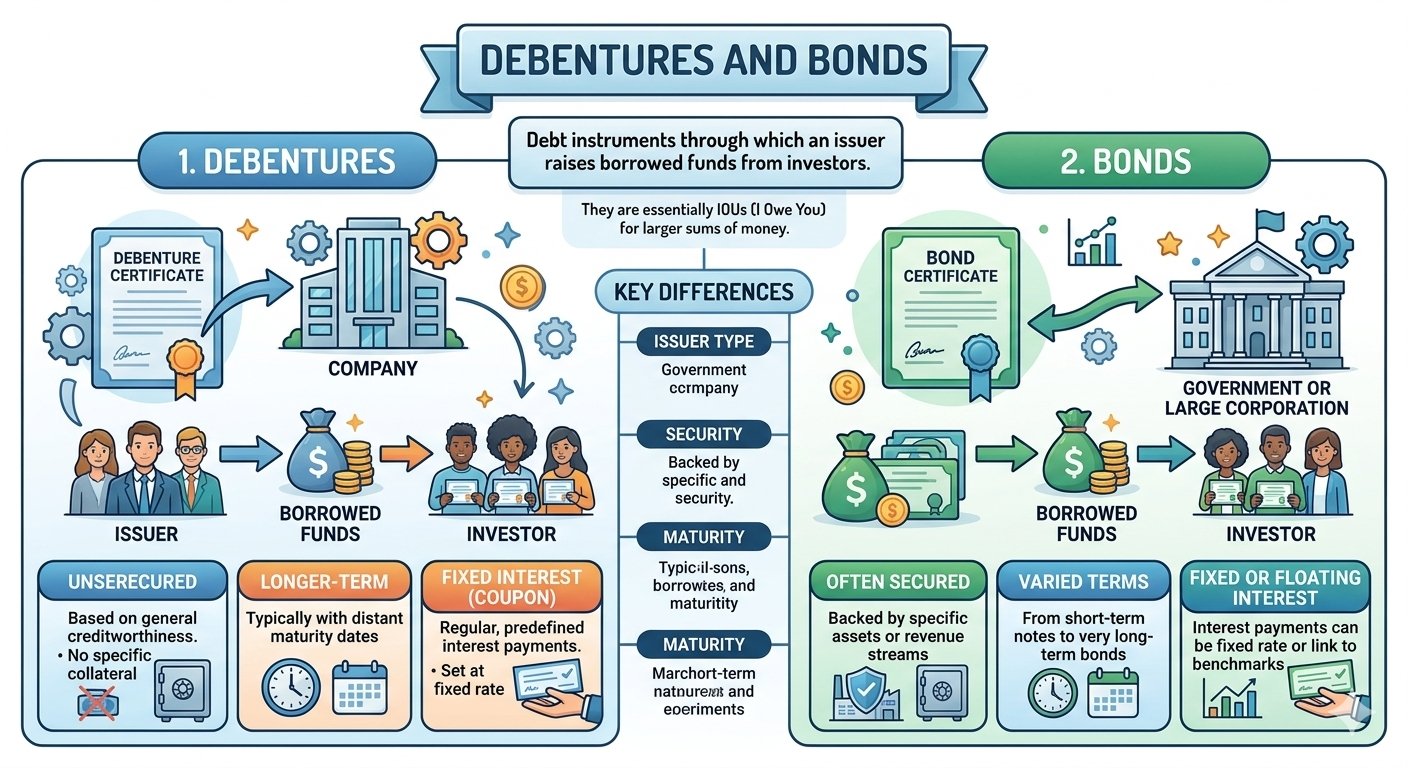
Debentures and bonds are debt instruments through which an issuer raises borrowed funds from investors.
The issuer promises payment according to the instrument’s terms, usually including interest and repayment of principal.
The terms “bond” and “debenture” overlap. Their exact meaning and security arrangements depend on the issue and legal context.
Features
- Creditor relationship: Holders are lenders, not ordinary owners.
- Interest: Usually payable at an agreed rate or according to another specified structure.
- Repayment: Principal is repaid according to the terms.
- Security: Instruments may be secured or unsecured.
- Priority: Debt claims generally rank ahead of shareholders.
- No ordinary voting rights: Holders normally do not vote as equity shareholders.
- Conversion: Some instruments can convert into shares.
Main Types
| Type | Meaning |
|---|---|
| Secured | Backed by a charge or security interest over specified assets |
| Unsecured | Not backed by such specific security |
| Convertible | Can convert into shares under agreed conditions |
| Non-convertible | Remain debt instruments |
| Redeemable | Repaid according to the agreed terms |
Merits to the Company
- No immediate dilution of ownership: Non-convertible debt does not create new shareholders.
- Predictable financing terms: Interest and repayment arrangements can be planned.
- May cost less than equity: Depending on risk and market conditions.
- Possible tax benefit: Eligible interest expenses may receive favourable tax treatment.
- Suitable for stable earnings: Regular cash flows can support debt payments.
Limitations
- Compulsory payments: Interest and principal obligations must be met.
- Financial risk: Heavy borrowing increases the risk of default.
- Security requirements: Assets may have to be pledged.
- Restrictions: Lenders may impose conditions on business decisions.
- Repayment burden: Funds must be available when the debt falls due.
Shares and Debentures: Differences
| Basis | Shares | Debentures |
|---|---|---|
| Nature | Ownership capital | Borrowed capital |
| Holder’s position | Shareholder | Creditor |
| Return | Dividend | Usually interest |
| Payment obligation | Dividend is subject to applicable conditions | Interest follows contractual terms |
| Voting rights | Depend on the class of shares | No ordinary shareholder voting rights |
| Repayment | Depends on the type of share | According to debt terms |
| Priority | After creditors | Before shareholders |
11. Retained Profits
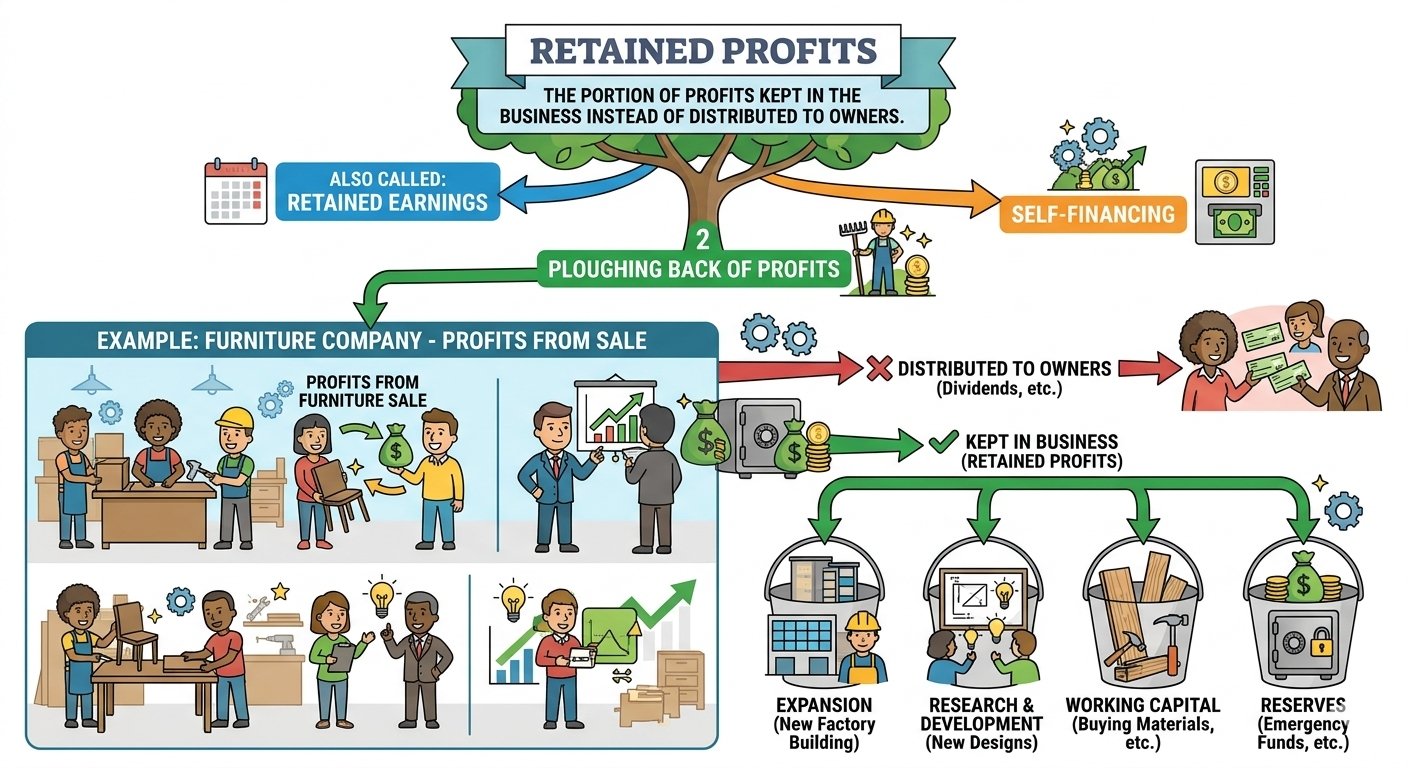
Retained profits are the portion of business profits kept in the business instead of being distributed to owners.
They are also called retained earnings, ploughing back of profits or self-financing.
Example
A company earns ₹10 lakh and distributes ₹4 lakh as dividends. Ignoring other adjustments, the remaining ₹6 lakh is retained.
Merits
- Internal source: No need to approach outside investors for those funds.
- No fixed interest: There is no loan-style interest payment.
- No dilution of control: No new shares need to be issued.
- Financial flexibility: Funds can support growth or unexpected needs.
- Stronger financial base: Retention can reduce dependence on borrowing.
Limitations
- Depends on profits: New or loss-making businesses may have little available.
- May disappoint shareholders: Investors may prefer higher dividends.
- Risk of inefficient use: Management may invest in unsuitable projects.
- Limited amount: Available profits may be insufficient for expansion.
Important: Retained profits are not cost-free. Shareholders give up the opportunity to receive and invest those funds elsewhere.
12. Public Deposits
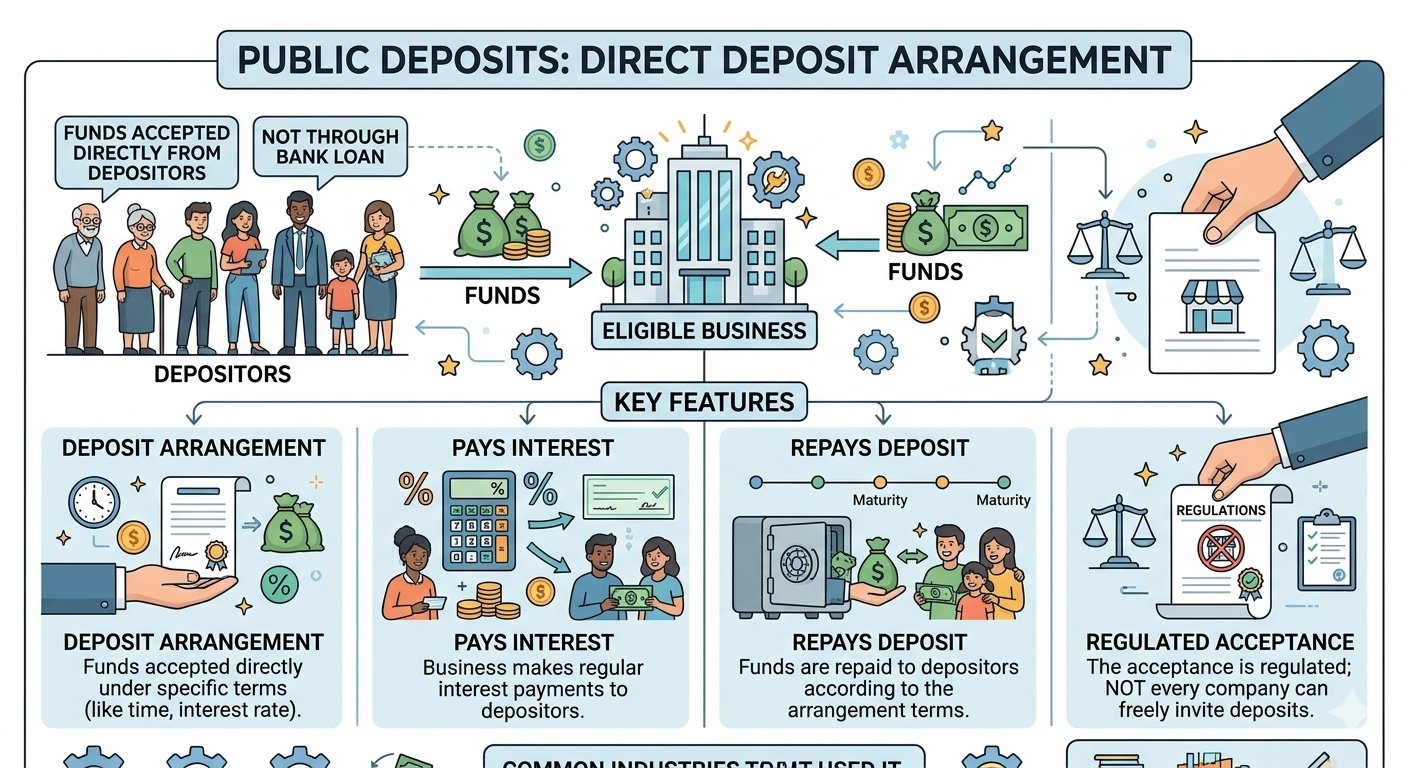
Public deposits are funds accepted by eligible businesses directly from depositors under a deposit arrangement, rather than through a bank loan.
The business pays interest and repays the deposit according to its terms.
Acceptance of deposits is regulated; not every company can freely invite deposits from the public.
Features
- Raised directly from depositors.
- Carry agreed interest and repayment terms.
- Commonly used for short- or medium-term needs.
- May be unsecured.
- Depend on the business’s eligibility, reputation and compliance.
Merits
- Potentially lower cost: May be cheaper than some other borrowing.
- No ownership dilution: Depositors do not ordinarily become shareholders.
- Alternative funding source: Reduces dependence on a single lender.
- May avoid pledging assets: Depending on the arrangement.
Limitations
- Legal restrictions: Acceptance is subject to applicable requirements.
- Uncertain availability: Depositors may be unwilling to invest.
- Difficult for unfamiliar businesses: Reputation strongly affects confidence.
- Repayment pressure: Deposits must be repaid when due.
- Investor risk: A company deposit should not be assumed to have the same protection as a bank deposit.
13. Loans from Financial Institutions
Financial institutions provide finance for business investment, development and other specified purposes.
Some specialize in sectors such as small enterprises, agriculture, infrastructure or exports.
Features
- Often support medium- or long-term needs.
- Assess the proposed project and repayment ability.
- May require security.
- Can provide technical or managerial guidance.
- May release funds in stages.
- Impose repayment terms and other conditions.
Merits
- Longer-term support: Useful for fixed assets and major projects.
- Large funding potential: May support substantial investment.
- Expert guidance: Project appraisal can improve planning.
- Structured repayment: Instalments may be aligned with the project’s expected cash flows.
- Specialized assistance: Some institutions understand particular industries.
Limitations
- Detailed procedure: Applications and appraisal can take time.
- Security requirements: Collateral may be necessary.
- Restrictions: The institution may impose conditions.
- Monitoring: Borrowers may need to submit regular reports.
- Compulsory servicing: Interest and repayments remain obligations.
Example: A manufacturer obtains a long-term loan to install a new production line.
14. Loans from Commercial Banks
Commercial banks provide loans and credit facilities to businesses for working capital, asset purchases and other needs.
Main Forms
| Facility | Meaning |
|---|---|
| Term loan | A loan repaid over an agreed period |
| Cash credit | Borrowing up to a sanctioned limit, usually against specified security |
| Overdraft | Permission to withdraw beyond the account balance up to an agreed limit |
| Bill discounting | Receiving funds before an eligible bill becomes due, after deducting charges |
Merits
- Different facilities: Businesses can choose suitable arrangements.
- No ordinary ownership dilution: The bank does not normally become an equity owner.
- Flexible working-capital support: Some facilities allow borrowing as needed within limits.
- Established relationships: A good banking record may support future funding.
- Business information remains relatively private: There is no public share invitation.
Limitations
- Interest and charges: Borrowing creates costs.
- Repayment obligations: Payments are due even during difficult periods.
- Security or guarantees: These may be required.
- Credit assessment: Approval depends on financial position and repayment capacity.
- Conditions and limits: Banks may restrict use or periodically review facilities.
Example: A retailer uses cash credit to finance stock purchases before a busy season.
15. Trade Credit
Trade credit is the credit given by one business to another when goods or services are supplied now and payment is allowed later.
The supplier becomes a trade creditor, and the buyer owes a trade payable.
Example
A wholesaler supplies goods worth ₹50,000 to a retailer and allows payment after 30 days. The retailer receives 30 days’ trade credit.
Factors Affecting Trade Credit
- Buyer’s reputation and payment record.
- Financial position.
- Volume and frequency of purchases.
- Supplier’s financial capacity.
- Competition and industry practice.
- Agreed credit terms.
Merits
- Convenient: Finance arises through normal purchases.
- Supports working capital: The buyer need not pay immediately.
- Relatively simple: Often involves fewer formalities than a loan.
- May grow with purchases: Regular reliable customers may obtain higher limits.
- No ownership dilution: The supplier does not become an owner.
Limitations
- Limited amount and period: It cannot usually finance large long-term projects.
- Possible hidden cost: Credit prices may be higher, or cash discounts may be lost.
- Late-payment consequences: Delays may attract charges or damage relationships.
- Dependence on suppliers: Future supplies may be restricted.
- Risk of overtrading: Easy credit may encourage purchases beyond the buyer’s capacity.
Remember: Trade credit is not always free merely because no interest is separately stated.
16. Comparison of Major Sources
| Source | Nature | Main advantage | Main limitation |
|---|---|---|---|
| Equity shares | Owner’s funds | No fixed interest or normal repayment date | Dilution of control |
| Preference shares | Share capital with preferential rights | Generally less voting dilution | Dividend preference and possible redemption needs |
| Debentures and bonds | Debt | Raises funds without immediate equity dilution | Interest and repayment burden |
| Retained profits | Internal owner’s funds | No new outside financing arrangement | Depends on available profits |
| Public deposits | Borrowed funds | Alternative direct funding source | Eligibility, compliance and repayment obligations |
| Financial institution loans | Borrowed funds | Support for projects and longer-term investment | Detailed appraisal and conditions |
| Commercial bank finance | Borrowed funds | Variety of credit facilities | Cost, approval requirements and repayment |
| Trade credit | Supplier finance | Convenient support for purchases | Limited period and possible hidden cost |
17. Factors Affecting the Choice of Finance
1. Cost
Compare interest, issue expenses, fees and other direct or indirect costs.
2. Financial Strength
A business with stable cash flows may be better able to meet fixed debt payments.
3. Purpose and Period
The financing period should broadly suit the need.
Example: A long-life machine generally requires stable, longer-term finance.
4. Control
New equity may dilute ownership; borrowing generally does not create ordinary voting rights.
5. Risk
Higher borrowing increases compulsory payments and financial pressure.
6. Flexibility
Consider whether the amount, repayment schedule and terms can adapt to business needs.
7. Availability of Security
Some loans require assets or guarantees that the business may not possess.
8. Business Form and Eligibility
Not every source is available to every business.
Example: A sole proprietor cannot issue company shares.
9. Market Conditions
Investor confidence, lending conditions and interest rates affect the availability and cost of funds.
10. Tax Implications
Different financing methods can have different tax effects, which should be considered under the applicable rules.