Chapter 3: Private, Public and Global Enterprises
Chapter 3
Private, Public and Global Enterprises
1. Introduction
Business enterprises can be classified according to who owns, manages and controls them.
- Private sector enterprises: Owned and controlled by private individuals or organizations.
- Public sector enterprises: Owned and controlled by the government.
- Global enterprises: Carry out business activities in more than one country.
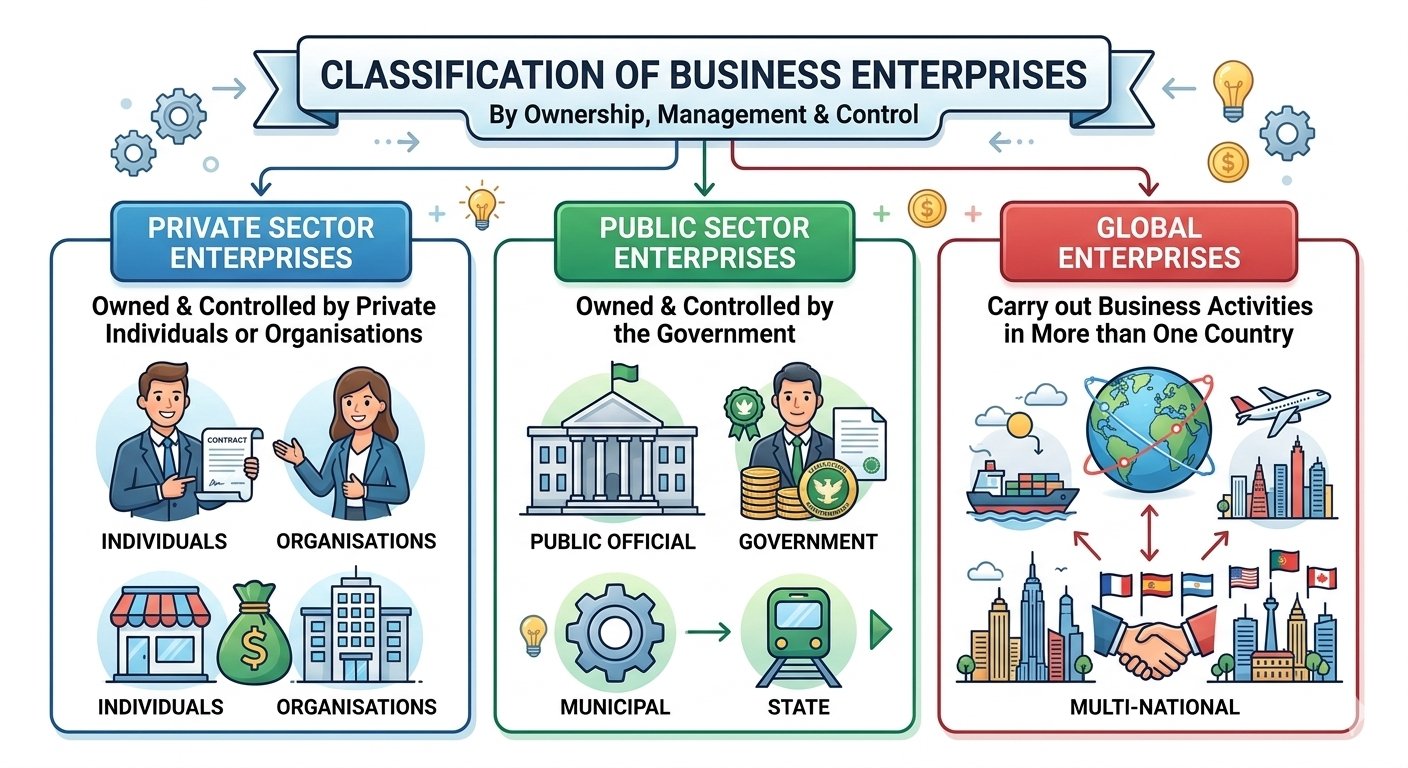
Important: Global enterprises are classified by their international operations. A global enterprise may be privately owned or government owned.
2. Private Sector
The private sector consists of businesses owned, managed and controlled by private individuals or organizations rather than the government.
Examples: A privately owned shop, a partnership firm and a privately controlled company.
Features
- Private ownership: Individuals or private organizations own the business.
- Private management: Owners or managers appointed by them take decisions.
- Profit motive: Earning profit is an important objective.
- Private finance: Funds come from owners, investors, retained profits and borrowing.
- Risk bearing: Owners and investors bear business risks according to the form of organization.
- Customer focus: Businesses must satisfy customers to earn revenue and compete successfully.
- Different organizational forms: Private enterprises may operate as sole proprietorships, partnerships, cooperatives or companies.
Role of the Private Sector
- Produces goods and services.
- Creates employment.
- Encourages innovation.
- Brings investment into the economy.
- Increases competition and consumer choice.
- Contributes to government revenue through taxes.
3. Public Sector
The public sector consists of enterprises owned and controlled by the central government, state governments, or both.
These enterprises undertake commercial activities while also serving economic and social objectives.
Features
- Government ownership: The government owns the enterprise fully or holds a controlling interest.
- Government control: Control is exercised through the relevant ministry, governing body or board.
- Public welfare: Providing essential services and supporting development are important aims.
- Public accountability: Public enterprises are answerable through mechanisms such as government oversight, legislative scrutiny and audit.
- Government investment: Capital may come from government funds, along with borrowing and internally generated funds.
- Large-scale operations: Many public enterprises operate in infrastructure, basic industries and essential services.
Main Objectives
- Provide essential goods and services.
- Develop infrastructure.
- Promote balanced regional development.
- Create employment.
- Support strategic and national interests.
- Prevent excessive concentration of economic power.
- Earn a reasonable return and use public resources efficiently.
Remember: Public enterprises may earn profit. Public welfare and profitability can both be important objectives.
Private Sector and Public Sector: Differences
| Basis | Private Sector | Public Sector |
|---|---|---|
| Ownership | Private individuals or organizations | Government |
| Control | Private owners or their appointed management | Government through the appropriate structure |
| Main emphasis | Profit, growth and business value | Public service, development and efficient commercial performance |
| Finance | Private investment, profits and borrowing | Government investment, internal funds and borrowing |
| Accountability | Mainly to owners, investors and regulators | To government, legislatures and other stakeholders |
| Decision-making | Often relatively flexible | May involve more procedures and public oversight |
| Examples | A private factory or retail business | A government-owned transport or manufacturing enterprise |
4. Forms of Organizing Public Sector Enterprises
The three main forms are:
- Departmental undertaking.
- Statutory corporation.
- Government company.
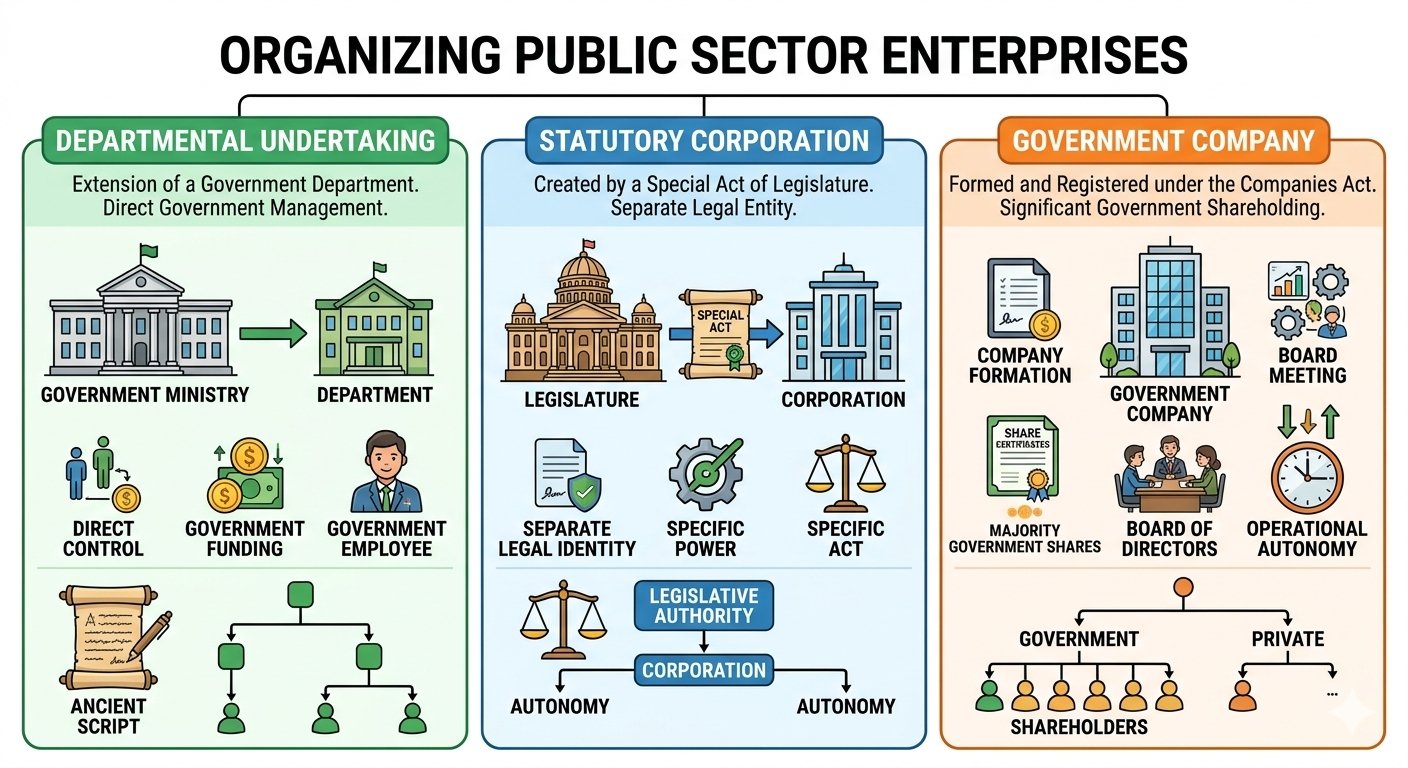
They differ mainly in their legal status, management, finance and degree of independence.
5. Departmental Undertaking
A departmental undertaking is a public enterprise operated as a part of a government department.
It functions under the direct control of a ministry and does not have a legal identity separate from the government.
Examples: Departmental postal services and government railway operations.
Features
- Part of a ministry: It is organized within a government department.
- No separate legal entity: It is legally part of the government.
- Budgetary finance: Expenditure is financed through government budget allocations, and receipts form part of government revenue.
- Government employees: Employees generally work under government service conditions.
- Direct ministerial control: The minister and departmental officials supervise its activities.
- Government accounting and audit: Government financial rules and audit procedures apply.
- Legislative accountability: The responsible minister is answerable to Parliament or the state legislature.
Merits
- Direct government control: Useful for services closely connected with national interests.
- Public accountability: Legislative scrutiny helps monitor the use of public funds.
- Budgetary support: Government funding can support essential services.
- Confidentiality: Suitable where secrecy is necessary.
- Public service orientation: Services can be provided even where commercial profits are limited.
Limitations
- Limited flexibility: Government rules may restrict operational freedom.
- Delay in decisions: Proposals may require approval at several levels.
- Political interference: Decisions may be influenced by political considerations.
- Limited financial independence: The undertaking cannot freely use funds outside approved arrangements.
- Weak business incentives: Management may have less motivation to reduce costs or improve commercial performance.
Suitable for: Essential services requiring close government control, accountability or confidentiality.
6. Statutory Corporation
A statutory corporation is a public enterprise created by a special Act of Parliament or a state legislature.
The Act defines its objectives, powers, functions and management structure.
It is also called a public corporation.
Examples: Life Insurance Corporation of India and Food Corporation of India.
Features
- Created by a special law: Its existence and powers come from a specific Act.
- Separate legal entity: It can own property, enter contracts, sue and be sued in its own name.
- Government ownership and control: It is established as a public body under government control.
- Defined powers and duties: Its activities must follow its governing Act.
- Operational autonomy: It generally has more managerial freedom than a departmental undertaking.
- Separate finances: It can earn revenue and use funds according to its legal framework.
- Own employment arrangements: Employees are generally governed by the corporation’s service rules.
- Public accountability: Reporting and audit requirements are determined by the applicable law.
Merits
- Greater autonomy: Management can take many operational decisions independently.
- Clear objectives: Its purpose and powers are set out in law.
- Continuity: It has a stable legal existence.
- Flexible management: It can combine public ownership with commercial methods.
- Public welfare: It can pursue social objectives alongside efficient operations.
Limitations
- Autonomy may be restricted in practice: Government intervention can affect decisions.
- Difficulty in major changes: Changes to provisions in the governing Act require legislative action.
- Political influence: Appointments and policies may be affected by political considerations.
- Possible inefficiency: Legal independence alone does not guarantee good performance.
- Conflicting objectives: Commercial goals and social responsibilities may be difficult to balance.
Suitable for: Important public services that need a separate legal identity and a clearly defined statutory role.
7. Government Company
In the Indian business studies context, a government company is a company in which at least 51% of the paid-up share capital is held by:
- The central government; or
- One or more state governments; or
- The central and state governments together.
The definition also includes a subsidiary of a government company.
Paid-up share capital means the amount shareholders have actually paid towards the shares issued to them.
Simple Example
A company has paid-up share capital of ₹100 crore. If the central and state governments together hold ₹60 crore, government ownership is 60%, which satisfies the ownership requirement.
Features
- Incorporated under company law: A separate special Act is not required for its incorporation.
- Government ownership: The required government shareholding gives it government-company status.
- Separate legal entity: It has an identity distinct from the government and its shareholders.
- Board management: A board of directors manages the company.
- Limited liability: Shareholders’ liability is generally limited according to the company’s structure.
- Own property and contracts: It can hold assets and enter agreements in its own name.
- Financial flexibility: It can earn revenue, retain funds and borrow within applicable rules.
- Accountability: Special audit and reporting requirements apply in addition to company-law obligations.
Merits
- Relatively easy formation: It can be incorporated under company law.
- Operational flexibility: It generally has more commercial freedom than a departmental undertaking.
- Separate identity: Business activities can be conducted in its own name.
- Professional management: It can appoint managers with specialized skills.
- Private participation: Private investors can hold part of its capital.
- Ability to compete: The company structure supports commercial operations.
Limitations
- Government interference: Actual independence may be less than the formal structure suggests.
- Political appointments: Management appointments may not always be based only on expertise.
- Conflicting objectives: Profitability and government policy goals may pull in different directions.
- Indirect legislative control: Day-to-day activities are less directly controlled by the legislature than those of a department.
- Possible inefficiency: Government ownership does not automatically ensure efficient management.
Suitable for: Commercial activities requiring government control together with the flexibility of a company.
8. Comparison of Public Sector Forms
| Basis | Departmental Undertaking | Statutory Corporation | Government Company |
|---|---|---|---|
| Formation | Through government administrative arrangements | By a special Act | By incorporation under company law |
| Legal identity | Part of the government | Separate legal entity | Separate legal entity |
| Control | Directly through a ministry | Through its statutory governing structure | Through shareholders and a board of directors |
| Finance | Mainly government budget | Revenue, government support and borrowing as permitted | Share capital, revenue and borrowing |
| Operational freedom | Relatively limited | Defined by its Act | Generally greater commercial flexibility |
| Employees | Generally government employees | Generally governed by corporation service rules | Generally company employees |
| Accountability | Through ministerial and legislative control | Through its Act, reporting and audit | Through company law and government-company oversight |
9. Changing Role of the Public Sector
The changing role of the public sector refers to changes in its responsibilities and priorities as the economy develops.
In India, the public sector initially played a major role in building an industrial base and infrastructure. Economic reforms later increased the importance of competition, efficiency, private participation and commercial accountability.
A. Traditional Role of the Public Sector
1. Development of Infrastructure
Public investment helped develop power, transport, communication and other facilities needed by businesses and households.
2. Development of Basic and Heavy Industries
The government invested in industries requiring large amounts of capital and long periods before earning returns.
Examples: Steel, heavy engineering and power generation.
3. Balanced Regional Development
Public enterprises were established in less-developed areas to encourage investment, employment and supporting businesses.
4. Employment Generation
Public enterprises created direct jobs and supported employment in related activities.
5. Economies of Scale
Large public enterprises could operate on a scale needed for industries involving heavy investment.
6. Checking Concentration of Economic Power
Public ownership helped reduce dependence on a small number of private business groups.
7. Import Substitution and Self-reliance
Public enterprises helped develop domestic production of goods that previously had to be imported.
B. Changes in the Role of the Public Sector
1. Greater Private Participation
Many activities previously dominated by public enterprises became open to private businesses.
2. Increased Competition
Public enterprises increasingly had to compete on price, quality, service and efficiency.
3. Greater Focus on Performance
More attention was placed on productivity, cost control, customer satisfaction and financial results.
4. Disinvestment
Disinvestment means the government sells part or all of its shareholding in an enterprise.
It may be used to raise resources, widen ownership or support restructuring.
Disinvestment does not always mean privatization. Privatization involves a transfer of ownership or control to the private sector.
5. Greater Managerial Autonomy
Some public enterprises have been given more freedom to make investment and operational decisions, together with greater accountability for results.
6. Restructuring of Weak Enterprises
Measures may include modernization, changes in management, mergers, financial restructuring or closure where appropriate.
7. Public–Private Partnerships
The government and private businesses may work together to provide infrastructure or services.
Example: A road project developed under a public–private partnership arrangement.
8. Focus on Strategic and Public-interest Activities
The public sector continues to have a role in national security, essential infrastructure, public services and areas where private investment may be insufficient.
Overall Change
The emphasis has moved from simply expanding government ownership towards improving performance, meeting public needs and choosing where government participation is most useful.
10. Global Enterprises or Multinational Companies
A global enterprise, or multinational company (MNC), is an enterprise that owns or controls business operations in more than one country.
It usually has a parent company or headquarters in one country and subsidiaries, branches or other operations in other countries.
Examples: Toyota, Samsung and Nestlé.
Remember: Merely exporting goods to another country does not, by itself, make a business an MNC.
Important Terms
| Term | Meaning |
|---|---|
| Home country | The country in which the parent company is based |
| Host country | A country in which the enterprise operates outside its home country |
| Parent company | The company that controls other companies in the group |
| Subsidiary | A company controlled by another company |
11. Features of Global Enterprises
1. Huge Capital Resources
Global enterprises generally have substantial financial resources and access to different sources of finance.
They may raise funds through investors, banks, retained earnings and international financial markets.
Benefit: They can invest in large projects, technology and expansion.
2. Foreign Collaboration
They may cooperate with businesses in other countries through joint ventures, licensing, technology agreements or other arrangements.
Example: A global manufacturer works with a local company to produce and distribute goods.
Collaboration is common, but it is not compulsory for every MNC.
3. Advanced Technology
Many global enterprises use modern production methods, automation and specialized technical knowledge.
Benefit: Technology can improve quality, productivity and consistency.
4. Product Innovation
They often invest heavily in research and development to introduce products or improve existing ones.
Example: An electronics company develops devices with improved battery life.
5. Strong Marketing Strategies
They use branding, advertising, distribution networks and market research to reach customers in different countries.
Example: A company changes its advertising and packaging to suit local preferences.
6. Expansion of Market Territory
Their operations extend across national boundaries, allowing them to serve large and varied markets.
Benefit: They can earn revenue from several countries and reduce dependence on one market.
7. Centralized Strategic Control
Headquarters generally coordinates major policies, investment decisions and global strategy.
Local branches or subsidiaries may adapt day-to-day activities to conditions in their countries.
8. Large-scale Operations
Many MNCs produce and sell in large quantities, which can help spread costs and create economies of scale.
9. Professional Management
They employ specialists in areas such as finance, technology, marketing, human resources and international business.
10. Global Sourcing
They may obtain materials, components, services and talent from different countries.
Example: A product may be designed in one country, assembled in another and sold worldwide.
12. Domestic and Global Enterprises: Differences
| Basis | Domestic Enterprise | Global Enterprise |
|---|---|---|
| Area of operations | Mainly within one country | Operations in more than one country |
| Markets served | Mainly the domestic market | Markets across countries |
| Management complexity | Deals mainly with one national environment | Coordinates different legal, cultural and economic environments |
| Resources | May rely mainly on domestic sources | Can access resources across countries |
| Risks | Mainly domestic business risks | Also faces exchange-rate, political and international coordination risks |
| Scale | Can be small or large | Often operates on a substantial international scale |