Chapter 7: Formation of a Company
Chapter 7
Formation of a Company
1. Meaning of Formation of a Company
Formation of a company means completing the activities and legal formalities needed to bring a company into existence and prepare it to conduct business.
It begins with identifying a business opportunity and includes planning, registration, arranging funds and fulfilling the requirements for starting operations.
Example: A group identifies demand for school furniture, examines whether the business is practical, registers a company and prepares to manufacture and sell furniture.
2. Stages in the Formation of a Company
For study purposes, company formation is commonly explained through four stages:
| Stage | Main purpose |
|---|---|
| 1. Promotion | Developing the business idea and making preliminary arrangements |
| 2. Incorporation | Registering the company and creating its legal identity |
| 3. Capital subscription | Arranging share capital, including a public issue where applicable |
| 4. Commencement of business | Fulfilling applicable requirements and beginning business operations |
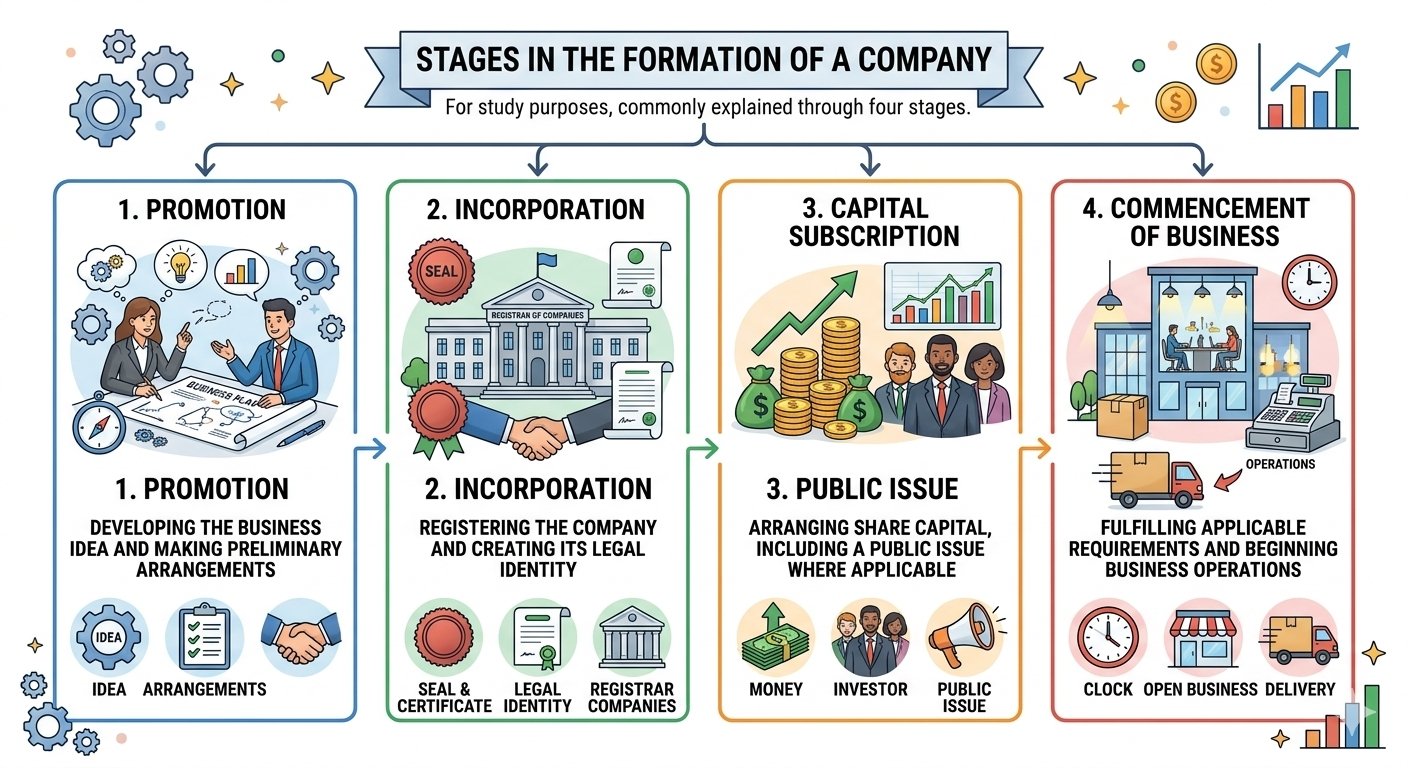
Important: Every company does not raise money from the public. Capital subscription as a public-issue stage applies only where the company chooses and is eligible to make a public offer.
3. Promotion
Promotion is the process of discovering a business opportunity, examining its feasibility and taking the steps necessary to form a company.
It is the planning and preparation stage.
Who Is a Promoter?
A promoter is a person who takes the initiative to establish a company and makes arrangements for its formation.
A promoter may be an individual, a group or an organization.
Example: People who develop the idea of a packaged-food company and organize its registration act as promoters.
A professional who merely provides professional assistance, such as preparing documents, does not become a promoter only because of that assistance.
4. Functions of Promoters
1. Identification of a Business Opportunity
Promoters identify a product or service that may satisfy a market need.
Example: They notice demand for affordable reusable water bottles.
2. Feasibility Studies
Promoters examine whether the proposed business can work successfully.
A. Technical Feasibility
Checks whether the required technology, machinery, materials and skills are available.
Question: Can the product actually be manufactured using available resources?
B. Financial Feasibility
Checks how much money is required and whether it can be arranged.
Question: Can the business obtain sufficient funds?
C. Economic Feasibility
Examines expected demand, costs, revenue and profitability.
Question: Is the proposal commercially worthwhile?
3. Selection and Approval of Name
Promoters select a suitable name and apply for its approval through the prescribed process.
4. Identification of Initial Members and Directors
They identify people willing to subscribe to the company’s formation documents and serve as its first directors.
5. Appointment of Professional Advisers
They may engage company secretaries, accountants, lawyers and other experts.
6. Preparation of Documents
They arrange the company’s constitutional documents, declarations and other information required for registration.
7. Preliminary Arrangements
They may identify premises, contact suppliers and negotiate arrangements needed for the proposed business.
Functions at a Glance
| Function | Main question |
|---|---|
| Identify opportunity | What business should be started? |
| Technical feasibility | Can it be operated technically? |
| Financial feasibility | Can the necessary funds be arranged? |
| Economic feasibility | Is it likely to be commercially worthwhile? |
| Select name | What will the company be called? |
| Identify people | Who will be the initial members and directors? |
| Prepare documents | What is needed for registration? |
5. Position and Responsibilities of Promoters
Promoters occupy a position of trust towards the company they are forming.
They should:
- Act honestly and in good faith.
- Disclose relevant interests in transactions.
- Avoid making undisclosed secret profits.
- Provide truthful information in formation documents.
- Follow applicable legal requirements.
Example: If a promoter sells personally owned property to the proposed company, the promoter’s interest should be properly disclosed.
Preliminary Contracts
Preliminary contracts are agreements made by promoters before the company is incorporated.
At this stage, the company does not yet legally exist. Therefore, these agreements do not automatically become binding company contracts merely because incorporation takes place. Their legal treatment requires the applicable rules and appropriate contractual arrangements.
Example: A promoter negotiates the rental of premises before registration.
6. Incorporation
Incorporation is the legal process of registering a company with the Registrar of Companies.
Once incorporated, the company comes into existence as a legal person separate from its members. Its legal existence begins on the date stated in its certificate of incorporation.
Registrar of Companies — ROC
The Registrar of Companies is the authority responsible for company registration and specified company records within its jurisdiction.
Main Steps in Incorporation
- Obtain approval of the proposed name through the prescribed process.
- Prepare the Memorandum and Articles of Association.
- Arrange details and required consent of the initial members and directors.
- Prepare identity, address and registered-office information.
- Submit the prescribed application, declarations and supporting documents.
- Pay the required fees.
- Receive the certificate of incorporation after the registration requirements are satisfied.
7. Important Documents Used in Incorporation
A. Memorandum of Association — MOA
The Memorandum of Association is a fundamental document defining the company’s constitution and the scope of its activities.
It sets out matters such as the company’s name, objects, liability and capital structure.
Main Clauses
| Clause | What it states |
|---|---|
| Name clause | The company’s name |
| Registered office clause | The state in which its registered office will be situated |
| Objects clause | The purposes for which the company is formed |
| Liability clause | The nature of members’ liability |
| Capital clause | Authorized share capital and its division into shares, where applicable |
| Subscription or association clause | Subscribers’ intention to form the company and their agreed share subscriptions |
Example: A school-furniture company’s objects may include manufacturing and selling furniture.
B. Articles of Association — AOA
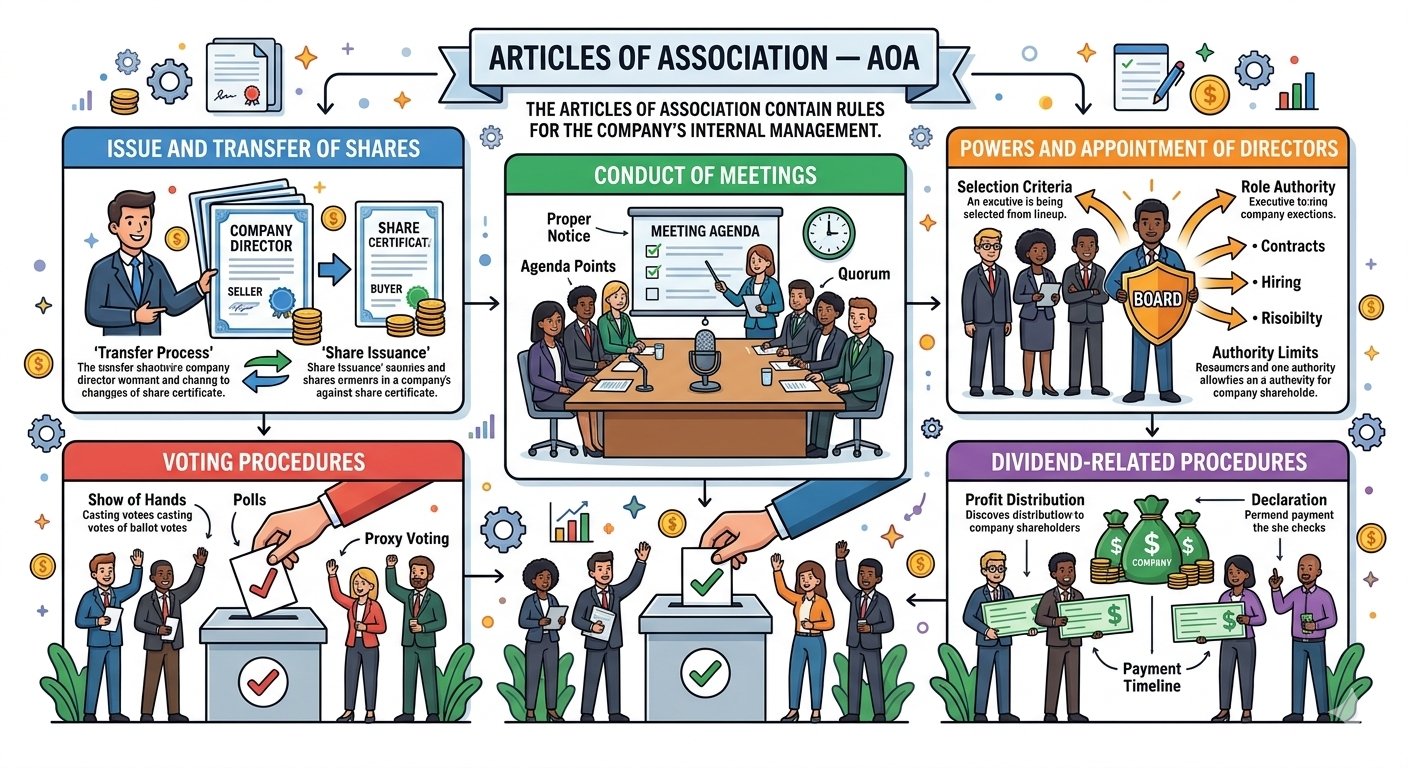
The Articles of Association contain rules for the company’s internal management.
They may cover:
- Issue and transfer of shares.
- Conduct of meetings.
- Powers and appointment of directors.
- Voting procedures.
- Dividend-related procedures.
MOA and AOA: Differences
| Basis | MOA | AOA |
|---|---|---|
| Main purpose | Defines the company’s constitution and objects | Provides internal management rules |
| Main question | What is the company formed to do? | How will the company be managed? |
| Position | A fundamental constitutional document | Must be consistent with the MOA and company law |
| Example | Object of manufacturing furniture | Rules for board meetings |
C. Other Required Information and Documents
These generally include:
- Particulars of subscribers and first directors.
- Required director consents.
- Identity and address evidence.
- Registered-office information and supporting evidence, as applicable.
- Declarations concerning compliance with formation requirements.
The Companies Act specifies the principal documents and information required for incorporation.
8. Certificate of Incorporation
The certificate of incorporation is the official certificate confirming that a company has been registered.
It records the company’s legal birth.
Importance
From incorporation, the company:
- Has a separate legal identity.
- Can own property in its own name.
- Can enter contracts through authorized persons.
- Can sue and be sued.
- Continues despite changes in its membership.
These effects arise from registration under the Companies Act.
Remember: Legal existence and permission to begin business are related but separate matters. Applicable commencement requirements must also be fulfilled.
9. Capital Subscription
Capital subscription means obtaining commitments and funds from people who agree to take the company’s shares.
A company may arrange capital from its initial subscribers or other permitted investors. An eligible public company may also raise funds through a public issue.
Where a Public Issue Is Made
The process broadly involves:
- Completing applicable approvals and issue arrangements.
- Preparing and issuing the required offer document.
- Receiving applications and subscription money.
- Allotting shares according to applicable requirements.
A prospectus is an offer document inviting the public to subscribe to securities and providing information needed to assess the offer.
Important: A prospectus is not a document that every company must issue when it is formed.
10. Commencement of Business
Commencement of business means beginning the company’s business activities after satisfying the applicable requirements.
Example: A registered furniture company begins accepting customer orders and manufacturing desks after completing the necessary arrangements.
Main Preparations
The company should arrange:
- Required capital and banking facilities.
- Premises, equipment and materials.
- Employees and management systems.
- Necessary licenses or sector-specific approvals.
- Applicable commencement filings.
- Accounting and operational procedures.
Current Indian Legal Position
For companies covered by Section 10A of the Companies Act, 2013, having share capital, business cannot commence and borrowing powers cannot be exercised until:
- A director files the required declaration within 180 days of incorporation, confirming that every subscriber has paid for the shares agreed to be taken; and
- The required verification of the registered office has been filed.
These requirements can apply to both private and public companies.
Study note: Older textbooks may describe a separate “certificate of commencement of business” for public companies and immediate commencement by private companies. That historical description should be distinguished from the applicable declaration-based requirements.
11. Promotion, Incorporation and Commencement: Differences
| Basis | Promotion | Incorporation | Commencement of Business |
|---|---|---|---|
| Meaning | Developing and organizing the business idea | Legally registering the company | Beginning business after applicable requirements are fulfilled |
| Main purpose | Assess and prepare the proposal | Create the company’s legal identity | Start operations |
| Main participants | Promoters and advisers | Applicants, professionals and ROC | Directors, managers and employees |
| Company’s position | Not yet incorporated | Comes into legal existence | Operates as an incorporated company |
| Main result | A workable formation proposal | Certificate of incorporation | Business activities begin |