Chapter 2: Forms of Business Organization Private, Public and Global Enter
Chapter 2
Forms of Business Organization Private, Public and Global Enter
1. Business Organization
A form of business organization is the legal and ownership structure under which a business operates. It determines who owns the business, who manages it, how profits are shared and who bears losses.
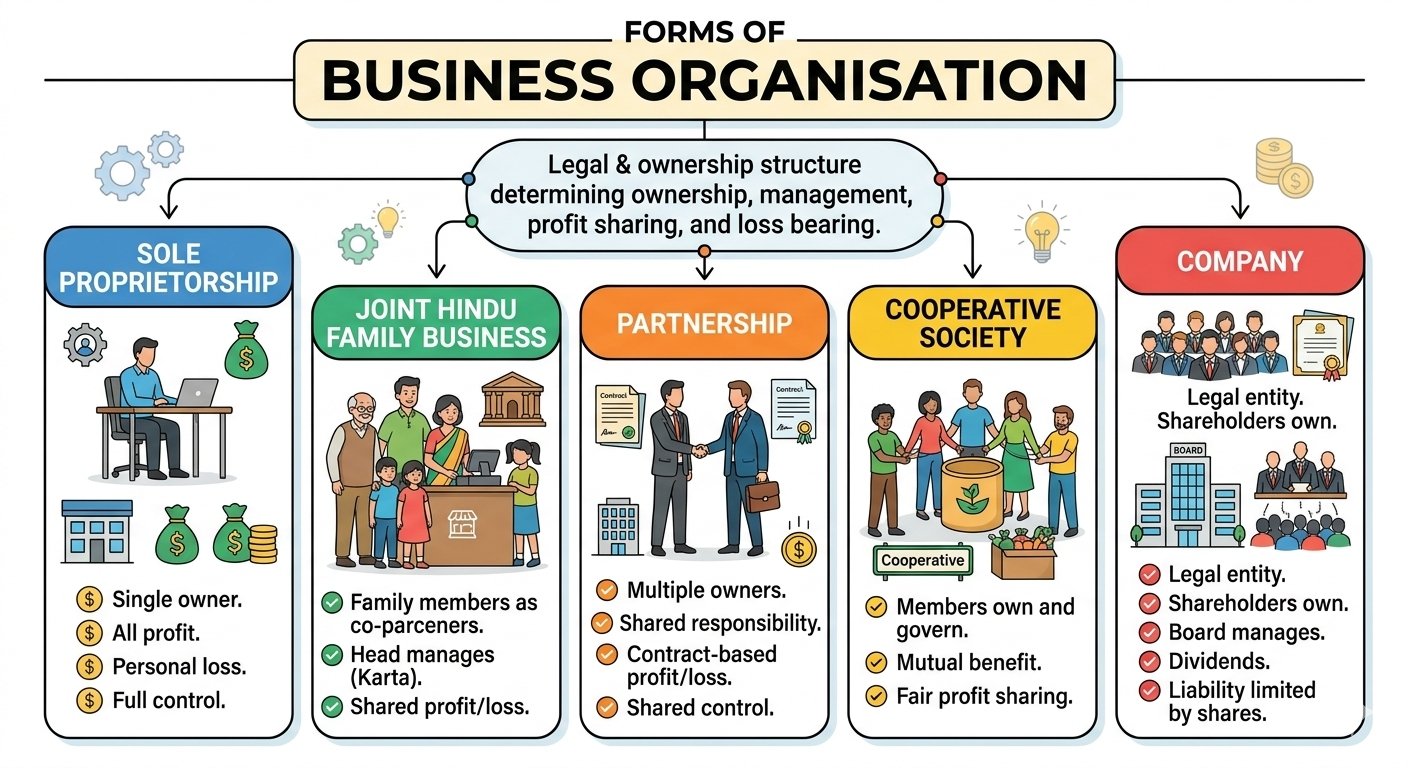
The main forms are:
- Sole proprietorship.
- Joint Hindu Family business.
- Partnership.
- Cooperative society.
- Company.
2. Sole Proprietorship
Sole proprietorship is a business owned, managed and controlled by one person. The owner receives all profits and bears all business risks.
Examples: A small grocery shop, a tailoring shop or a beauty parlour owned by one person.
Features
- Single ownership: One person owns the business and provides its capital.
- Single control: The owner takes all important decisions.
- No separate legal entity: The owner and the business are legally treated as one.
- Unlimited liability: If business assets cannot pay business debts, the owner’s personal assets may also be used.
- Sole risk bearer and profit recipient: The owner bears all losses and receives all profits.
- Easy formation and closure: There are relatively few formalities, although applicable licenses and registrations may be needed.
- Lack of continuity: The owner’s death, serious illness or incapacity may interrupt or end the business.
Merits
- Quick decisions: The owner does not need to consult other owners.
- Direct incentive: All profits belong to the owner, encouraging hard work.
- Confidentiality: Business information can remain private.
- Personal attention: The owner can maintain close relations with customers.
- Flexibility: Changes can be made quickly.
- Easy to establish: It is suitable for many small businesses.
- Sense of achievement: Successful operation gives the owner personal satisfaction.
Limitations
- Limited resources: Capital depends mainly on the owner’s savings and borrowing capacity.
- Unlimited liability: Personal property may be at risk.
- Limited managerial ability: One person may not be skilled in finance, marketing, production and other areas.
- Limited continuity: The business depends heavily on the owner.
- Heavy workload: The owner carries the main responsibility for managing the business.
Suitable for: Small businesses requiring limited capital, personal service and quick decisions.
3. Joint Hindu Family Business
A Joint Hindu Family business, also called a Hindu Undivided Family (HUF) business, is a business owned and carried on by members of a Hindu undivided family.
It is governed by Hindu law. The business is managed by the Karta, generally the senior-most coparcener.
A coparcener is a family member who has a birthright in the coparcenary property. Both sons and daughters can be coparceners.
Features
- Membership by birth: Coparcenary rights arise by birth, rather than through a partnership agreement.
- Family ownership: The business is carried on using joint family property.
- Control by the Karta: The Karta manages the business and takes major decisions.
- Different liability: The Karta has unlimited liability. Other coparceners’ liability is generally limited to their interest in the family property.
- Continuity: The death of a member does not automatically end the business. Another eligible member can become Karta.
- Minor members: A minor can have coparcenary rights by birth.
- No partnership agreement required: Its existence is based on family status and Hindu law.
Merits
- Effective control: Centralized authority allows quick decisions.
- Continuity: The business can continue across generations.
- Limited liability of other coparceners: Their separate personal assets are generally protected from business debts.
- Loyalty and cooperation: Family relationships may encourage commitment.
- Confidentiality: Important information can remain within the family.
Limitations
- Limited resources: Funds depend mainly on family property and borrowing capacity.
- Unlimited liability of the Karta: The Karta bears considerable financial risk.
- Dominance of the Karta: Other members may have little influence over management.
- Limited managerial ability: The Karta may lack the skills needed for a growing business.
- Possibility of family disputes: Disagreements may affect the business or lead to partition.
Suitable for: Family businesses supported by joint family property and cooperation among members.
4. Partnership
Partnership is the relationship between persons who agree to share the profits of a business carried on by all, or by any one of them acting for all.
The owners are called partners. Together, they are called a firm.
Example: Two people contribute capital and jointly operate a stationery shop.
Features
- Agreement: Partnership arises from an agreement between persons.
- Lawful business: It must involve a lawful business activity.
- Profit sharing: Partners agree to share business profits.
- Mutual agency: Each partner acts as both a principal and an agent. A partner’s authorized actions can bind the firm and the other partners.
- Unlimited liability: In an ordinary partnership, partners may have to use personal assets to pay business debts.
- Joint and individual responsibility: Partners can be held jointly and individually liable for the firm’s obligations.
- No separate legal personality: An ordinary partnership is not a separate legal person like a company.
- Continuity depends on agreement: Events such as death or insolvency of a partner may affect the firm’s continuation.
Most important feature: Mutual agency is the true test of partnership.
Partnership Deed
A partnership deed is a written document containing the terms and conditions agreed upon by the partners.
It usually includes:
- Name and address of the firm and partners.
- Nature and place of business.
- Capital contributed by each partner.
- Profit and loss sharing ratio.
- Duties, powers and responsibilities.
- Rules regarding drawings, interest and remuneration.
- Admission, retirement and death of partners.
- Settlement of disputes and dissolution.
A written deed helps prevent misunderstandings.
Types of Partnership
A. On the Basis of Duration
| Type | Meaning | Example |
|---|---|---|
| Partnership at will | Has no fixed duration; it continues according to the partners’ wishes | Partners open a shop without fixing an ending date |
| Particular partnership | Formed for a specific project, undertaking or period | Partners join to complete a construction project |
B. On the Basis of Liability
| Type | Meaning |
|---|---|
| General partnership | Partners generally have unlimited liability and mutual agency |
| Limited Liability Partnership (LLP) | A separate legal entity in which partners generally enjoy limited liability |
An LLP is a distinct legal structure. A partner remains responsible for their own wrongful acts, and limited liability does not protect fraud.
Registration of Partnership
Registration means recording the firm’s details with the Registrar of Firms.
For an ordinary partnership, registration is generally optional, but non-registration creates important legal disadvantages.
General Procedure
- Prepare the required application.
- Provide details such as the firm’s name, addresses, partners and date of joining.
- Obtain the required signatures and submit the application with the prescribed fee.
- The Registrar records the firm in the Register of Firms after checking the requirements.
Effects of Non-registration
Subject to legal exceptions:
- A partner cannot sue the firm or other partners to enforce contractual rights.
- The firm cannot sue a third party to enforce contractual rights.
- Certain claims of set-off are restricted.
However:
- Third parties can sue an unregistered firm.
- Rights to seek dissolution, accounts of a dissolved firm and realization of its property are not barred in the same way.
Remember: Non-registration does not make the business automatically illegal, but it restricts the enforcement of certain rights.
Merits of Partnership
- Easy formation: An ordinary partnership is relatively simple to establish.
- More resources: Partners can combine their capital and borrowing capacity.
- Better decisions: Partners bring different skills and experience.
- Sharing of risk: The burden of losses is shared among partners.
- Division of work: Duties can be assigned according to ability.
- Confidentiality: An ordinary firm generally faces fewer public disclosure requirements than a company.
Limitations of Partnership
- Unlimited liability: Personal assets may be used to settle business debts.
- Possibility of conflict: Differences over decisions or profit sharing may arise.
- Risk from other partners’ actions: An authorized act of one partner can bind the others.
- Limited resources compared with large companies: Raising very large amounts of capital may be difficult.
- Uncertain continuity: Changes in partners may affect the firm.
- Difficult transfer of ownership: A person cannot normally become a partner without the consent of existing partners.
Types of Partners
| Type | Meaning |
|---|---|
| Active partner | Contributes to and takes part in managing the business |
| Sleeping or dormant partner | Is a partner but does not take an active part in management |
| Secret partner | Is a partner, but their connection with the firm is not known to the public |
| Nominal partner | Lends their name to the firm without ordinarily contributing capital or sharing profits; may still be liable to outsiders |
| Partner by estoppel | By words or conduct, represents themselves as a partner and may become liable to a person who relies on that representation |
| Partner by holding out | Knowingly allows themselves to be represented as a partner and may become liable to those who rely on it |
Note: Estoppel and holding out are closely related ideas.
Minor Admitted to the Benefits of Partnership
A minor cannot become a full partner in an ordinary partnership. With the consent of all partners, a minor may be admitted to its benefits.
- The minor receives an agreed share of profits.
- The minor can inspect and copy the firm’s accounts.
- The minor is not personally liable for the firm’s debts, although their share in the firm is liable.
- On attaining majority, the person must decide whether to become a partner according to the applicable legal procedure.
5. Cooperative Societies
A cooperative society is a voluntary association of people who join together to protect and promote their common economic interests.
Its main aim is service to members, although it must earn enough to operate successfully.
Example: Farmers form a cooperative to purchase seeds and fertilizers at reasonable prices.
Features
- Voluntary membership: Eligible persons can generally join or leave according to the society’s rules.
- Separate legal entity: A registered cooperative has an identity separate from its members.
- Democratic control: The general principle is one member, one vote.
- Service motive: Members’ welfare is the main purpose.
- Limited liability: Members’ liability is generally limited according to the applicable law and society’s constitution.
- Registration: Registration is required to operate as a registered cooperative society.
Types of Cooperative Societies
| Type | Main purpose | Example |
|---|---|---|
| Consumer cooperative | Supplies goods to members at reasonable prices and reduces dependence on middlemen | A cooperative consumer store |
| Producer cooperative | Helps small producers obtain inputs, equipment and other support | A cooperative of artisans |
| Marketing cooperative | Collects and sells members’ products to obtain better prices | A farmers’ produce marketing society |
| Farmers’ cooperative | Helps members improve farming through joint facilities or coordinated operations | Farmers sharing machinery and irrigation facilities |
| Credit cooperative | Provides loans and encourages saving among members | A cooperative credit society |
| Housing cooperative | Helps members obtain housing, plots or related facilities | A cooperative housing society |
Merits
- Democratic management: Voting power is generally based on membership rather than capital.
- Limited liability: Members’ personal financial risk is generally restricted.
- Continuity: Changes in membership do not normally end the society.
- Economy in operations: Bulk purchases and shared facilities can reduce costs.
- Support for weaker sections: Members can improve their bargaining power.
- Government support: Eligible societies may receive assistance or concessions.
- Ease of formation: Formation is relatively simple when the legal requirements are met.
Limitations
- Limited resources: Members may have limited capacity to contribute capital.
- Management difficulties: The society may struggle to attract experienced managers.
- Lack of motivation: Limited financial rewards may reduce some members’ involvement.
- Conflicts: Personal interests and group differences can delay decisions.
- Regulatory interference: Extensive supervision may reduce operational freedom.
- Limited secrecy: Reporting and discussion among members may make confidentiality difficult.
6. Company
A company is an organization incorporated under company law. It has a legal identity separate from its owners.
In a company limited by shares, the owners are called shareholders, and management is generally entrusted to a board of directors.
Main Features
- Separate legal entity: The company can own property, enter contracts, sue and be sued in its own name.
- Artificial legal person: It is created by law and acts through people authorized to represent it.
- Limited liability: In a company limited by shares, shareholders’ liability is generally limited to the unpaid amount on their shares.
- Perpetual succession: Changes in shareholders do not end the company.
- Separation of ownership and management: Shareholders own the company, while directors oversee its management.
- Transfer of shares: Transfer rules depend on the type of company.
- Legal formalities: Incorporation and continuing compliance are required.
Private Limited Company
A private limited company restricts the transfer of its shares and cannot invite the public to subscribe to its securities.
It is often suitable for businesses owned by a small group, family or selected investors.
Public Limited Company
A public limited company can raise funds from the public subject to legal requirements.
A public company may be listed or unlisted. Its shares are traded on a stock exchange only if it is listed.
Private Limited and Public Limited Companies: Key Differences
| Basis | Private Limited Company | Public Limited Company |
|---|---|---|
| Ownership | Usually held by a smaller, selected group | Can have a broad shareholder base |
| Invitation to the public | Cannot invite the public to subscribe to securities | May invite the public, subject to legal requirements |
| Transfer of shares | Restricted by its articles | Generally more freely transferable, subject to law |
| Raising capital | Mainly through selected investors and borrowing | Has wider opportunities, including public issues |
| Compliance | Generally fewer requirements than a public company | Generally more extensive requirements |
| Name ending | Usually “Private Limited” | Usually “Limited” |
Merits of a Private Limited Company
- Limited liability: Shareholders’ personal financial risk is generally restricted.
- Continuity: The company continues despite changes in ownership.
- Control: Restrictions on share transfers help a selected group retain ownership.
- Access to investment: It can raise funds from selected investors.
- Relatively greater flexibility: It generally faces fewer compliance requirements than a public company.
Limitations of a Private Limited Company
- Restricted capital raising: It cannot invite the public to subscribe to securities.
- Restricted share transfer: Shareholders may find it difficult to sell their shares.
- Formation and compliance costs: Accounts, filings and other obligations require time and money.
- Less secrecy than an unincorporated business: Certain information must be filed with authorities.
- Possible disputes: Conflicts may arise among shareholders or directors.
Merits of a Public Limited Company
- Large financial resources: It has wider opportunities to raise capital.
- Limited liability: Shareholders’ liability is generally restricted.
- Continuity: Its existence is independent of individual shareholders.
- Professional management: Greater resources can help attract specialized managers.
- Transferability: Shares are generally more transferable; listed shares can be traded through stock exchanges.
- Scope for expansion: It is suitable for large operations.
Limitations of a Public Limited Company
- Difficult and costly formation: Establishment requires substantial legal formalities.
- Extensive compliance: Reporting, disclosure and governance requirements are significant.
- Reduced secrecy: More business information must be disclosed.
- Possible delay in decisions: Formal procedures may slow some decisions.
- Separation of ownership and control: Managers’ interests may differ from shareholders’ interests.
- Possible conflicts of interest: Different stakeholder groups may have competing demands.
7. Choice of Form of Business Organization
There is no single form suitable for every business. The choice depends on the following factors.
1. Cost and Ease of Formation
A small business with limited funds may prefer sole proprietorship because it is relatively simple to establish.
2. Liability
If owners want to limit their personal financial exposure, a company or LLP may be more suitable than an ordinary partnership or sole proprietorship.
3. Continuity
A company is useful when the business should continue independently of changes in its owners.
4. Management Ability
A complex business may require several people with different skills or professional managers.
5. Capital Requirements
A small shop may need limited funds. A large manufacturing business may require a structure that can attract substantial investment.
6. Degree of Control
A person who wants complete control may prefer sole proprietorship. Those willing to share control may choose partnership or a company.
7. Nature of Business
Businesses requiring close personal attention may suit sole proprietorship. Large operations may suit a company.
8. Flexibility and Secrecy
Small ownership structures can often make changes quickly and keep more information private.
9. Legal and Tax Requirements
Owners should consider the registrations, reporting duties, taxes and other requirements applicable to each form.
10. Future Expansion
The form should support likely growth, additional investment and changes in ownership.
8. Starting a Business: Basic Factors
Before starting a business, an entrepreneur should examine the following factors.
1. Selection of the Line of Business
Choose the product or service to offer after studying customer needs, demand, competition and personal skills.
Example: A stationery shop near a school may have a regular customer base.
2. Size of the Business
Decide whether to begin on a small, medium or large scale.
The decision depends on available funds, expected demand, experience and the level of risk.
3. Choice of Form of Ownership
Select an appropriate form, such as sole proprietorship, partnership, cooperative society or company.
Consider control, capital, liability and continuity.
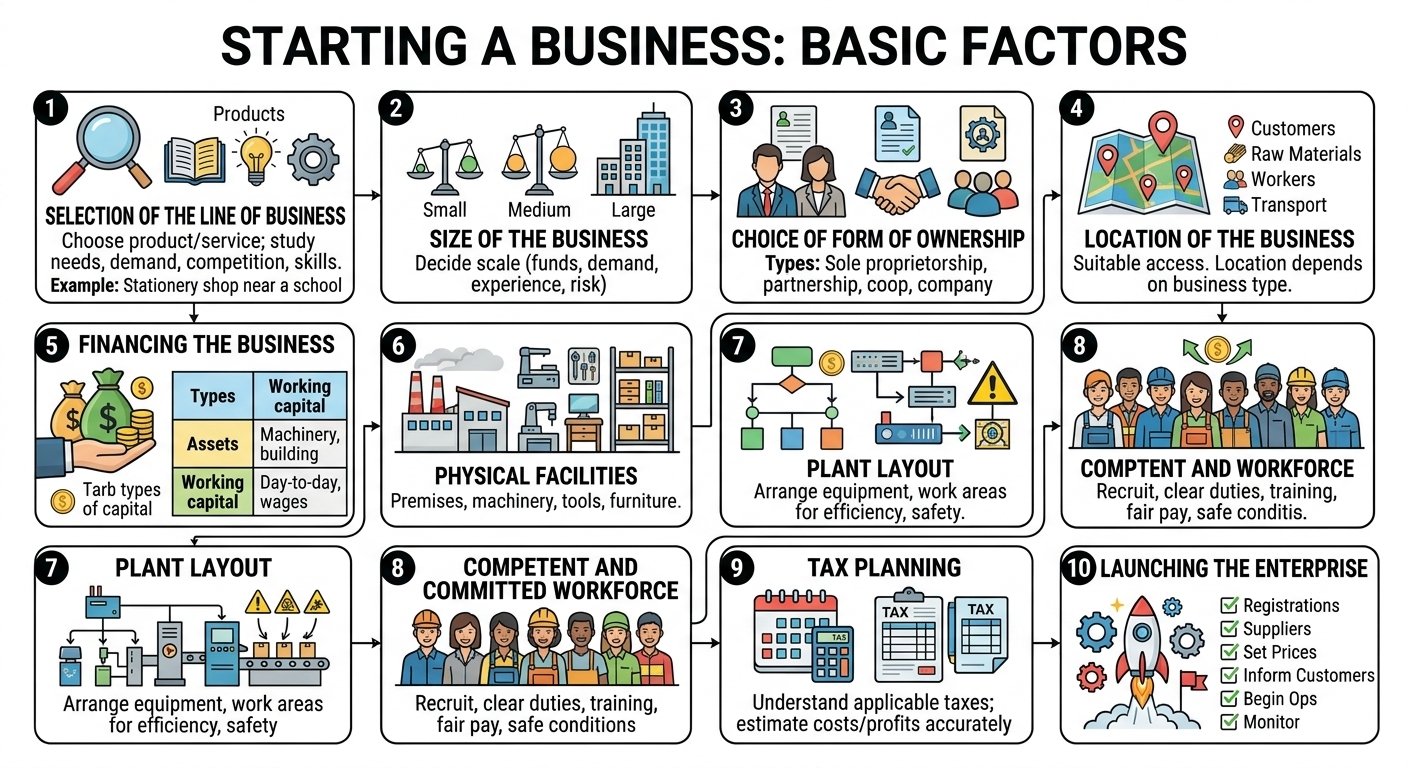
4. Location of the Business
Choose a place with suitable access to:
- Customers and markets.
- Raw materials.
- Workers.
- Transport.
- Electricity, water and other facilities.
The best location depends on the type of business.
5. Financing the Business
Estimate how much money is needed and how it will be arranged.
| Type of capital | Purpose | Examples |
|---|---|---|
| Fixed capital | Buying assets used for a long period | Machinery, furniture and buildings |
| Working capital | Meeting day-to-day operating needs | Stock purchases, wages and electricity bills |
6. Physical Facilities
Arrange suitable premises, equipment, machinery, storage, furniture and other necessary facilities.
7. Plant Layout
For a production business, decide how machines, equipment and work areas should be arranged.
A good layout reduces unnecessary movement, saves time and improves safety.
8. Competent and Committed Workforce
Recruit people with suitable skills and provide clear duties, training, fair pay and safe working conditions.
9. Tax Planning
Understand the applicable taxes and plan to meet them correctly. Tax obligations should be included when estimating costs and expected profits.
10. Launching the Enterprise
Once the arrangements are ready:
- Complete necessary registrations and permissions.
- Arrange suppliers and supplies.
- Set prices.
- Inform potential customers.
- Begin operations and monitor performance.