Chapter 1: Business, Trade and Commerce
Chapter 1
Business, Trade and Commerce
1. Concept of Business
Business is an economic activity in which goods or services are regularly produced, purchased or sold to earn profit.
For example, a bakery sells cakes, a factory manufactures furniture, and a transport company carries passengers or goods.
Characteristics of Business
Economic activity: Business is carried out to earn money or a livelihood. Cooking for your family is not business, but cooking and selling meals is business.
Production or purchase of goods and services: A business either produces goods or purchases them for resale. It may also provide services such as banking, transport or insurance.
Sale or exchange: Goods and services must be sold or exchanged for value. Making a table for personal use is not business; making tables for sale is business.
Regular dealings: Business involves repeated transactions. Selling your old bicycle once is normally not a business activity.
Profit motive: An important aim of business is to earn profit. Profit helps the business survive and grow.
Uncertainty of return: Business income is not fixed. A business may earn a profit, suffer a loss or recover only its costs.
Element of risk: Every business faces the possibility of loss because of changes in demand, competition, theft, accidents and other events.
2. Business, Profession and Employment
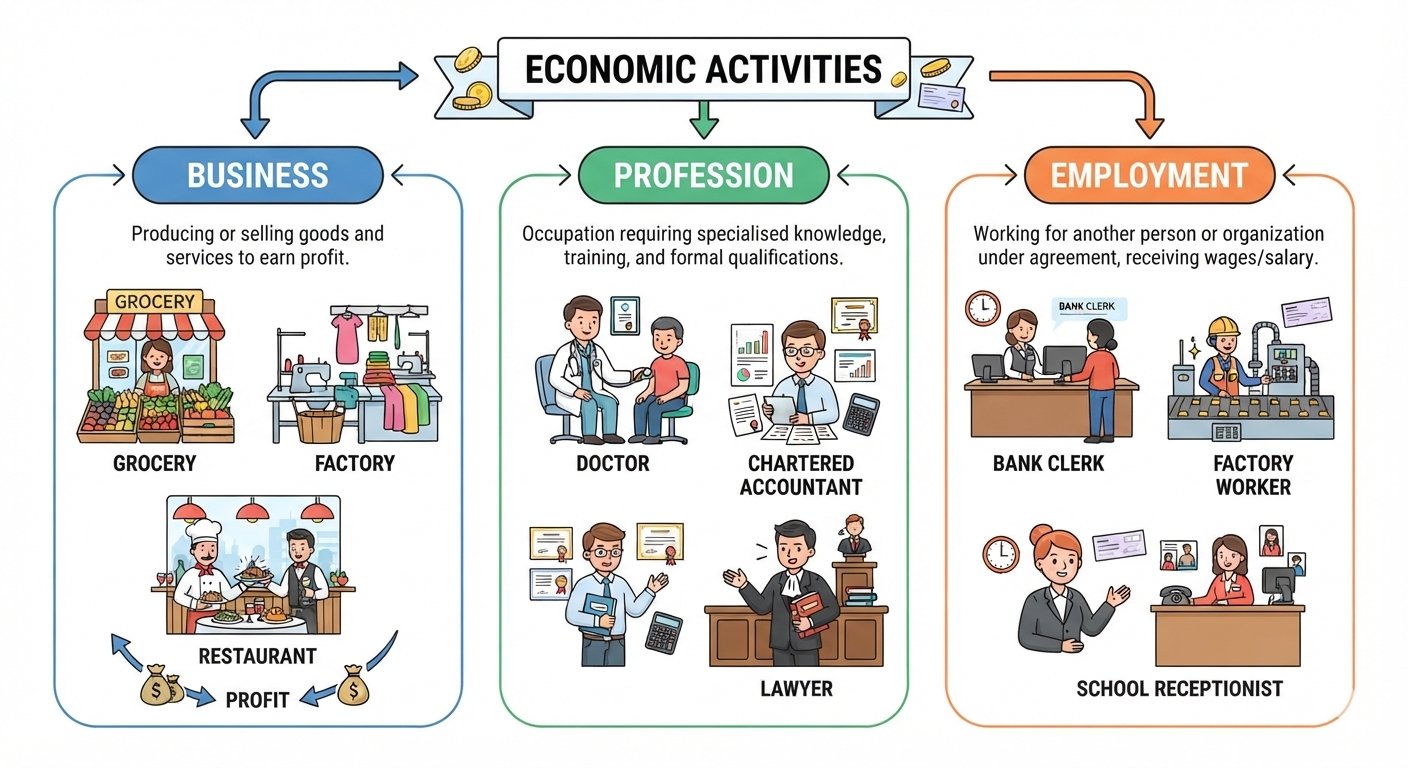
Economic activities are commonly divided into business, profession and employment.
Business
Business involves producing or selling goods and services to earn profit.
Examples: A grocery shop, a clothing factory and a restaurant.
Profession
A profession is an occupation that requires specialized knowledge, training and usually a formal qualification.
Examples: A doctor, a chartered accountant and a lawyer.
Employment
Employment means working for another person or organization under an agreement and receiving wages or salary.
Examples: A bank clerk, a factory worker and a school receptionist.
Distinctive Features
| Basis | Business | Profession | Employment |
|---|---|---|---|
| How it starts | By deciding to start an enterprise and completing required formalities | By obtaining required qualifications and fulfilling professional requirements | By receiving an appointment and accepting employment terms |
| Nature of work | Producing or supplying goods and services | Providing specialized expert services | Performing duties assigned by the employer |
| Qualification | No single qualification is compulsory for all businesses | Specialized qualification and training are generally required | Depends on the job |
| Income | Profit | Professional fee | Salary or wages |
| Capital needed | Depends on the size and type of business | Usually needed to establish a practice | Employees normally do not invest capital in the employer’s business |
| Risk of income | Profit is uncertain; losses are possible | Earnings may vary and involve some uncertainty | Pay is generally agreed in advance, although job security may vary |
| Rules of conduct | Business laws and ethical practices | Professional code of conduct | Service rules and employment contract |
| Transfer of interest | Ownership may be transferred, subject to conditions | A professional qualification or right to practice cannot simply be transferred | A job cannot be transferred by the employee to another person |
Remember: The arrangement matters. A doctor running an independent clinic is practicing a profession; a doctor working for a hospital on salary is also in employment.
3. Objectives of Business
Business objectives are the results that a business wants to achieve. A business needs both economic objectives and social objectives.
A. Economic Objectives
These objectives relate to the survival, performance and growth of the business.
1. Earning Profit
A business must earn enough profit to continue operating, reward its owners and support future growth.
2. Creating and Retaining Customers
Customers bring revenue to a business. A business should understand their needs and provide satisfactory goods and services.
3. Market Standing
Market standing means the position of a business compared with its competitors. A business aims to build a good reputation and a strong customer base.
4. Innovation
Innovation means introducing new ideas or improving existing products and methods.
Example: A bakery introduces healthier snacks or starts online ordering.
5. Improving Productivity
Productivity means the amount of output produced using a given amount of resources.
Example: Producing more notebooks with the same quantity of paper by reducing wastage.
6. Efficient Use of Resources
A business should use money, materials, machinery and workers efficiently. It must also arrange sufficient funds and physical resources for its activities.
B. Social Objectives
A business operates within society and should contribute to its welfare.
- Provide quality goods at fair prices: Supply safe and useful products at reasonable prices.
- Follow fair trade practices: Avoid false advertising, adulteration, hoarding and other dishonest practices.
- Create employment: Provide opportunities for people to earn a livelihood.
- Care for employees: Offer fair wages, safe working conditions and respectful treatment.
- Protect the environment: Control pollution, reduce waste and use resources responsibly.
- Support community welfare: Contribute to education, health, skill development and other useful activities.
- Follow laws and pay taxes honestly: Fulfil legal responsibilities towards society and government.
Role of Profit in Business
Profit is the amount left when total revenue exceeds total cost.
Profit = Total Revenue − Total Cost
For example, if a shop’s revenue is ₹80,000 and its total cost is ₹65,000, its profit is ₹15,000.
Profit is important because it:
- Supports survival: A business needs earnings to continue for a long period.
- Finances growth: Retained profit can help buy machinery, open branches or introduce products.
- Rewards risk: Owners invest resources without a guarantee of success.
- Indicates performance: Profit is one useful measure of business performance.
- Helps attract funds: A profitable business may find it easier to attract investors and lenders.
- Encourages improvement: The possibility of profit motivates businesses to innovate and work efficiently.
Key point: Profit is essential, but a business should earn it through fair methods while meeting its responsibilities towards society.
4. Classification of Business Activities
Business activities are broadly classified into industry and commerce.
| Activity | Main function | Example |
|---|---|---|
| Industry | Produces or processes goods, extracts resources, or constructs structures | Mining, manufacturing and construction |
| Commerce | Helps goods and services move from producers to consumers | Trade, transport, banking and warehousing |
Example: Manufacturing shoes is an industrial activity. Transporting, storing, advertising and selling those shoes are commercial activities.
5. Industry and Its Types
Industry includes activities concerned with extracting resources, producing or processing goods, and constructing buildings and other structures.
Industries are commonly classified into primary, secondary and tertiary industries.
A. Primary Industry
Primary industries obtain products from nature or reproduce and develop living organisms.
They are of two main types:
1. Extractive Industry
These industries obtain resources from natural sources.
Examples: Mining, fishing, hunting and forestry.
2. Genetic Industry
These industries breed, reproduce or grow plants and animals.
Examples: Plant nurseries, poultry breeding, cattle breeding and fish hatcheries.
B. Secondary Industry
Secondary industries process materials obtained from primary industries or construct buildings and infrastructure.
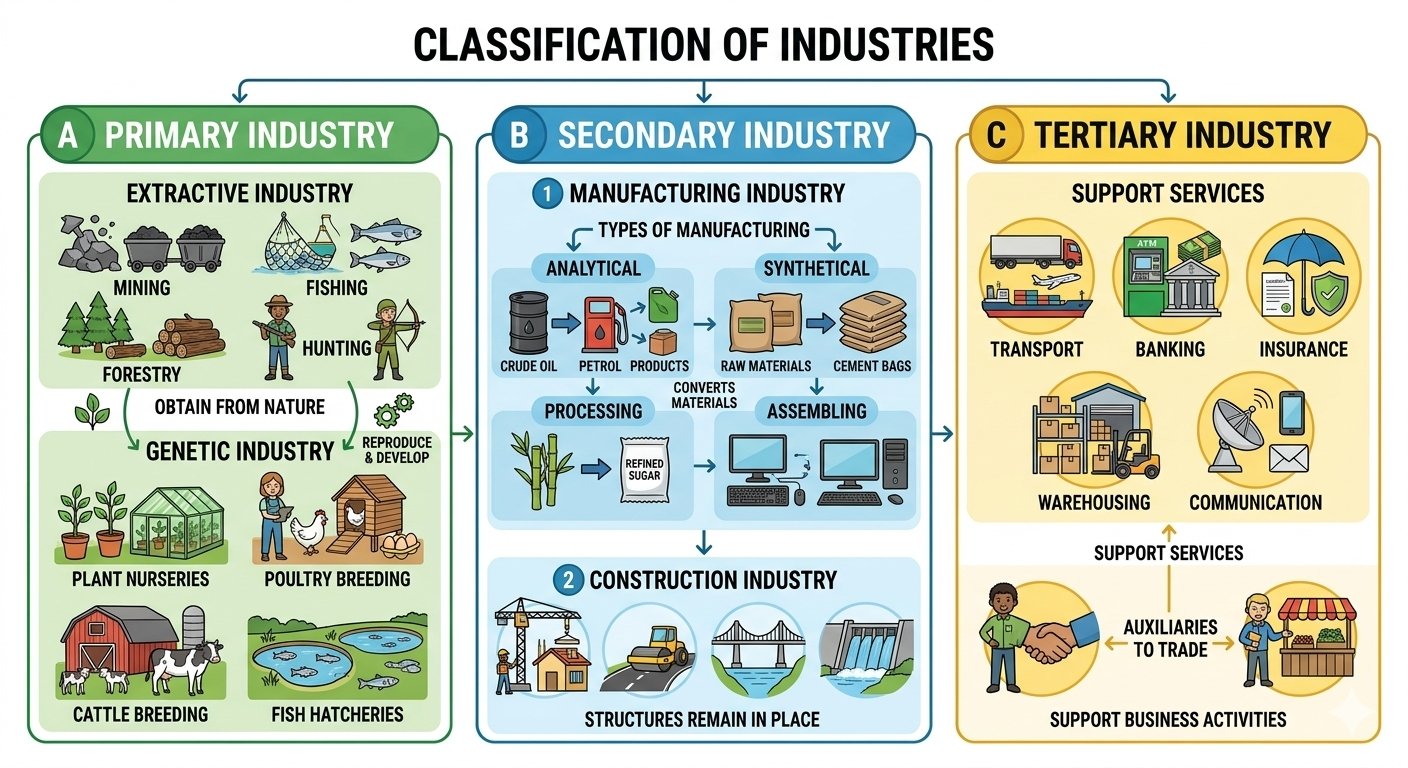
They are divided into:
1. Manufacturing Industry
Manufacturing converts raw materials or partly finished materials into useful products.
Examples: Making cloth from cotton and furniture from wood.
Manufacturing industries can be further classified as follows:
| Type | Meaning | Example |
|---|---|---|
| Analytical | Separates one material into different products | An oil refinery separates crude oil into petrol, diesel and other products |
| Synthetical | Combines different materials to make a product | Cement manufacturing |
| Processing | Takes material through successive stages of production | Sugar manufacturing |
| Assembling | Joins different components to make a finished product | Manufacturing computers or cars |
2. Construction Industry
Construction industries build structures and infrastructure.
Examples: Houses, roads, bridges, dams and tunnels.
The final structures generally remain at the place where they are built.
C. Tertiary Industry
Tertiary industries provide services that support primary and secondary industries and help business activities run smoothly.
Examples: Transport, banking, insurance, warehousing and communication.
Many of these services also form part of the auxiliaries to trade studied under commerce.
6. Commerce
Commerce includes trade and all activities that help the exchange of goods and services between producers and consumers.
Commerce = Trade + Auxiliaries to Trade
Commerce connects producers with customers and removes difficulties in buying and selling.
For example, a manufacturer may need transport to deliver goods, a warehouse to store them, a bank to provide finance and advertising to inform buyers.
7. Trade
Trade means buying and selling goods and services for value.
Trade is broadly divided into internal trade and external trade.
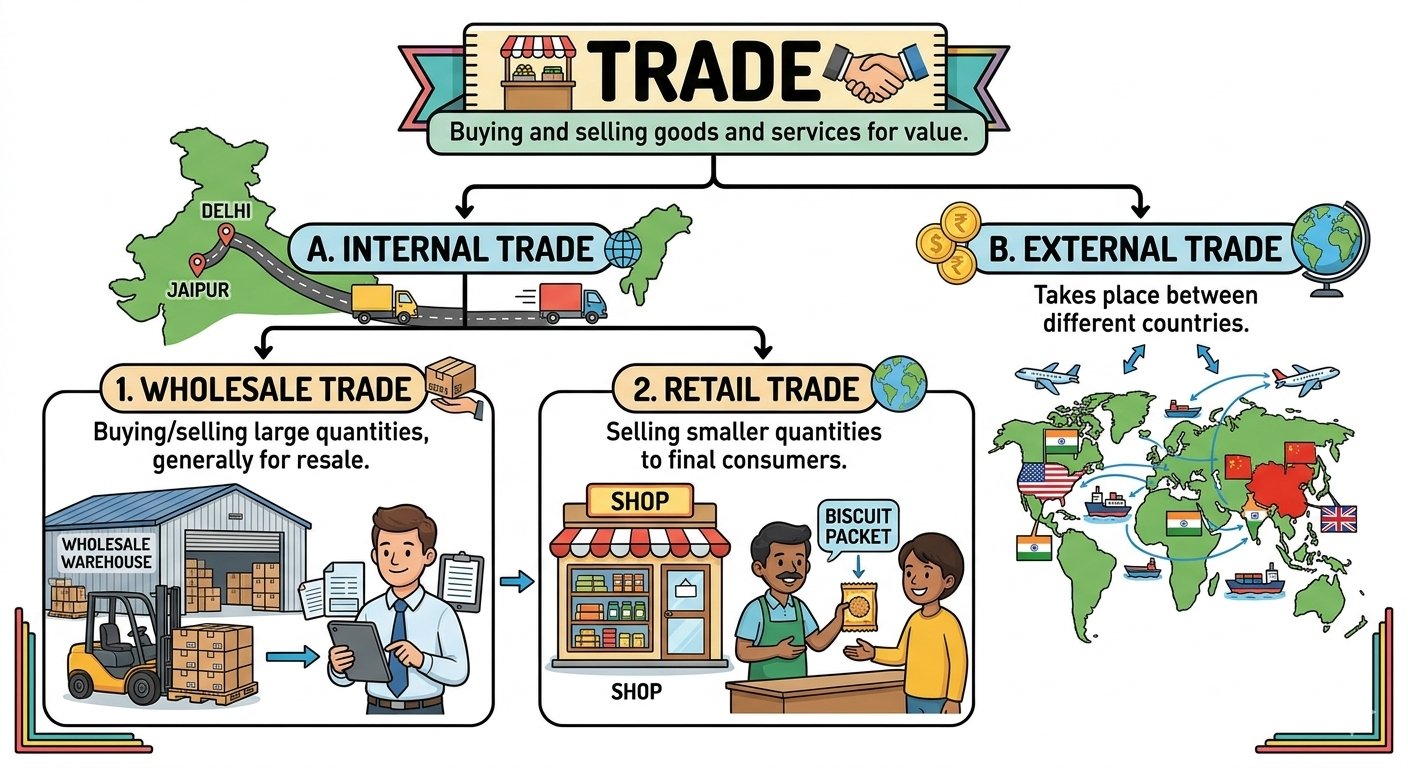
A. Internal Trade
Internal trade takes place within the boundaries of one country.
Example: A seller in Delhi supplies goods to a buyer in Jaipur.
Its main types are:
| Type | Meaning | Example |
|---|---|---|
| Wholesale trade | Buying and selling goods in large quantities, generally for resale or business use | A wholesaler supplies cartons of biscuits to shops |
| Retail trade | Selling goods to final consumers, usually in smaller quantities | A shop sells a packet of biscuits to a customer |
B. External Trade
External or foreign trade takes place between different countries.
| Type | Meaning | Example |
|---|---|---|
| Import trade | Buying goods from another country | An Indian business buys machinery from Germany |
| Export trade | Selling goods to another country | An Indian business sells tea to the UK |
| Entrepôt trade | Importing goods for the purpose of exporting them to another country | An Indian trader imports goods from one country and re-exports them to another |
8. Auxiliaries to Trade
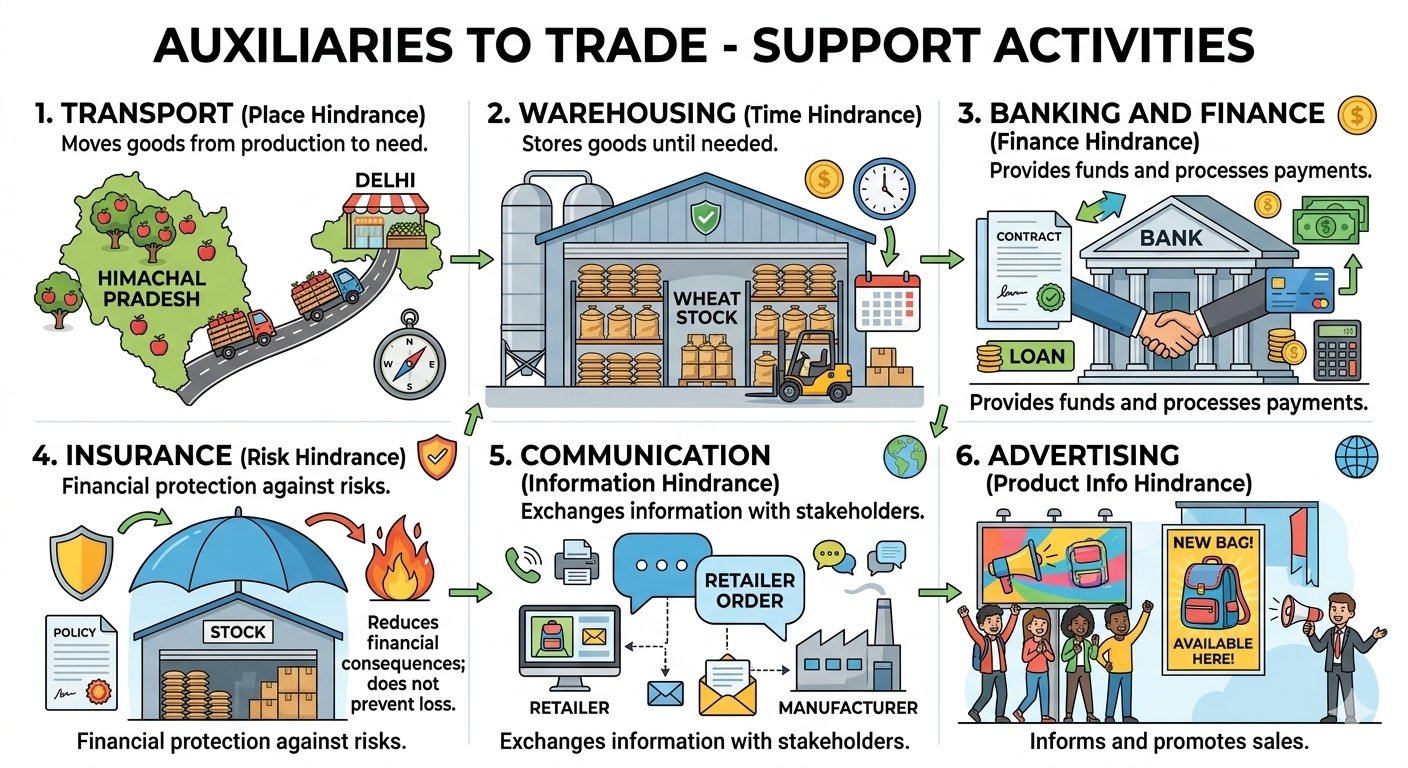
Auxiliaries to trade are activities that support and facilitate trade.
They remove the difficulties, also called hindrances, that arise in the exchange of goods and services.
1. Transport
Transport moves goods from the place of production to the place where they are needed.
Hindrance removed: Place.
Example: Carrying apples from Himachal Pradesh to Delhi.
2. Warehousing
Warehousing stores goods safely until they are needed or sold.
Hindrance removed: Time.
Example: Storing wheat after harvest so that it can be supplied throughout the year.
3. Banking and Finance
Banks and other financial institutions help businesses obtain funds and make or receive payments.
Hindrance removed: Finance.
Example: A bank provides a loan to purchase machinery.
4. Insurance
Insurance provides financial protection against specified risks according to the terms of an insurance policy.
Hindrance reduced: Financial consequences of certain risks.
Example: Fire insurance may compensate a business for covered damage to its stock.
Insurance does not prevent every loss or cover every business risk.
5. Communication
Communication allows businesses to exchange information with customers, suppliers and others.
Hindrance removed: Difficulty in exchanging information.
Example: A retailer emails an order to a manufacturer.
6. Advertising
Advertising informs potential customers about products and services and helps promote their sale.
Hindrance removed: Lack of product information.
Example: An advertisement tells customers about a new school bag and where to buy it.
Quick Revision Table
| Activity | Main difficulty removed or reduced |
|---|---|
| Trade | Difficulty in connecting buyers and sellers |
| Transport | Place |
| Warehousing | Time |
| Banking and finance | Lack of funds and payment facilities |
| Insurance | Financial consequences of specified risks |
| Communication | Difficulty in exchanging information |
| Advertising | Lack of awareness about products |
9. Business Risk
Business risk means the possibility of inadequate profits or losses because of uncertainties or unexpected events.
For example, a shopkeeper buys winter clothes expecting cold weather. If the winter is unusually warm, sales may fall and the shopkeeper may suffer a loss.
Nature or Characteristics of Business Risk
1. Risk Arises from Uncertainty
The future cannot be predicted with complete accuracy. Demand, prices, technology and government policies may change.
2. Risk Is an Essential Part of Business
Every business involves some risk. Careful planning can reduce risk, but cannot remove it completely.
3. Risk Depends on the Nature and Size of Business
Different businesses face different levels and types of risk.
Examples:
- A fashion business faces the risk of rapidly changing tastes.
- A business dealing in perishable food faces the risk of spoilage.
- A large business may have more money exposed to loss than a small business.
4. Profit Is the Reward for Risk Taking
Business owners accept uncertainty in the hope of earning profit. However, taking a greater risk does not guarantee a greater profit.
Types of Business Risk
| Type | Meaning | Examples |
|---|---|---|
| Speculative risk | Involves the possibility of either gain or loss | Changes in demand, selling prices or fashion |
| Pure risk | Involves the possibility of loss or no loss, without an opportunity for gain from the event | Fire, theft or an accident |
Causes of Business Risk
A. Natural Causes
Risks caused by natural events.
Examples: Floods, earthquakes, droughts and storms.
Effect: Damage to factories, crops, stock or transport routes.
B. Human Causes
Risks arising from human actions, mistakes or behavior.
Examples: Theft, dishonesty, negligence, strikes and riots.
Effect: Loss of goods, disruption of production or damage to property.
C. Economic Causes
Risks caused by changes in economic and market conditions.
Examples:
- Fall in demand.
- Increase in raw material costs.
- Stronger competition.
- Changes in consumer tastes.
- Failure of customers to pay.
- Changes in technology.
Effect: Higher costs, lower sales or reduced profits.
D. Other Causes
Risks arising from events such as political disturbances, changes in government policy, exchange rate fluctuations or mechanical failures.
Example: A machine breakdown stops production and delays deliveries.
10. Important Differences
Industry and Commerce
| Basis | Industry | Commerce |
|---|---|---|
| Main purpose | Production, processing, extraction or construction | Exchange and distribution of goods and services |
| Main activities | Mining, manufacturing and construction | Trade and auxiliaries to trade |
| Utility mainly created | Form utility through manufacturing and processing | Place and time utility through transport and storage |
| Example | Manufacturing school bags | Transporting, storing, advertising and selling school bags |
Trade and Commerce
| Basis | Trade | Commerce |
|---|---|---|
| Meaning | Buying and selling goods and services | Trade and the activities that support it |
| Scope | Narrower | Wider |
| Includes | Internal and external trade | Trade, transport, banking, insurance and other supporting activities |
| Relationship | A part of commerce | Includes trade |