Chapter 4: Business Services
Chapter 4
Business Services
1. Meaning of Business Services
Business services are activities that support the production, purchase, sale and distribution of goods and help businesses operate smoothly.
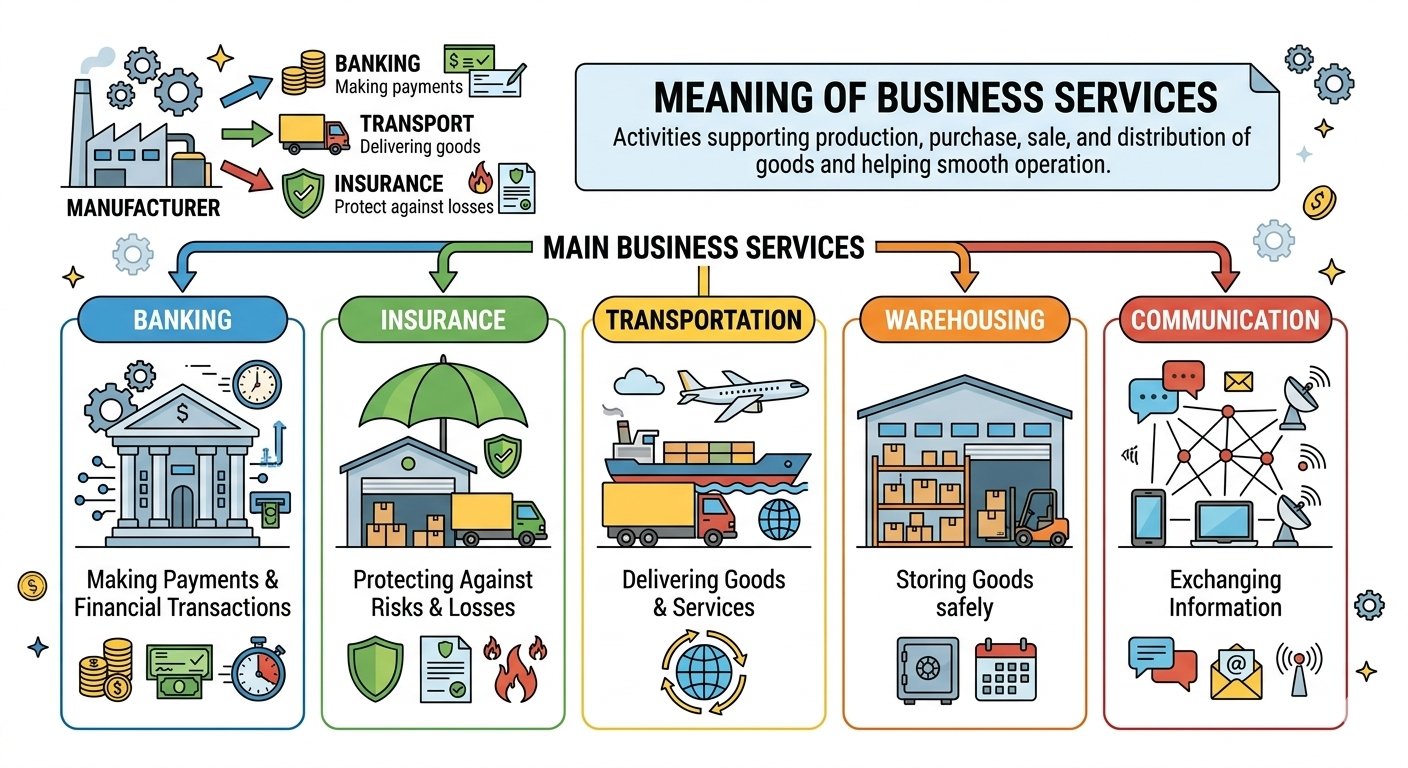
For example, a manufacturer needs banking to make payments, transport to deliver goods and insurance to protect against certain losses.
The main business services are:
- Banking.
- Insurance.
- Transportation.
- Warehousing.
- Communication.
2. Nature or Characteristics of Services
1. Intangibility
Services cannot be touched or physically examined like goods. Their quality is usually experienced when they are provided.
Example: A customer experiences the quality of a bank’s service while using it.
2. Inconsistency or Variability
The quality of a service may vary according to the person providing it, the time and the circumstances.
Example: Customer service may differ between two branches of the same business.
3. Inseparability
Many services are produced and consumed at the same time. The service provider and the customer often need to interact.
Example: A haircut is provided and received at the same time.
4. Inventory Cannot Be Stored
Services cannot generally be stored for later sale.
Example: An empty seat on a bus journey cannot be stored and sold after that journey ends.
This characteristic is also called perishability.
5. Customer Involvement
Customers often participate in the delivery of a service by providing information, instructions or preferences.
Example: A business tells its bank the amount and beneficiary details for a payment.
Goods and Services: Difference
| Basis | Goods | Services |
|---|---|---|
| Nature | Tangible | Intangible |
| Storage | Many goods can be stored | Service capacity generally cannot be stored |
| Ownership | Ownership can be transferred | Usually provides a benefit without ownership of a physical item |
| Production and consumption | Usually occur separately | Often occur together |
| Uniformity | Can often be standardized | Quality may vary |
3. Types of Services
Services can broadly be classified into three categories.
| Type | Meaning | Example |
|---|---|---|
| Business services | Support business activities | Banking, insurance and transport |
| Social services | Promote social welfare, often without profit as the main aim | Charitable healthcare and community education |
| Personal services | Meet individual needs and preferences | Beauty treatments and personal fitness training |
The same service may serve different purposes. For example, transport can be used for a business delivery or a personal journey.
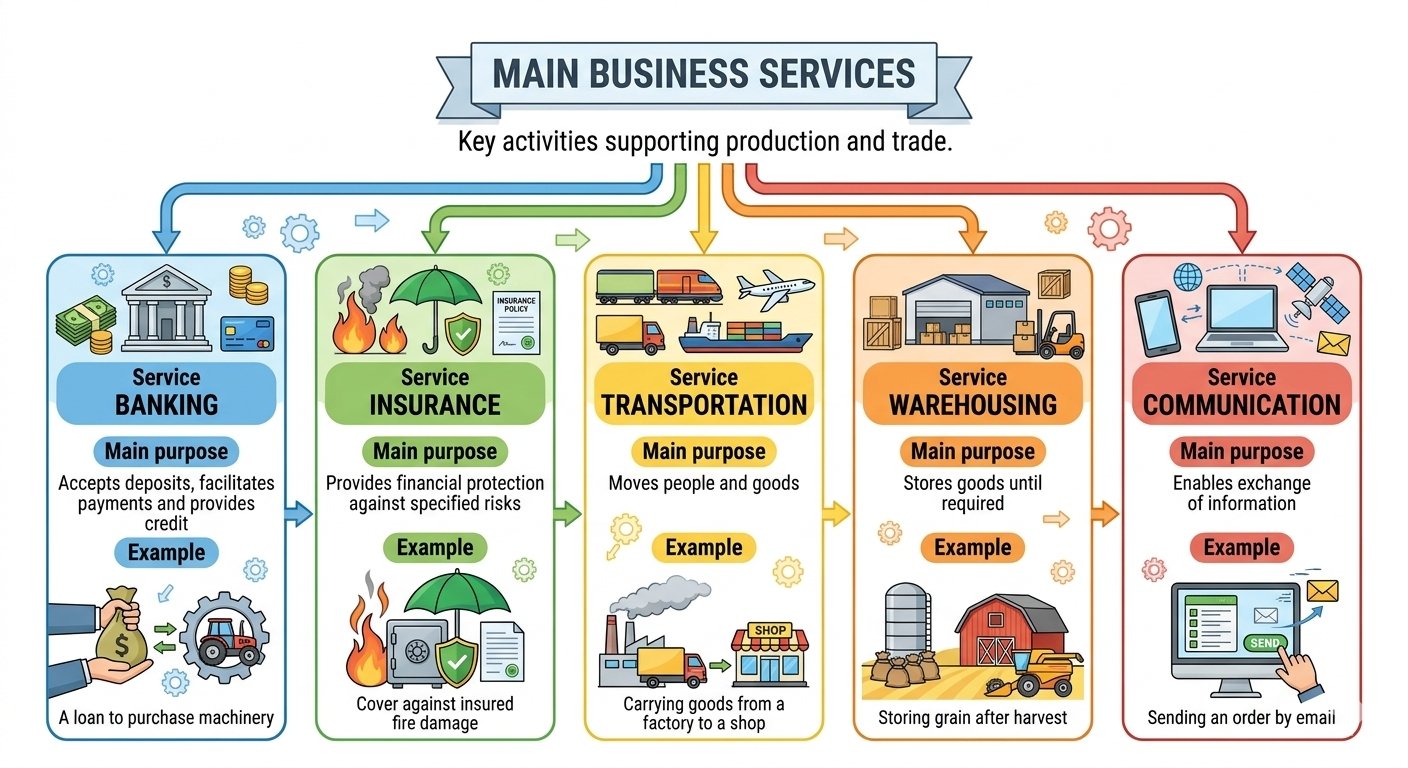
4. Main Business Services
| Service | Main purpose | Example |
|---|---|---|
| Banking | Accepts deposits, facilitates payments and provides credit | A loan to purchase machinery |
| Insurance | Provides financial protection against specified risks | Cover against insured fire damage |
| Transportation | Moves people and goods | Carrying goods from a factory to a shop |
| Warehousing | Stores goods until required | Storing grain after harvest |
| Communication | Enables exchange of information | Sending an order by email |
5. Banking
Banking involves accepting deposits from the public for lending or investment, with deposits repayable according to agreed terms and withdrawable through permitted methods.
Banks connect people who have surplus money with those who need funds.
Importance of Banking
- Encourages saving.
- Provides credit to businesses and individuals.
- Makes payments and transfers easier.
- Supports trade and investment.
- Reduces the need to carry cash.
- Helps businesses manage their finances.
6. Types of Banks
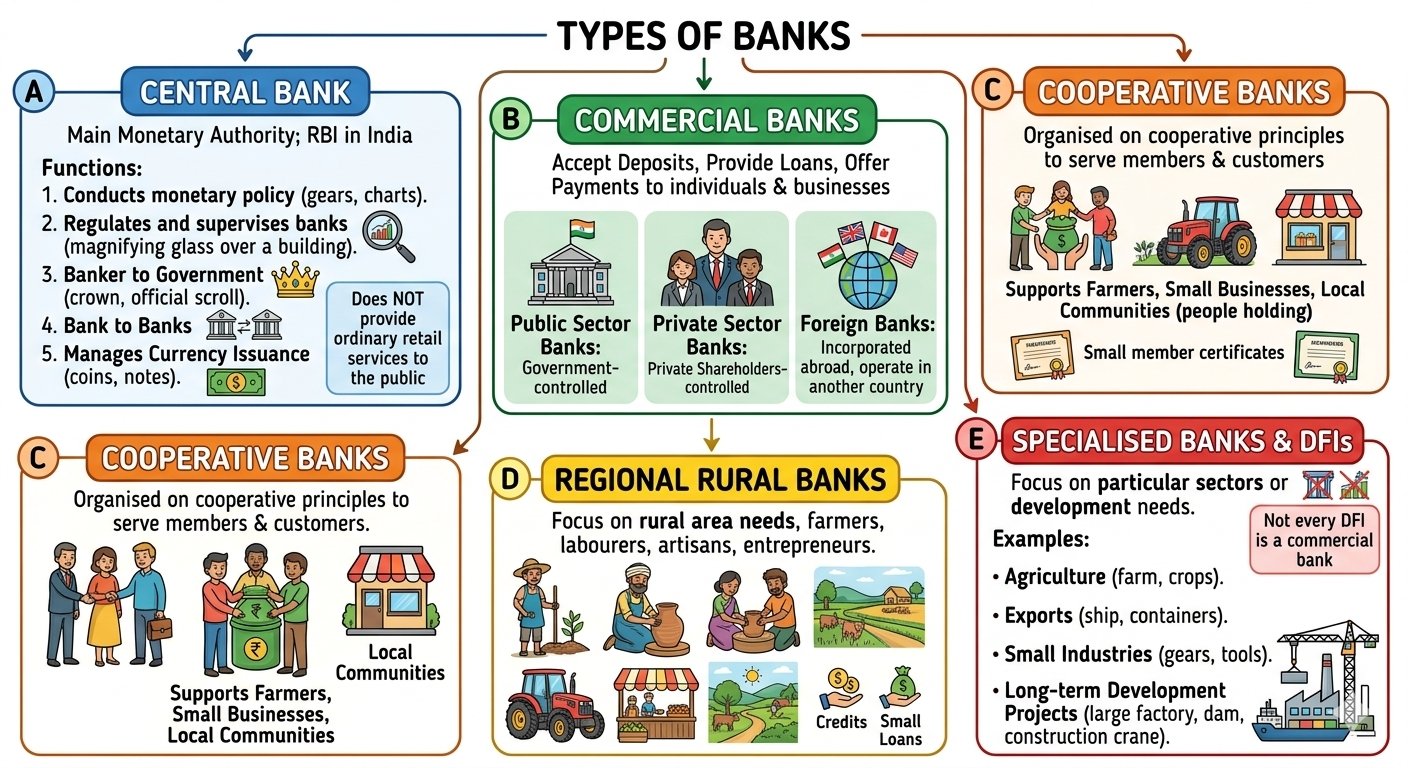
A. Central Bank
The central bank is the main monetary authority of a country.
In India, this role is performed by the Reserve Bank of India (RBI).
Its main functions include:
- Conducting monetary policy.
- Regulating and supervising banks within its authority.
- Acting as banker to the government.
- Acting as a bank to banks.
- Managing currency issuance within the legal framework.
Remember: The central bank does not normally provide ordinary retail banking services to the public.
B. Commercial Banks
Commercial banks accept deposits, provide loans and offer payment services to individuals and businesses.
They may be:
- Public sector banks: Government-controlled banks.
- Private sector banks: Banks controlled by private shareholders.
- Foreign banks: Banks incorporated abroad that operate in another country.
C. Cooperative Banks
Cooperative banks are organized on cooperative principles to serve their members and customers.
They commonly support farmers, small businesses and local communities.
D. Regional Rural Banks
Regional Rural Banks focus on banking and credit needs in rural areas, particularly those of farmers, agricultural laborer’s, artisans and small entrepreneurs.
E. Specialized Banks and Development Financial Institutions
These institutions focus on particular sectors or development needs.
Examples of areas supported: Agriculture, exports, small industries and long-term development projects.
Note: Not every development financial institution is a commercial bank.
7. Functions of Commercial Banks
Commercial bank functions are broadly divided into primary functions and secondary functions.
A. Primary Functions
1. Accepting Deposits
Banks accept money through different types of accounts.
| Account | Meaning | Main use |
|---|---|---|
| Savings account | An account intended mainly for saving, generally earning interest | Personal savings and routine payments |
| Current account | An account designed for frequent business transactions, generally without interest | Regular business receipts and payments |
| Fixed deposit | Money deposited for an agreed period at agreed terms | Investing a lump sum |
| Recurring deposit | A fixed amount deposited regularly for a selected period | Building savings gradually |
2. Providing Loans and Advances
Banks lend money to eligible borrowers.
a. Term Loan
A loan provided for an agreed period and repaid according to a schedule.
Example: A business borrows money to purchase machinery.
b. Cash Credit
A borrower can withdraw funds up to a sanctioned limit, generally against specified security.
Interest is normally charged on the amount used.
c. Bank Overdraft
A bank allows an account holder to withdraw more than the available account balance, up to an agreed limit.
Example: A business with ₹20,000 in its account may be permitted to withdraw an additional amount under an overdraft arrangement.
d. Discounting Bills of Exchange
A bank pays the holder of an eligible bill before its maturity after deducting a discount or charge. The bank then collects payment when the bill becomes due.
Benefit: The business receives money earlier.
B. Secondary Functions
1. Agency Functions
The bank acts on behalf of its customers.
Examples include:
- Collecting cheques and other payments.
- Making payments under customer instructions.
- Collecting dividends and interest.
- Facilitating permitted investments and securities transactions.
- Transferring funds.
2. General Utility Functions
Banks may provide:
- Safe deposit lockers.
- Bank guarantees.
- Letters of credit.
- Foreign exchange services through authorized channels.
- Debit cards, credit cards and digital payment facilities.
Important Terms
| Term | Meaning |
|---|---|
| Bank guarantee | A bank’s undertaking to pay a beneficiary if its customer fails to meet specified obligations, subject to the guarantee’s terms |
| Letter of credit | A bank’s undertaking to pay a seller when the required documents and conditions are satisfied |
| Cheque | A written instruction directing a bank to pay a specified amount from the drawer’s account |
8. E-banking
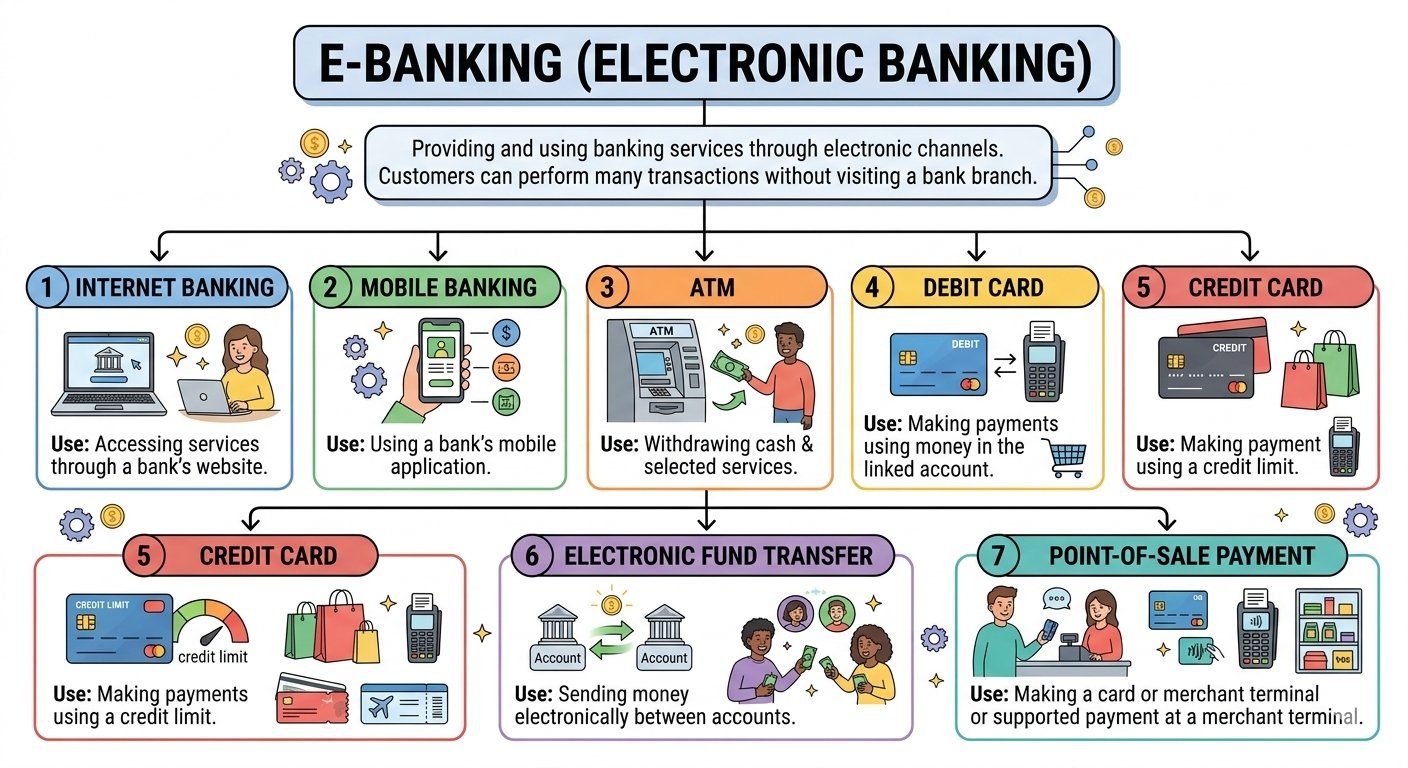
E-banking means providing and using banking services through electronic channels.
Customers can perform many transactions without visiting a bank branch.
Main Forms and Facilities
| Facility | Main use |
|---|---|
| Internet banking | Accessing banking services through a bank’s website |
| Mobile banking | Using a bank’s mobile application or other mobile channels |
| ATM | Withdrawing cash and accessing selected banking services |
| Debit card | Making payments using money available in the linked account |
| Credit card | Making payments using a credit limit provided by the issuer |
| Electronic fund transfer | Sending money electronically between accounts |
| Point-of-sale payment | Making a card or other supported electronic payment at a merchant terminal |
Common Electronic Payment Systems in India
- NEFT: A system for electronic transfer of funds between bank accounts.
- RTGS: A system in which eligible transfers are settled individually in real time.
- IMPS: An instant interbank electronic funds transfer service.
- UPI: A system enabling instant bank-account payments through participating applications.
UPI is a payment system; it is not itself a bank account.
Benefits to Customers
- Access to many services beyond branch hours.
- Payments and transfers from convenient locations.
- Less time spent travelling or waiting.
- Easy access to balances and transaction records.
- Reduced need to carry cash.
Benefits to Banks
- Reduces routine work at branches.
- Allows service to more customers.
- Can lower the cost of processing transactions.
- Improves the speed of many banking services.
- Supports electronic record-keeping.
Limitations and Precautions
E-banking depends on reliable technology, connectivity and safe use.
Customers should:
- Use official banking websites and applications.
- Keep passwords, PINs and OTPs confidential.
- Check recipient details before sending money.
- Avoid opening suspicious payment links.
- Report unauthorized transactions promptly.
9. Insurance
Insurance is a contract under which an insurer promises specified financial protection in return for a payment called a premium.
Payment depends on the insured event and the policy’s terms.
Important Terms
| Term | Meaning |
|---|---|
| Insurer | The company providing insurance |
| Insured | The person or entity whose life, property or interest is covered |
| Premium | The amount paid for insurance cover |
| Policy | The document setting out the insurance contract |
| Claim | A request for payment under the policy |
| Sum insured / sum assured | The stated amount of cover, with its meaning depending on the policy type |
Functions of Insurance
- Provides financial protection: Helps meet the financial consequences of covered events.
- Pools risks: Premiums from many policyholders help fund covered losses.
- Supports business continuity: Claim payments may help a business recover after a loss.
- Encourages risk management: Policy conditions and loss-prevention measures can promote safer practices.
- Mobilizes funds: Insurers invest funds according to applicable rules.
Remember: Insurance does not remove every risk or guarantee payment for every loss.
10. Principles of Insurance
1. Utmost Good Faith
Both parties must honestly disclose material information relevant to the contract.
A material fact is information that could influence the insurer’s decision to provide cover or determine its terms.
Example: A person applying for life insurance must truthfully provide the health information requested.
2. Insurable Interest
The policyholder must have a legally recognized interest in the subject matter of insurance.
This means the person would suffer a financial or other legally recognized loss if the insured event occurred.
Example: A shop owner has an insurable interest in the shop’s stock.
3. Indemnity
Indemnity means restoring the insured, as far as the contract allows, to the financial position before the covered loss.
Insurance should not become a source of profit from that loss.
Example: If covered stock worth ₹40,000 is destroyed, a policy with a higher limit does not automatically entitle the owner to receive the full limit.
Important: Life insurance is generally not a contract of indemnity because a human life cannot be valued as an ordinary property loss.
4. Proximate Cause
When several causes contribute to a loss, the insurer identifies the dominant and effective cause to determine whether the loss is covered.
Proximate cause does not simply mean the event nearest in time.
5. Subrogation
After paying an indemnity claim, the insurer may take over the insured’s recovery rights against the party responsible for the loss, to the extent permitted.
Example: After compensating a business for covered goods damaged by a negligent carrier, the insurer may pursue recovery from that carrier.
6. Contribution
If the same interest is covered against the same risk by more than one indemnity policy, insurers may share the claim.
The insured cannot recover more than the actual covered loss.
Example: Two applicable policies may contribute towards one fire loss.
7. Mitigation of Loss
The insured must take reasonable steps to prevent or reduce a loss.
Example: During a fire, the owner should take safe and reasonable steps to protect property rather than allow avoidable damage to increase.
Quick Revision Table
| Principle | Easy meaning |
|---|---|
| Utmost good faith | Disclose material information honestly |
| Insurable interest | Have a legally recognized interest in what is insured |
| Indemnity | Compensate the covered loss rather than create a profit |
| Proximate cause | Identify the dominant effective cause |
| Subrogation | Insurer takes over relevant recovery rights after payment |
| Contribution | Applicable insurers share an indemnity claim |
| Mitigation | Take reasonable steps to reduce loss |
11. Types of Insurance
A. Life Insurance
Life insurance provides an agreed benefit on death or another event specified in the policy, such as survival to a stated date.
Benefits depend on the type and terms of the policy.
Features
- Relates to human life.
- Requires payment of premiums according to the contract.
- Provides the agreed benefit when the policy conditions are met.
- Is generally not a contract of indemnity.
- May provide protection alone or combine protection with savings.
Common Types
| Type | Main purpose |
|---|---|
| Term insurance | Provides death cover for a specified period; ordinary term cover generally has no survival benefit |
| Whole-life insurance | Provides long-term life cover according to the policy terms |
| Endowment insurance | Provides a benefit on death during the term or survival to maturity |
| Annuity plan | Provides periodic payments according to an agreed arrangement |
Important: Not every life insurance policy provides a maturity or savings benefit.
B. Fire Insurance
Fire insurance covers specified property against loss or damage caused by fire and other risks included in the policy.
Features
- Relates to property such as buildings, machinery and stock.
- Is generally a contract of indemnity.
- Compensation depends on the actual covered loss, policy limit and other conditions.
- The loss must arise from a risk covered by the policy.
- Insurable interest is required.
Example: A shop’s stock is damaged by an insured fire, and the insurer pays the admissible claim.
C. Marine Insurance
Marine insurance covers specified risks connected with ships, cargo and marine transit.
Depending on the policy, cover may include related inland portions of a journey.
Main Types
| Type | What it covers |
|---|---|
| Hull insurance | The ship or vessel |
| Cargo insurance | Goods being transported |
| Freight insurance | The insured interest in freight earnings at risk |
Features
- Protects interests connected with marine transport.
- Is generally a contract of indemnity.
- Covers only the risks included in the policy.
- May be arranged for a voyage, a period or another agreed basis.
Example: Cargo is damaged during an insured sea voyage, and the insurer pays the admissible loss.
Life, Fire and Marine Insurance: Differences
| Basis | Life Insurance | Fire Insurance | Marine Insurance |
|---|---|---|---|
| Subject matter | Human life | Property exposed to fire-related risks | Vessel, cargo, freight or other marine interests |
| Main event covered | Death or another specified life event | Covered fire or related property damage | Covered marine or transit loss |
| Indemnity | Generally does not apply | Generally applies | Generally applies |
| Payment basis | Agreed policy benefit | Admissible actual loss within policy terms | Admissible actual loss within policy terms |
| Duration | Depends on the plan | Depends on the policy period | May relate to a voyage, period or other arrangement |
12. Transportation
Transportation means moving people and goods from one place to another.
It removes the hindrance of place by connecting production centers with markets.
Main Modes
| Mode | Main suitability |
|---|---|
| Road | Flexible routes and door-to-door movement |
| Rail | Large quantities over long land distances |
| Water | Bulky goods and international shipping |
| Air | Urgent, high-value or time-sensitive goods |
| Pipeline | Continuous movement of liquids and gases |
Importance
- Brings raw materials to factories.
- Delivers finished goods to customers.
- Connects distant markets.
- Supports large-scale production.
- Helps supply perishable goods quickly.
- Encourages domestic and international trade.
13. Warehousing
Warehousing means storing and protecting goods until they are required for use or sale.
It removes the hindrance of time between production and consumption.
Functions
- Storage: Keeps goods until they are needed.
- Protection: Helps safeguard goods against damage, theft and deterioration.
- Regular supply: Makes seasonal goods available beyond the production season.
- Consolidation: Combines smaller consignments into a larger shipment.
- Break-bulk: Divides a large consignment into smaller deliveries.
- Value-added services: May include sorting, grading, packing and labelling.
- Financing support: Eligible warehouse receipts may help owners obtain finance.
Types of Warehouses
| Type | Meaning |
|---|---|
| Private warehouse | Operated by a business mainly for its own goods |
| Public warehouse | Provides storage to users for a fee |
| Government warehouse | Owned or operated by a government body |
| Bonded warehouse | Stores imported goods under customs control pending the permitted duty or clearance arrangements |
| Cooperative warehouse | Operated cooperatively for members’ benefit |
| Cold storage | Maintains controlled temperatures for suitable goods |
Remember: Warehousing helps preserve goods and regulate supply, but it cannot completely prevent price changes or losses.
14. Communication Services
Communication means exchanging information, ideas, instructions and messages.
Businesses communicate with employees, customers, suppliers, banks and government authorities.
Importance
- Helps place and confirm orders.
- Supports coordination between departments.
- Allows quick responses to customers.
- Helps share prices, product details and delivery information.
- Supports decision-making.
- Connects businesses across locations.
Two important communication services are postal services and telecommunications.
15. Postal Services
Postal services collect, sort, carry and deliver letters, documents and parcels.
They are useful when physical documents or goods must reach another person or organization.
Main Categories
A. Mail and Parcel Services
These include services for:
- Letters and documents.
- Parcels and business goods.
- Time-sensitive delivery.
- Recorded or trackable delivery, where offered.
Business use: Sending invoices, documents, samples and customer orders.
B. Financial Services
Postal networks may provide savings, remittance and other financial services through the relevant postal or associated arrangements.
Business use: Access to financial services in areas where other facilities may be limited.
C. Insurance Services
Postal systems may also offer specified insurance products.
The nature of the cover and eligibility depend on the relevant scheme.
D. Business Support Services
Postal networks can support bulk mailing, parcel distribution and other services for organizations.
Importance
- Connects urban and rural areas.
- Delivers physical documents and goods.
- Supports small businesses and distance selling.
- Provides a wide distribution network.
- Offers delivery records or tracking where included in the service.
Note: Particular postal products, delivery standards and charges depend on the service available.
16. Telecom Services
Telecommunication services transmit voice, text, images and data over distances using electronic systems.
Main Types
1. Fixed-line Services
Provide communication through fixed connections.
Example: An office telephone connection.
2. Mobile or Cellular Services
Provide wireless voice, messaging and data communication through mobile networks.
Example: A salesperson contacts customers while travelling.
3. Internet and Broadband Services
Provide internet access for email, websites, online banking, video meetings and other activities.
Example: A retailer uses broadband to process online orders.
4. Leased-line Services
Provide a dedicated communication connection with agreed capacity and service terms.
Example: A large organization uses a leased line for reliable connectivity between offices.
5. Satellite Communication Services
Use satellites to transmit information and support connectivity over wide areas, including some remote locations.
Example: Connecting operations where suitable ground-based networks are unavailable.
6. Cable Communication Services
Use cable networks to distribute television and, where supported, broadband and other services.
Importance of Telecom Services
- Enables quick exchange of information.
- Supports online business and digital payments.
- Connects branches, suppliers and customers.
- Makes remote work and video meetings possible.
- Improves coordination and customer service.
- Supports access to wider markets.
Postal and Telecom Services: Differences
| Basis | Postal Services | Telecom Services |
|---|---|---|
| Main method | Physical delivery | Electronic transmission |
| What is sent | Letters, documents and parcels | Voice, text, images and data |
| Speed | Depends on physical movement and service selected | Usually rapid |
| Physical goods | Can deliver parcels | Cannot deliver physical goods |
| Example | Sending a signed original document | Emailing a scanned copy |