Changing Cultural Traditions – Class 11 History Notes
Part-III | Chapter – 5
Changing Cultural Traditions
1. Introduction
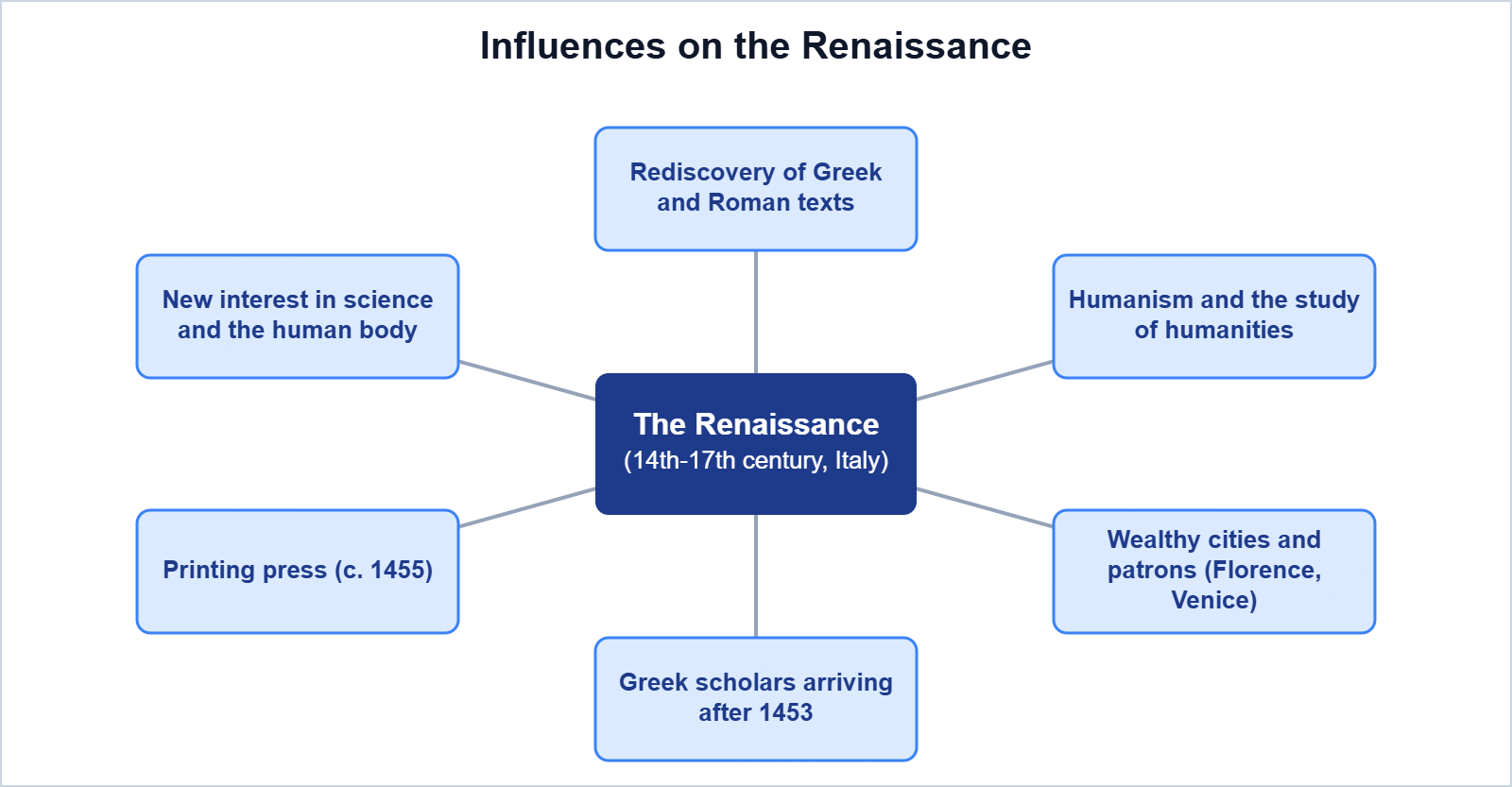
From the 14th to the 17th century, towns in Europe, especially in Italy, saw a great flowering of art, literature, learning and science. This period is called the Renaissance, meaning “rebirth”, because scholars believed that the learning of ancient Greece and Rome was being reborn. The Swiss historian Jacob Burckhardt, in his book The Civilisation of the Renaissance in Italy (1860), drew attention to this period and its focus on the individual.
2. The Revival of Italian Cities
- After the fall of the Western Roman Empire, Italian cities declined. From the 12th century, trade between Europe and Asia revived them.
- Cities such as Venice and Genoa became rich trading centres and were run as republics by merchants and bankers.
- Florence became a great centre of art and learning, supported by wealthy families such as the Medici.
- Universities grew; Padua and Bologna were famous centres for law and medicine.
3. Humanism
- Humanism was a new way of thinking that placed importance on human abilities and life in this world, and not only on religion.
- Humanists studied the humanities: grammar, rhetoric, poetry, history and moral philosophy, using classical Greek and Latin texts.
- Petrarch is often called the father of humanism. Earlier, Dante wrote on religious themes in the Italian language.
- Humanists believed that a person could shape his or her own life through education and effort.
Remember: Arab scholars had preserved and translated many Greek texts (for example, works of Aristotle and Ptolemy). Thinkers like Ibn Sina and Ibn Rushd influenced European learning.
4. Art and Architecture
- Artists tried to show the world realistically. They studied anatomy, light and shadow, and perspective (making a flat painting look three-dimensional).
- Leonardo da Vinci painted the Mona Lisa and The Last Supper and made scientific studies of plants, animals and flying machines.
- Michelangelo painted the ceiling of the Sistine Chapel and carved the Pieta and David.
- Brunelleschi designed the great dome of Florence Cathedral.
- Andreas Vesalius, a professor of medicine at Padua, studied the human body by dissection.

5. The Printing Press
Johannes Gutenberg of Mainz, Germany, developed printing with movable metal type and printed the Bible around 1455. Printing made books cheaper and more widely available. Ideas, including humanist and religious ideas, spread quickly across Europe.
Exam point: Printing helped spread the Renaissance and the Reformation, because many more people could now read the same texts.
6. A New Concept of Human Beings
- The Renaissance stressed the dignity and abilities of the individual.
- Writers discussed politics and ethics; Machiavelli wrote The Prince (1513) about how rulers gain and keep power.
- Some women were educated and active in public life, such as Isabella d’Este, who ruled Mantua, and Cassandra Fedele of Venice, a learned scholar. However, most women had limited rights.
7. Debates within Christianity: The Reformation
- Christian humanists like Erasmus and Thomas More criticised the Church for its wealth and corruption.
- In 1517, Martin Luther, a German monk, protested against the sale of indulgences (documents claimed to free people from punishment for sins). This began the Protestant Reformation.
- Luther said that faith alone could lead people to heaven, and he translated the Bible into German.
- Other reformers like Zwingli and Calvin also spread Protestant ideas. In England, the king broke away from the Pope.
- The Catholic Church responded with its own reforms; the Society of Jesus (Jesuits) was founded by Ignatius Loyola in 1540.
8. The Scientific Revolution

The Church taught that the earth was the centre of the universe. Copernicus argued that the earth and the planets moved around the sun. Later, Kepler, Galileo and Newton built on this work. Science came to be based on observation and experiment, an approach that led to modern science.
Easy Memory Trick: “C-K-G-N”: Copernicus, Kepler, Galileo, Newton, in order.
9. Important Terms
Term | Meaning |
|---|---|
Renaissance | Rebirth of classical learning, art and culture |
Humanism | A philosophy that gives importance to human beings and their abilities |
Perspective | A technique that shows depth and distance in a painting |
Indulgence | A document sold by the Church, said to reduce punishment for sins |
Reformation | A 16th-century movement to reform the Catholic Church, leading to Protestantism |
10. Short Answer Questions
Q1. What does the word “Renaissance” mean?
Ans. It means “rebirth”. It refers to the revival of classical Greek and Roman learning, art and culture in Europe from the 14th century.
Q2. Why did the Renaissance begin in Italy?
Ans. Italian cities were rich from trade, had wealthy patrons, had Roman ruins and classical traditions, had universities, and later received Greek scholars after the fall of Constantinople in 1453.
Q3. Who was Martin Luther?
Ans. Martin Luther was a German monk who protested against the sale of indulgences in 1517, beginning the Protestant Reformation.
Q4. What was the contribution of Copernicus?
Ans. Copernicus argued that the earth and other planets revolve around the sun, challenging the belief that the earth was the centre of the universe.
11. Long Answer Questions
Q1. What were the main features of Renaissance art?
Ans. Renaissance artists aimed to show people and nature realistically. They studied anatomy to draw the human body accurately, and they used perspective, light and shadow to make paintings look three-dimensional. Inspired by classical art, they created sculptures and paintings of great beauty, such as Michelangelo’s David and Leonardo’s Mona Lisa. Architects like Brunelleschi revived classical styles with domes, columns and arches. Art was supported by wealthy patrons and the Church. Thus Renaissance art combined realism, classical inspiration and scientific study.
Q2. Explain the causes and effects of the Protestant Reformation.
Ans. The Church had become very wealthy and powerful, and many people were unhappy with practices such as the sale of indulgences. Humanists like Erasmus criticized such corruption, and printing helped spread these ideas. In 1517, Martin Luther protested against indulgences and argued that faith alone could save people. His ideas spread rapidly in Germany and Switzerland. As a result, Christianity split into Catholics and Protestants, several Protestant churches were formed, and rulers gained more control over religion in their states. The Catholic Church responded with its own reform, including the founding of the Jesuits.
Conclusion: The Renaissance, the Reformation and the Scientific Revolution changed the cultural traditions of Europe. They placed new value on the individual, on reason and on observation, laying the foundation of the modern world.