Displacing Indigenous Peoples – Class 11 History Notes
Part-IV | Chapter – 6
Displacing Indigenous Peoples
1. Introduction
From the 17th century onwards, Europeans settled in large numbers in North America, South America, Australia and New Zealand. These lands were already home to indigenous peoples. As settlers took over their lands, the native peoples were pushed out, their numbers fell, and their ways of life were destroyed. This chapter focuses on North America (the USA and Canada) and Australia.
Remember: The word settler refers to Europeans (and others) who came to live permanently in these lands, as different from traders or soldiers who only visited.
2. European Colonisation
- In South America, the Spanish and Portuguese conquered the Aztec and Inca empires in the 16th century.
- In North America, the English, French and Dutch set up colonies from the 17th century.
- Settlers came for land, trade and religious freedom. Many also brought diseases (such as smallpox), which killed large numbers of native people.
3. The Native Peoples of North America
- Native Americans lived in groups along river valleys and in forests and plains. They grew crops like maize, hunted animals such as the bison, and fished.
- They did not believe in private ownership of land; land was shared by the community and respected as a gift of nature.
- They had their own languages, oral traditions, crafts and systems of exchange, such as belts of shells (wampum) used in agreements.
- At first, they traded furs with Europeans for blankets, guns, metal goods and alcohol.
4. Settlers Take Over the Land
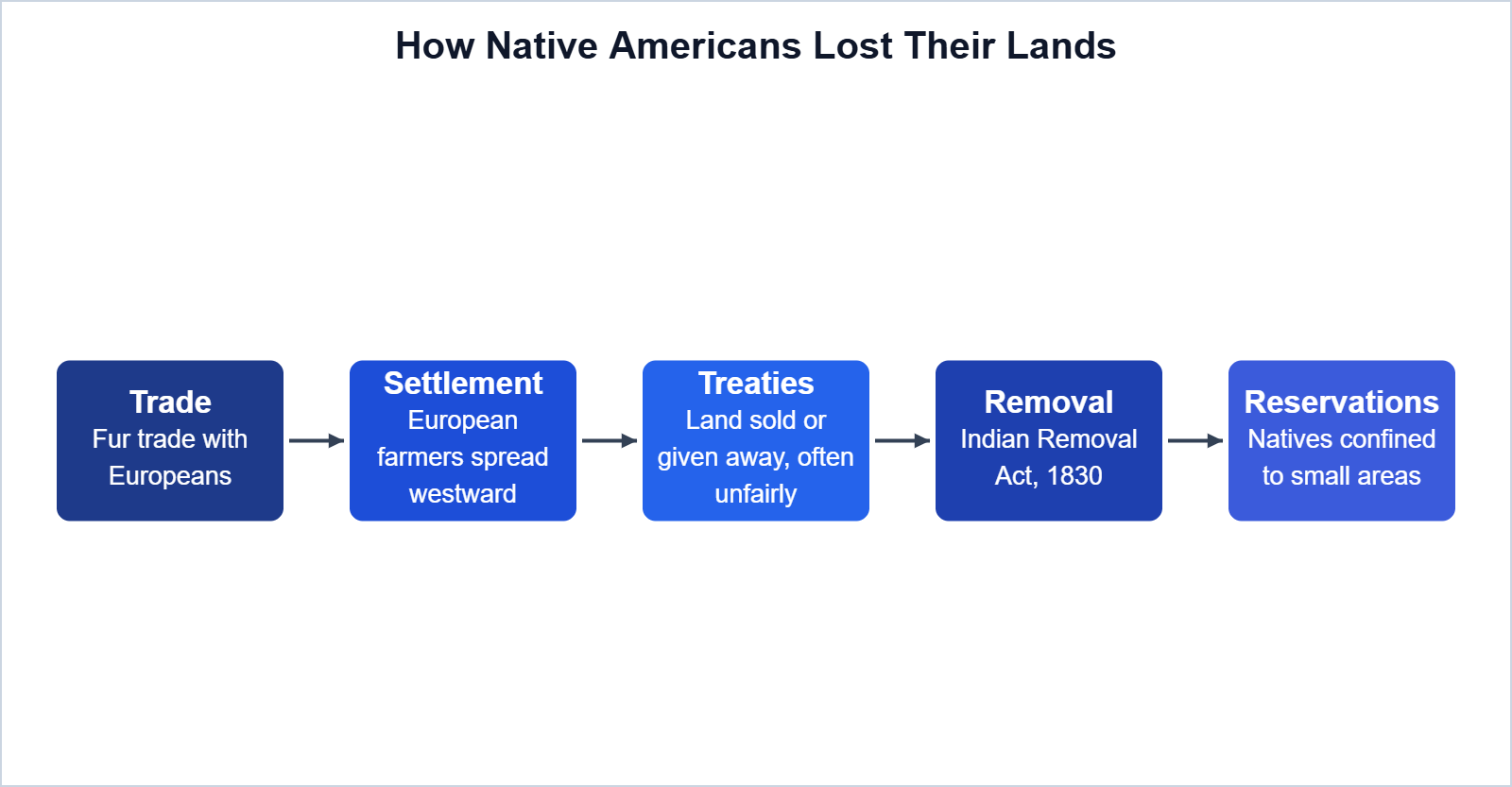
- After the USA became independent (1776), settlers moved steadily westward. The USA bought Louisiana from France in 1803, doubling its size.
- Native Americans were made to sign treaties giving away land, often for very little, or were pushed out by war.
- Under President Andrew Jackson, the Indian Removal Act of 1830 forced native peoples living east of the Mississippi to move west.
- The Cherokee had adopted farming, a written language and their own laws, but they too were forced out. In 1838-1839, thousands died on the forced march known as the Trail of Tears.
- Natives were confined to areas called reservations, often on poor land.
- The discovery of gold in California (1849) and the building of railways brought more settlers to the west.
Exam point: The Trail of Tears is a symbol of the forced removal of Native Americans. Remember the Indian Removal Act of 1830.
5. Canada
In Canada, the British took control from the French in the 18th century. The Metis, people of mixed native and European descent, rebelled in the late 19th century to protect their land and rights. Native lands were gradually taken over by settlers and railways.
6. The Winds of Change in North America
- By the 1920s, the poor condition of natives on reservations was widely recognised.
- The Indian Reorganisation Act of 1934 in the USA gave native communities the right to buy land on reservations and to form their own communities.
- In 1954, native groups prepared a Declaration of Indian Rights, demanding citizenship while keeping their traditions and land.
- In Canada, the Constitution of 1982 recognised the existing rights of aboriginal peoples.
7. Australia
- The Aboriginal peoples had lived in Australia for tens of thousands of years. They were divided into many groups with their own languages, and they lived by hunting and gathering, with deep spiritual links to the land.
- Captain James Cook reached the east coast in 1770 and claimed it for Britain.
- In 1788, the First Fleet arrived with convicts and founded the first British settlement at Sydney.
- The British treated the land as terra nullius (“land belonging to no one”), ignoring the Aboriginal people’s rights.
- Settlers took over land for sheep farming, mining and towns. Many Aboriginal people died from violence and disease.
- Many Aboriginal children were taken away from their families to be raised in institutions; they are known as the Stolen Generations.
8. The Winds of Change in Australia
- In 1968, the anthropologist W.E.H. Stanner gave a famous lecture called “The Great Australian Silence”, pointing out that Aboriginal people had been left out of Australian history.
- In 1974, Australia adopted a policy of multiculturalism, giving respect to native cultures and to immigrants.
- In 1992, the High Court’s Mabo judgment recognised that Aboriginal people had rights to land (native title), rejecting the idea of terra nullius.
- In 2008, the Prime Minister of Australia formally apologised to the Stolen Generations.
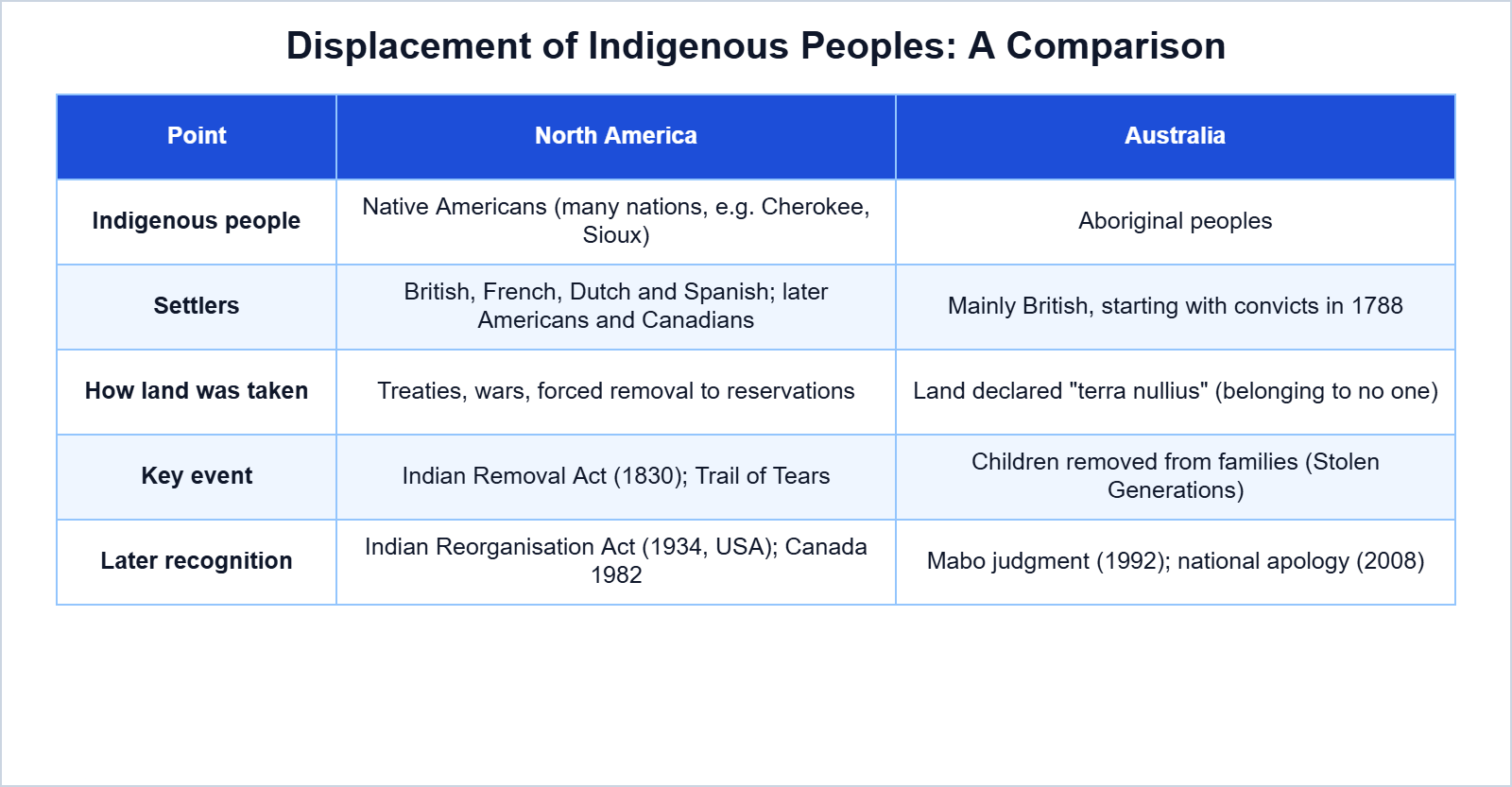
Easy Memory Trick: “Cook 1770, Fleet 1788, Mabo 1992” for Australia; “Removal 1830, Reorganisation 1934” for the USA.
9. Important Terms
Term | Meaning |
|---|---|
Indigenous | Original inhabitants of a land |
Settler | A person who comes to live permanently in a new land |
Reservation | Land set aside for native peoples by the government |
Terra nullius | Latin for “land belonging to no one” |
Native title | Legal recognition of indigenous rights to land |
10. Short Answer Questions
Q1. What is meant by “terra nullius”?
Ans. It is a Latin term meaning “land belonging to no one”. The British used it to claim Australia, ignoring the rights of the Aboriginal people.
Q2. What was the Trail of Tears?
Ans. It was the forced journey of the Cherokee people from their homeland in the south-eastern USA to lands in the west in 1838-1839, during which thousands died.
Q3. How did Native Americans view land?
Ans. They believed land belonged to the whole community and to nature. They did not believe in private ownership of land, unlike the European settlers.
Q4. What was the importance of the Mabo case?
Ans. In 1992 the Australian High Court recognized that Aboriginal people had rights to their traditional land, rejecting the idea that Australia had been terra nullius.
11. Long Answer Questions
Q1. How were Native Americans displaced from their lands?
Ans. When Europeans arrived, the natives at first traded furs with them. As settlers increased, they wanted more land for farming. Natives were made to sign treaties selling their land, often for very little, and were pushed westward through wars. The Indian Removal Act of 1830 forced the natives living east of the Mississippi to move west; the Cherokee suffered the Trail of Tears. The gold rush and railways brought more settlers. Finally, native peoples were confined to reservations on poor land, and their population, culture and independence were greatly reduced.
Q2. Describe the changes in the condition of Aboriginal peoples in Australia in the 20th century.
Ans. For a long time Aboriginal people were ignored in Australian history and suffered loss of land and the removal of their children. From the late 1960s, attitudes began to change. Stanner’s lecture in 1968 highlighted the silence about Aboriginal history. In 1974, Australia adopted multiculturalism, respecting native cultures. The Mabo judgment of 1992 recognized native title to land and rejected the idea of terra nullius. In 2008, the government formally apologized to the Stolen Generations. These steps marked a new respect for the rights of Aboriginal people, though many problems remain.
Conclusion: The story of the indigenous peoples of the Americas and Australia shows the darker side of modernisation and colonisation. Their struggle for land, rights and recognition continues even today.