The Three Orders – Class 11 History Notes
Part-III | Chapter – 4
The Three Orders
1. Introduction
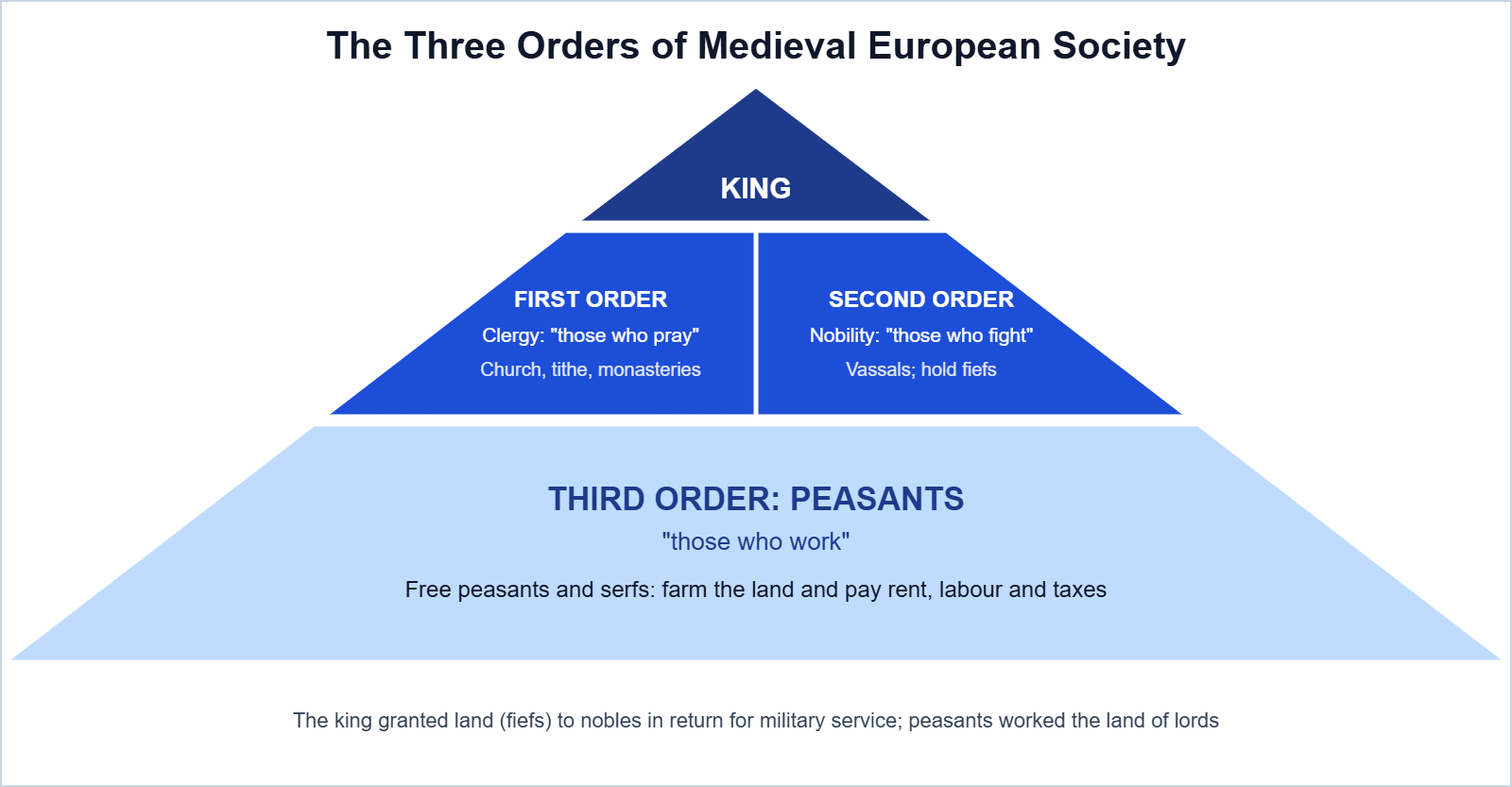
This chapter describes the society of Western Europe between about the 9th and the 16th centuries. Church writers described society as made up of three orders: the clergy (those who pray), the nobility (those who fight) and the peasantry (those who work). This social and economic system based on land is known as feudalism.
2. Feudalism
- The word comes from the German word feud, meaning “a piece of land”.
- Feudalism refers to the economic, legal, political and social relationships that existed in medieval Europe.
- It was based on the relationship between a lord and his vassal: the lord gave land (a fief) and protection; the vassal gave loyalty and military service.
- Peasants worked on the lord’s land in the manor, and gave labour, rent and services.
- The French historian Marc Bloch wrote an important study called Feudal Society, focusing on the social relationships and daily life of people.
3. Background: France and England
- The Roman province of Gaul was taken over by the Franks, a Germanic people, who gave their name to France. Their king Clovis became a Christian.
- In 800 CE, the Frankish king Charlemagne was crowned emperor by the Pope.
- In England, William, Duke of Normandy, conquered the country in 1066 and introduced a feudal system.
4. The First Order: The Clergy
- The Catholic Church, headed by the Pope in Rome, was very powerful. It owned large lands and collected a tax called the tithe (one-tenth of a peasant’s produce).
- Priests and bishops formed the clergy. They could not marry.
- Monks lived in monasteries (abbeys) away from towns, following strict rules of prayer, study and work. Famous examples: St Benedict’s monastery in Italy (529 CE) and Cluny in France (910 CE). Women became nuns; Hildegard of Bingen was a famous abbess.
- From the 13th century, friars (Franciscans and Dominicans) moved from place to place, preaching and living on charity.
Remember: The Church influenced daily life through festivals, prayers, pilgrimages and ceremonies such as baptism and marriage.
5. The Second Order: The Nobility
- Nobles were vassals of the king. They received land and swore loyalty through a ceremony of homage.
- A noble controlled his land, had his own courts and could raise troops.
- Lower nobles called knights received smaller fiefs in return for fighting for their lord. They were trained in horse riding and warfare.
- The noble lived in a manor house; the manor included villages, farmland, forests, a mill and a church.
6. The Third Order: Peasants
Free peasants | Serfs |
|---|---|
Held land as tenants of the lord | Worked on land belonging to the lord |
Gave military service and some days of labour to the lord | Most of their produce went to the lord; could not leave the manor |
Paid a direct tax called the taille (in France) to the king | Had to use the lord’s mill, oven and wine press and pay for them; needed permission to marry |
Exam point: The tithe was paid to the Church; the taille was a direct tax paid by peasants to the king in France. The clergy and nobles were exempt from the taille.
7. Changes in Agriculture (from the 11th century)
- Heavy iron-tipped ploughs and mouldboards turned the soil better.
- Horse collars and iron horseshoes allowed horses to pull ploughs.
- The three-field system (one field each for autumn crops, spring crops and rest) improved output.
- Water mills and windmills were used to grind grain.
- Food production and population increased.
8. A Fourth Order? New Towns and Townspeople
- As agriculture improved, towns grew from the 11th century as centres of trade and crafts.
- A popular saying claimed that “town air makes free”: a serf who lived in a town for a year and a day without being caught by his lord became free.
- Craftsmen and merchants organized into guilds, which controlled quality, prices and training.
- Large cathedrals such as the one at Chartres were built in towns.
9. The Crisis of the Fourteenth Century
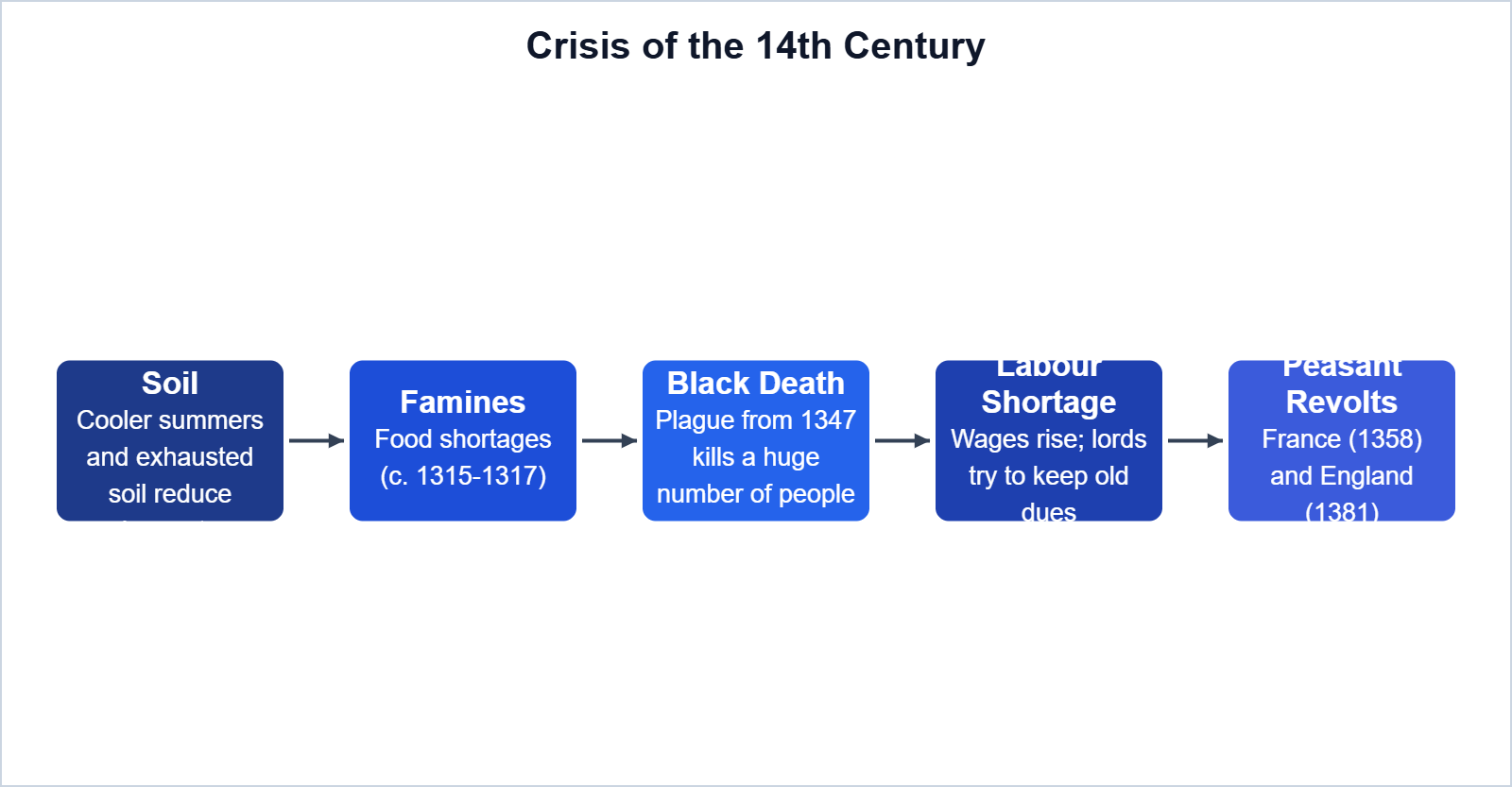
The Black Death (1347-1350) arrived in Europe through trade routes and spread rapidly, killing a very large part of the population. Labour became scarce and wages rose. When lords tried to force old services on peasants, revolts broke out: the Jacquerie in France (1358) and the Peasants’ Revolt in England (1381).
10. Political Changes: New Monarchs
In the 15th and 16th centuries, kings became more powerful. Rulers such as Louis XI of France, Henry VII of England, and Ferdinand and Isabella of Spain built standing armies, a permanent bureaucracy and a national tax system. The power of feudal nobles declined. In France, the assembly called the Estates-General (representing the three orders) met in 1614 and then not again until 1789.
Easy Memory Trick: “Pray, Fight, Work”: clergy pray, nobles fight, peasants work.
11. Important Terms
Term | Meaning |
|---|---|
Fief | Land given by a lord to a vassal in return for service |
Vassal | A person who holds land from a lord and owes him loyalty |
Manor | The estate of a lord, with villages and fields |
Serf | A peasant bound to the lord’s land |
Tithe | One-tenth of produce paid to the Church |
Guild | An association of craftsmen or merchants |
12. Short Answer Questions
Q1. What were the three orders of medieval society?
Ans. The clergy (those who pray), the nobility (those who fight) and the peasants (those who work).
Q2. What is meant by feudalism?
Ans. Feudalism was a system in medieval Europe in which lords gave land to vassals in return for military service, and peasants worked the land in return for protection, giving labour and part of their produce.
Q3. Distinguish between monks and friars.
Ans. Monks lived in monasteries away from towns, following a fixed routine of prayer and work. Friars moved from place to place, preaching to people and living on charity.
Q4. What does “town air makes free” mean?
Ans. A serf who escaped to a town and stayed there for a year and a day without being caught by his lord became a free person.
13. Long Answer Questions
Q1. Describe the condition of serfs in medieval Europe.
Ans. Serfs were peasants bound to the land of their lord. They cultivated plots that belonged to the lord, and most of the produce went to him. They also had to work on the lord’s own fields and do other unpaid labour. They could not leave the manor without permission and needed the lord’s consent to marry. They had to use the lord’s mill, oven and wine press and pay for them. The lord could judge them in his own court. Thus serfs had very little freedom and lived a hard life.
Q2. What were the causes and results of the 14th-century crisis in Europe?
Ans. In the early 14th century, cooler summers, poor soil and shortages of pasture reduced harvests, leading to famines. In 1347-1350 the Black Death spread across Europe through trade routes and killed a large part of the population. As a result, there was a severe shortage of labour, wages rose and farm prices fell. Lords tried to force peasants to perform their old services, which led to revolts such as the Jacquerie in France (1358) and the Peasants’ Revolt in England (1381). Although the revolts were crushed, the old feudal relationships weakened, and many peasants gained more freedom.
Conclusion: The three orders formed the basis of medieval European society. Changes in agriculture, the growth of towns, the crisis of the 14th century and the rise of strong kings gradually weakened feudalism and prepared the way for the modern world.