Empires: Introduction and Timeline II – Class 11 History
Part – II
Empires: Introduction and Timeline II
(c. 100 BCE to 1300 CE)
1. Introduction
An empire is a large state that rules over many regions and peoples, usually under one ruler. Part II studies two very different empires: the Roman Empire, built around the Mediterranean Sea and based on cities, money and a professional army, and the Mongol Empire, built by nomadic horsemen from the steppes of Central Asia. Between them, these empires affected Europe, Africa and almost the whole of Asia.
Remember: Empires need a strong army, a way of collecting taxes, a system of communication and a ruling class that can control distant areas.
2. Major Developments
- The Roman Empire united the lands around the Mediterranean.
- Iran was ruled by the Parthians and then the Sasanians, Rome’s great rivals.
- Christianity became the main religion of the Roman world in the 4th century.
- Islam arose in Arabia in the 7th century and spread rapidly.
- The Mongols under Genghis Khan and his successors created the largest land empire in history in the 13th century.
3. Timeline II
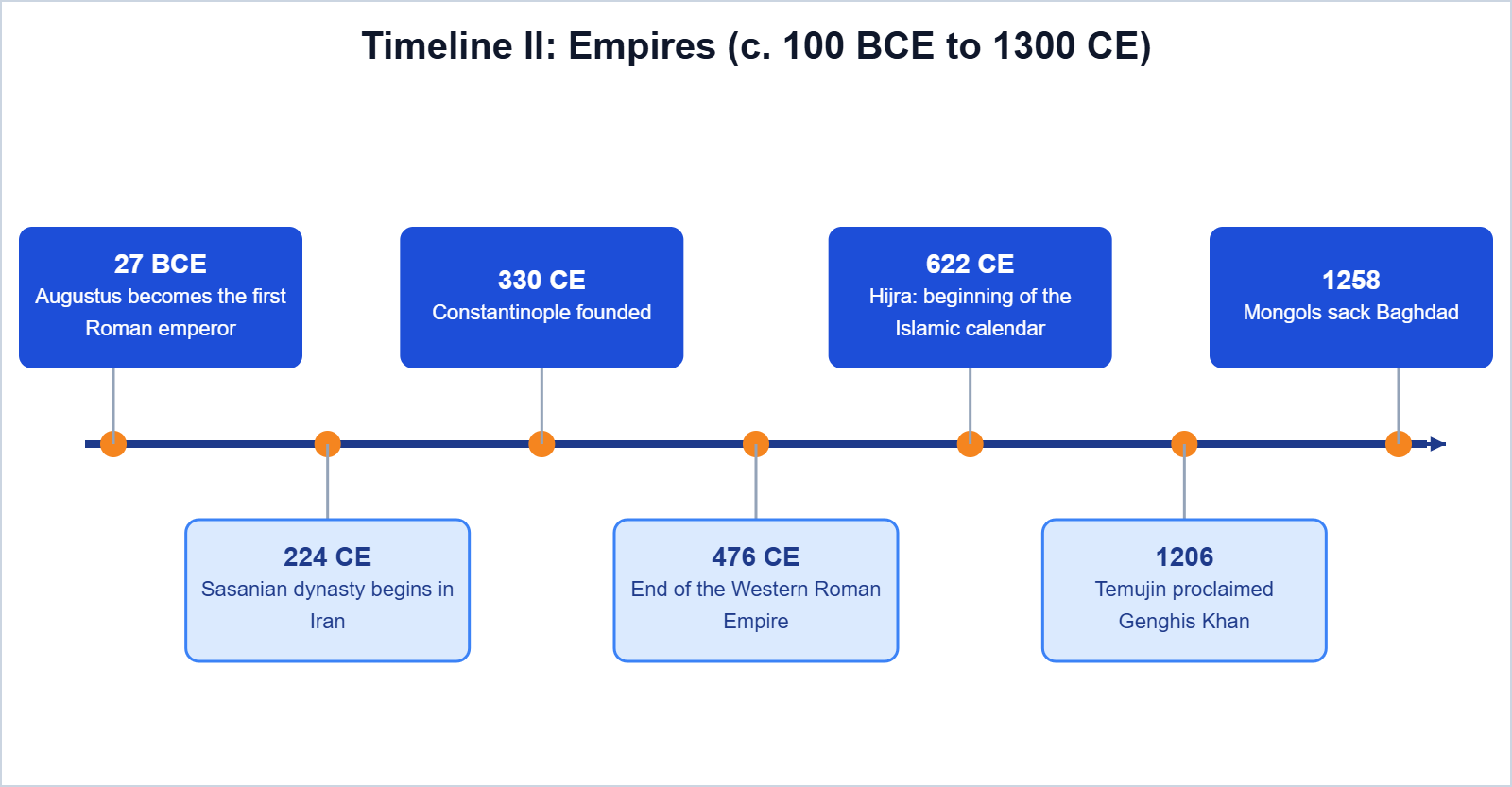
Date | Event |
|---|---|
27 BCE | Augustus becomes the first Roman emperor |
224 CE | The Sasanian dynasty takes power in Iran |
c. 312 CE | Emperor Constantine adopts Christianity |
330 CE | Constantinople becomes the new capital in the East |
476 CE | The last emperor of the Western Roman Empire is removed |
622 CE | Hijra (migration of Prophet Muhammad to Medina) |
800 CE | Charlemagne crowned emperor in Rome |
1206 | Temujin is proclaimed Genghis Khan |
1258 | Mongols under Hulegu sack Baghdad |
1279 | Kublai Khan completes the conquest of China |
Exam point: Notice the difference between the two empires: Rome was urban and settled, while the Mongols were nomadic.
Easy Memory Trick: “27 BCE to 476 CE” for the Western Roman Empire; “1206” for the rise of Genghis Khan.
Conclusion: Part II shows how empires were built and ruled in very different ways, by settled city-based societies and by nomadic peoples.