Paths to Modernisation – Class 11 History Notes
Part-IV | Chapter – 7
Paths to Modernisation
1. Introduction
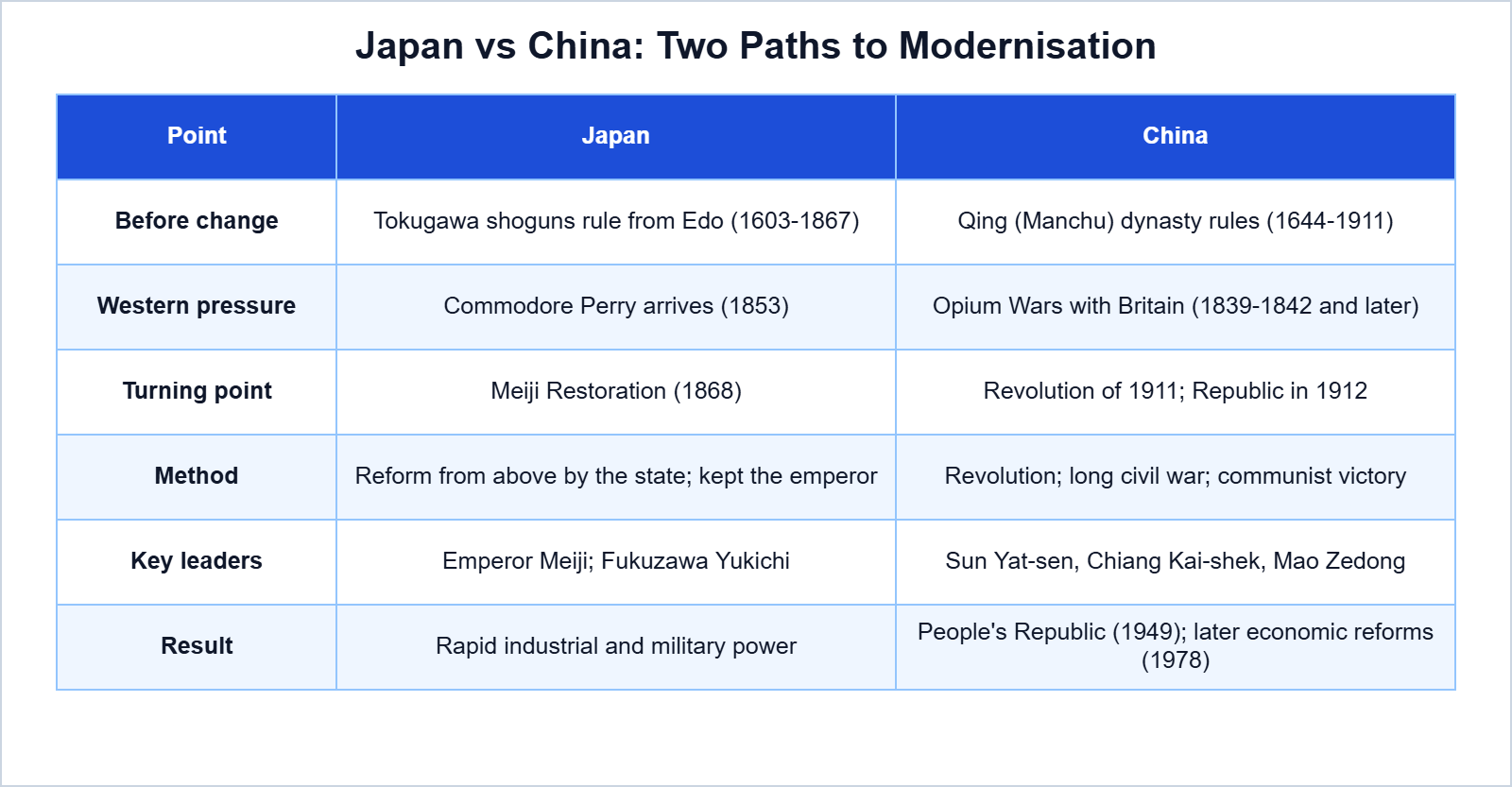
In the 19th century, the countries of East Asia faced the challenge of Western powers that wanted trade and influence. Japan and China responded in very different ways. Japan modernised quickly under its government and became an industrial and military power. China went through a long period of foreign pressure, rebellion and revolution before becoming a communist state in 1949.
2. Japan Under the Tokugawa
- From 1603 to 1867, Japan was ruled by the Tokugawa shoguns from Edo (present-day Tokyo). The emperor lived in Kyoto but had little power.
- Society was divided into classes, with the daimyo (lords) and samurai (warriors) at the top.
- Contact with the outside world was limited; only the Dutch and Chinese could trade, at Nagasaki.
- Towns grew, trade and money developed, and literacy spread. These changes prepared Japan for modernisation.
3. Opening of Japan and the Meiji Restoration
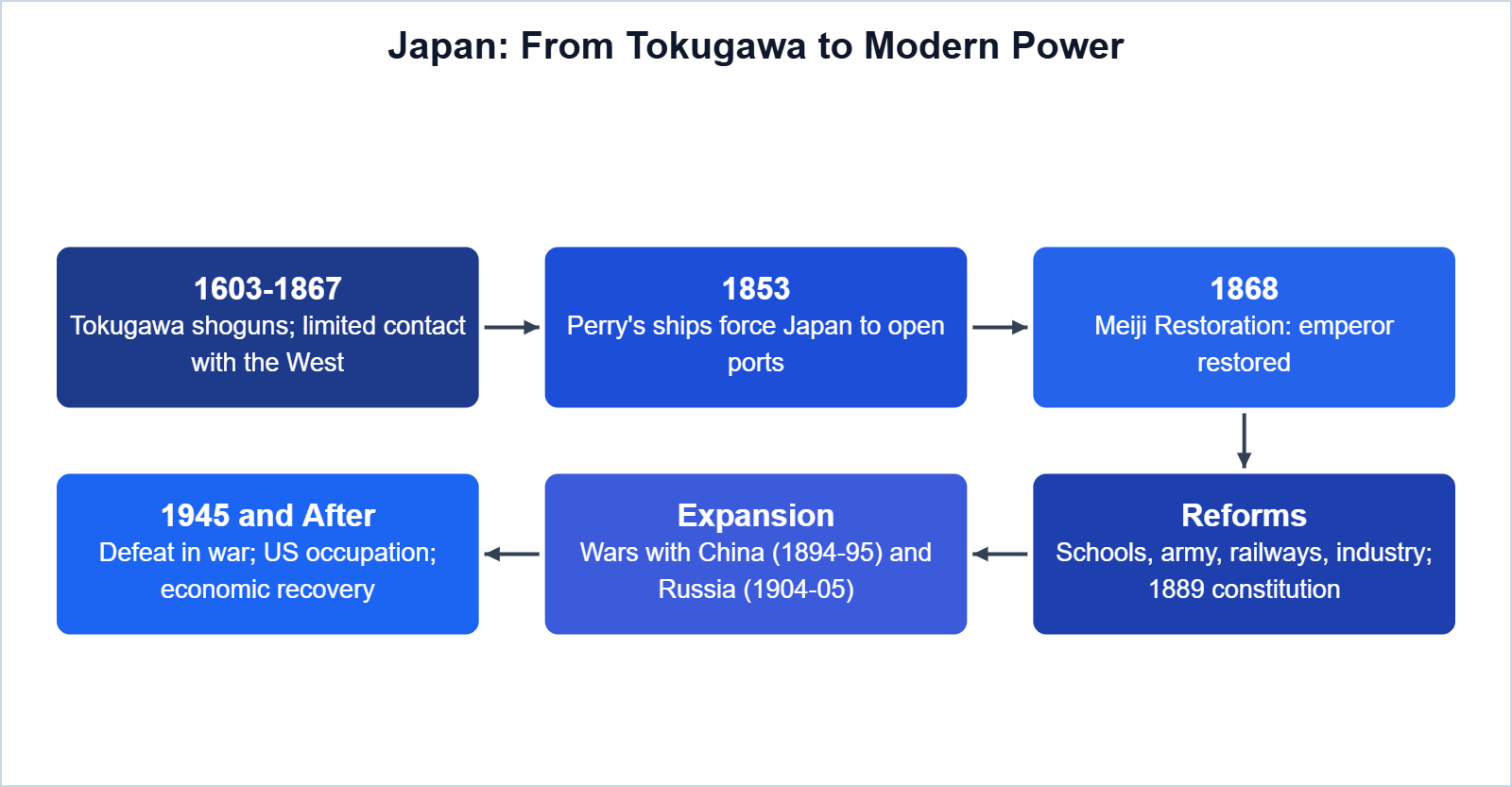
- In 1853, the American Commodore Matthew Perry arrived with warships and demanded that Japan open its ports. Japan signed treaties with Western powers.
- Many Japanese felt the shogun had failed to protect the country. In 1868, the shogun was removed and the emperor was restored to power. This is the Meiji Restoration; Meiji means “enlightened rule”. Edo was renamed Tokyo and became the capital.
- The slogan was “rich country, strong army” (fukoku kyohei).
4. Meiji Reforms
- Political: The old domains of the daimyo were abolished, and a centralised government was set up. A constitution was introduced in 1889.
- Military: A modern army was created through conscription; the samurai lost their special status.
- Education: Compulsory schooling was introduced from 1872, with Western subjects along with loyalty to the emperor.
- Economy: Railways (the first line between Tokyo and Yokohama, 1872), modern banks and industries were set up. Large business groups called zaibatsu dominated the economy.
- Thinkers: Fukuzawa Yukichi urged Japan to learn from the West.
Exam point: Japan modernised through reforms from above, led by the state, while keeping the emperor as a symbol of national unity.
5. Japan as an Imperial Power and After the War
- Japan defeated China (1894-1895) and Russia (1904-1905), and took over Taiwan (1895) and Korea (1910).
- In the 1930s, aggressive nationalism and militarism grew. Japan attacked China and, in 1941, the US base at Pearl Harbor, entering the Second World War.
- In August 1945, the USA dropped atomic bombs on Hiroshima and Nagasaki, and Japan surrendered.
- After the war, the USA occupied Japan until 1952. A new democratic constitution was adopted, and Japan rebuilt its economy rapidly. The 1964 Tokyo Olympics and the high-speed “bullet train” showed its recovery.
6. China: The Decline of the Qing
- China was ruled by the Qing (Manchu) dynasty. Britain wanted to sell opium in China to pay for Chinese tea.
- When China tried to stop the opium trade, Britain fought the First Opium War (1839-1842). China was defeated and signed the Treaty of Nanjing, giving Hong Kong to Britain and opening ports to foreign trade.
- Further defeats and unequal treaties followed. Large rebellions, such as the Taiping Rebellion (1850-1864) and the Boxer Uprising (1900), weakened the dynasty.
- Reformers like Kang Youwei and Liang Qichao tried to modernise the government, but their efforts largely failed.
7. The Republic and the Rise of the Communists
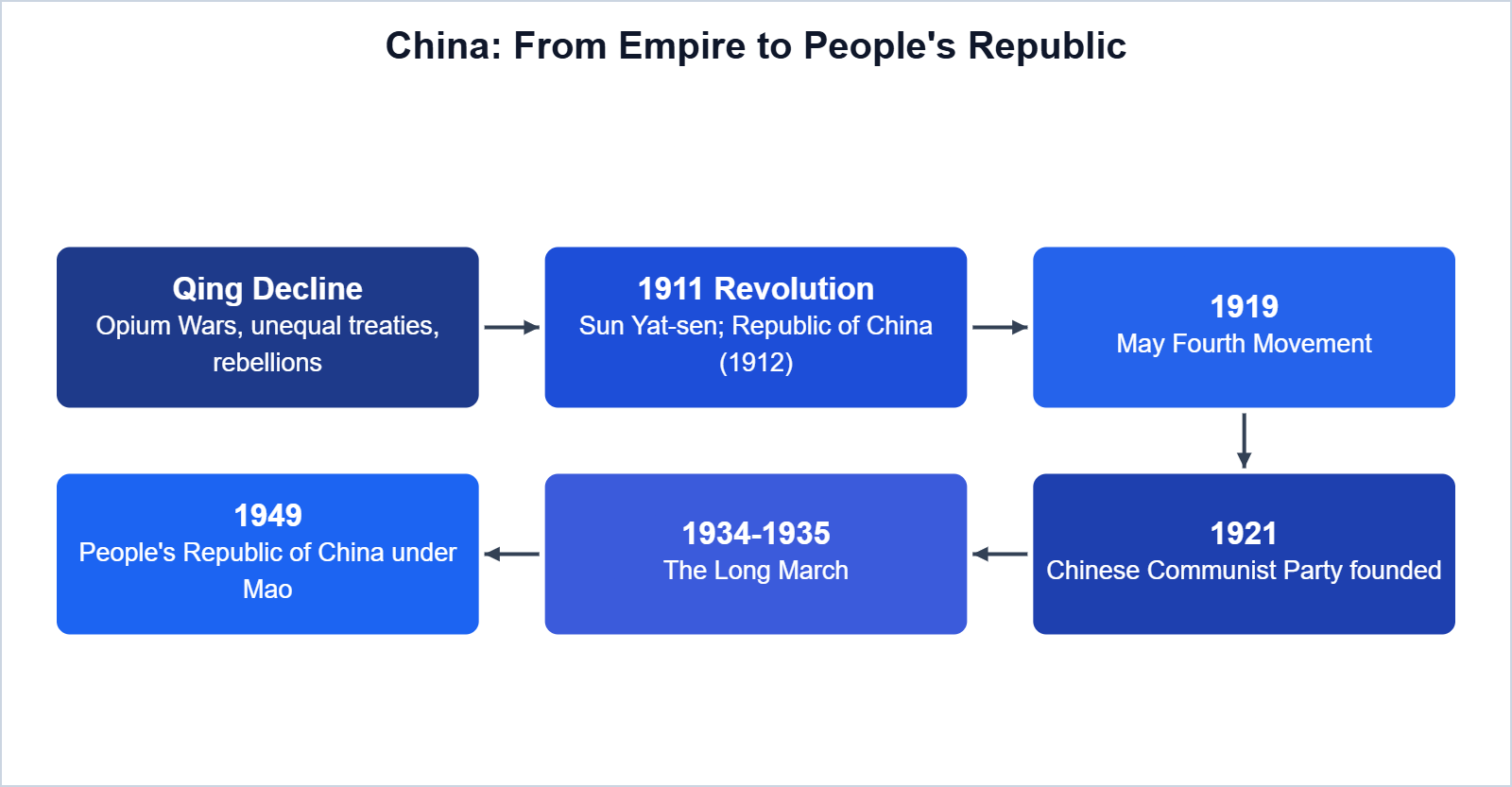
- In 1911, a revolution overthrew the Qing dynasty, and the Republic of China was set up in 1912. Sun Yat-sen is regarded as the founder of modern China. His Three Principles were nationalism, democracy and socialism (people’s livelihood).
- The May Fourth Movement (1919) was a protest by students and intellectuals against foreign domination and old traditions.
- After Sun’s death, Chiang Kai-shek led the Guomindang (Nationalist Party). The Chinese Communist Party, founded in 1921, became its rival.
- The communists, under Mao Zedong, made the Long March (1934-1935) and built support among peasants. After war with Japan and a civil war, they won, and the People’s Republic of China was proclaimed on 1 October 1949. Chiang Kai-shek’s government moved to Taiwan.
- Under Mao, China launched the Great Leap Forward (1958) and the Cultural Revolution (1966). From 1978, Deng Xiaoping introduced economic reforms that opened China to market forces.
Easy Memory Trick for China: “Opium, Revolution, Party, March, Mao” = 1839, 1911, 1921, 1934, 1949.
8. Important Terms
Term | Meaning |
|---|---|
Shogun | The military ruler of Japan before 1868 |
Samurai | The warrior class of Japan |
Meiji | “Enlightened rule”; the name of the emperor’s reign from 1868 |
Zaibatsu | Large family-controlled business groups in Japan |
Guomindang | The Nationalist Party of China |
Long March | The long retreat of the Chinese communists in 1934-1935 |
9. Short Answer Questions
Q1. What was the Meiji Restoration?
Ans. It was the event in 1868 when the rule of the Tokugawa shogun ended and power was restored to the emperor, beginning a period of rapid modernization in Japan.
Q2. What was the slogan of the Meiji government?
Ans. “Rich country, strong army” (fukoku kyohei).
Q3. Why did the Opium War take place?
Ans. Britain was selling opium in China to pay for tea. When China tried to stop the trade, Britain went to war (1839-1842) to force China to keep its markets open.
Q4. What were Sun Yat-sen’s Three Principles?
Ans. Nationalism, democracy and socialism (people’s livelihood).
Q5. When was the People’s Republic of China established?
Ans. On 1 October 1949, under the leadership of Mao Zedong.
10. Long Answer Questions
Q1. Describe the main reforms of the Meiji period in Japan.
Ans. After 1868, the Meiji government abolished the old feudal domains and created a strong central government. A modern army was built through conscription, and the samurai lost their privileges. Compulsory education was introduced, combining Western knowledge with loyalty to the emperor. The government built railways, modern banks and factories, and encouraged large business groups (zaibatsu). A constitution was adopted in 1889. These reforms turned Japan into a modern industrial and military power within a few decades.
Q2. Compare the paths to modernization followed by Japan and China.
Ans. Japan modernized through reforms from above. After the Meiji Restoration of 1868, the government led industrialization, education and military reform while keeping the emperor as a symbol of unity, and Japan quickly became a strong power. China, on the other hand, faced foreign defeats, unequal treaties and rebellions under the weak Qing dynasty. Modernization came through revolution: the Republic was set up in 1912, followed by a long struggle between the Nationalists and Communists, ending with the communist victory in 1949. Later, reforms after 1978 made China a major economic power. Thus Japan followed a path of state-led reform, while China followed a path of revolution.
Conclusion: Japan and China both had to face the West and modernize, but their histories, leaders and methods were different. Their experiences show that there is no single path to becoming a modern nation.