Changing Traditions: Introduction and Timeline III – Class 11 History
Part – III
Changing Traditions: Introduction and Timeline III
(c. 1300 to 1700)
1. Introduction
Part III looks at Western Europe from the medieval period to the early modern period. It studies how society was organised into three orders (clergy, nobility and peasants), and how this system slowly changed with the growth of towns, crises like the Black Death, the rise of strong kings, and new ideas of the Renaissance, the Reformation and the Scientific Revolution.
Remember: Medieval means “of the Middle Ages”, the period between the fall of the Western Roman Empire and the beginning of the modern age.
2. Major Developments
- Feudal society based on land and the three orders.
- Growth of towns, trade and guilds.
- Crisis of the 14th century: famine, plague and peasant revolts.
- Rise of new, more powerful monarchies.
- The Renaissance in Italy, the printing press, the Reformation and new scientific ideas.
- European voyages of exploration across the oceans.
3. Timeline III
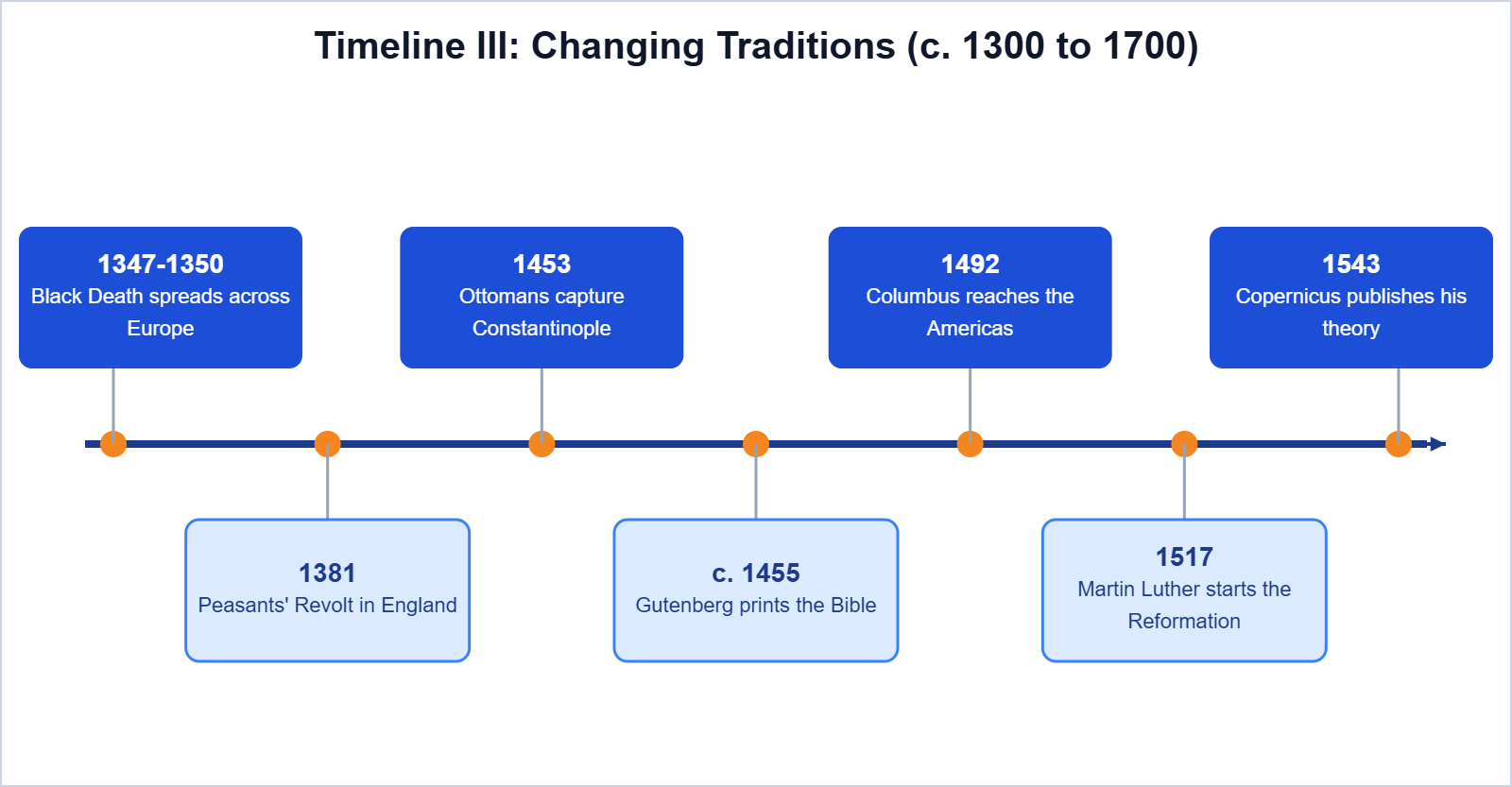
Date | Event |
|---|---|
1347-1350 | The Black Death (plague) spreads across Europe |
1381 | Peasants’ Revolt in England |
1453 | The Ottoman Turks capture Constantinople |
c. 1455 | Johannes Gutenberg prints the Bible with movable type |
1492 | Christopher Columbus reaches the Americas |
1498 | Vasco da Gama reaches India by sea |
1517 | Martin Luther begins the Protestant Reformation |
1543 | Copernicus publishes his theory that the earth moves around the sun |
1687 | Isaac Newton publishes his laws of motion and gravitation |
Exam point: 1453 (fall of Constantinople) and 1517 (Reformation) are among the most frequently asked dates of this part.
Easy Memory Trick: “Plague, Print, Protest”: Black Death (1347), printing (c. 1455) and Protestant Reformation (1517).
Conclusion: Between 1300 and 1700, European society moved from a feudal order dominated by the Church and the nobility towards new ideas about the individual, religion and science.