CHAPTER 15
LIFE ON THE EARTH
1. Biosphere
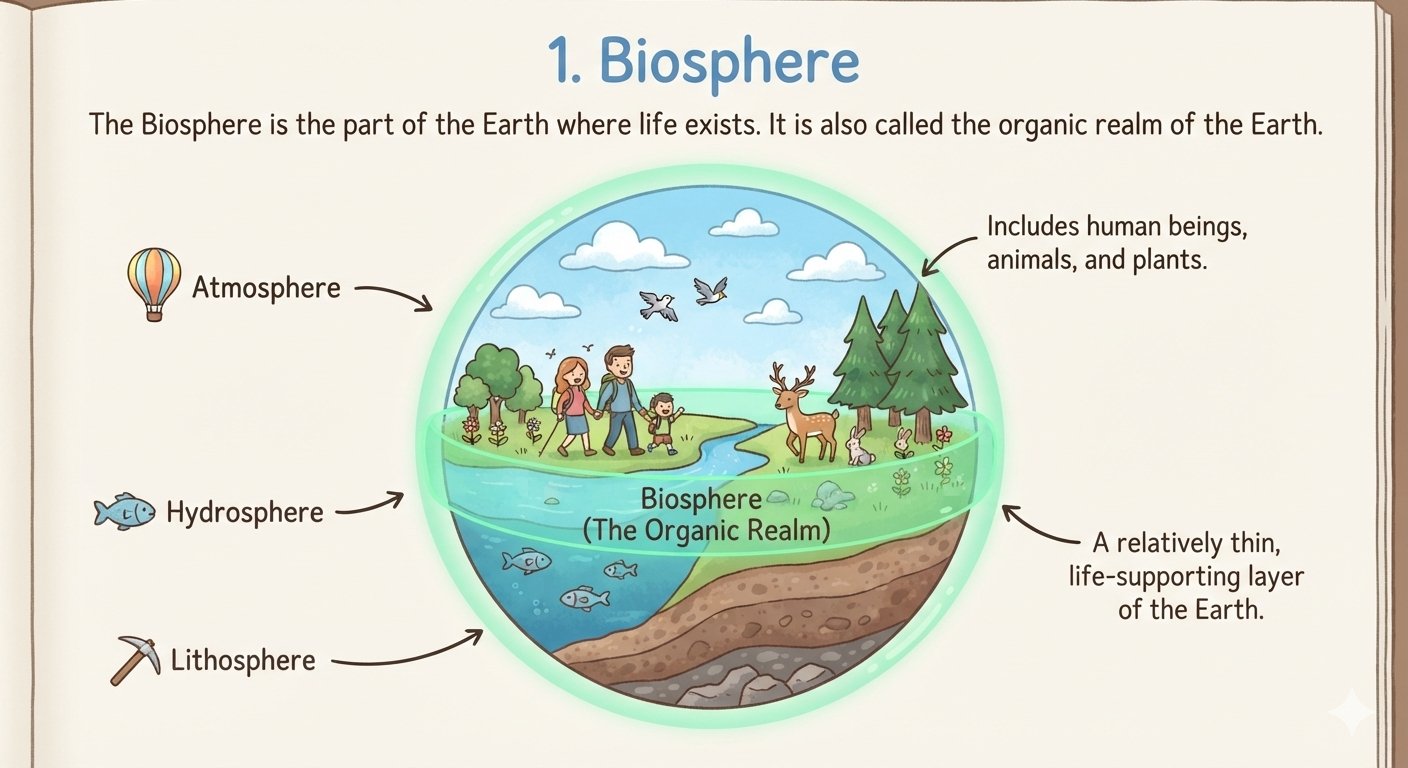
The biosphere is the part of the Earth where life exists. It is also called the organic realm of the Earth.
Main Points
- The biosphere supports all forms of life.
- It includes human beings, animals and plants.
- It is a relatively thin, life-supporting layer of the Earth.
- The biosphere exists at the interface of three major physical realms:
- Lithosphere – land and rocks
- Atmosphere – air
- Hydrosphere – water
- The biosphere therefore represents the zone where land, water and air interact to support life.
2. Ecosystem
An ecosystem is a system in which living organisms interact with one another and with their non-living surroundings.
Components of an Ecosystem
An ecosystem has two main components:
1. Biotic Components – Living things
- Plants
- Animals
- Humans
- Microorganisms
2. Abiotic Components – Non-living things
- Air
- Water
- Soil
- Sunlight
- Temperature
- Minerals
Important Point
The living and non-living components of an ecosystem are interdependent and work together to maintain the ecosystem.
3. Flow of Energy
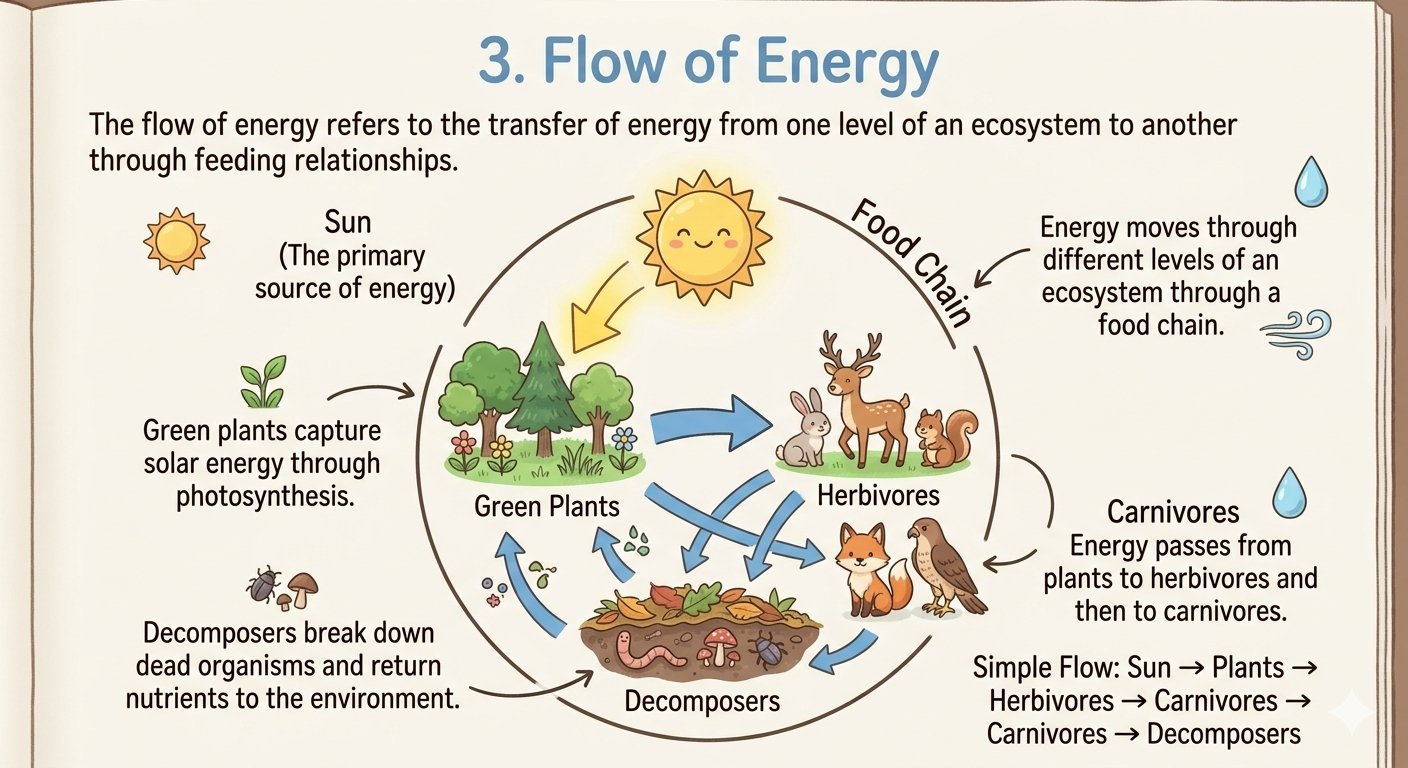
The flow of energy refers to the transfer of energy from one level of an ecosystem to another through feeding relationships.
Main Points
- The Sun is the primary source of energy for most ecosystems.
- Green plants capture solar energy through photosynthesis.
- Energy passes from plants to herbivores and then to carnivores.
- Decomposers break down dead organisms and return nutrients to the environment.
- Thus, energy moves through different levels of an ecosystem through a food chain.
Simple Flow:
Sun → Plants → Herbivores → Carnivores → Decomposers
4. Food Chain
A food chain is a sequence of organisms through which food, nutrients and energy are transferred as one organism eats another.
Main Stages
1. Producers
- Green plants are called producers.
- They prepare their own food through photosynthesis.
2. Primary Consumers
- Herbivores eat plants.
- Examples: deer, cow, rabbit and buffalo.
3. Secondary Consumers
- Carnivores that eat herbivores are secondary consumers.
- Examples: foxes and some other meat-eating animals.
4. Decomposers
- Bacteria and fungi break down dead plants and animals.
- They help return nutrients to the soil and environment.
Example
Grass → Deer → Tiger → Decomposers
The sequence of eating and being eaten results in the transfer of energy from one level to another.
5. Biome
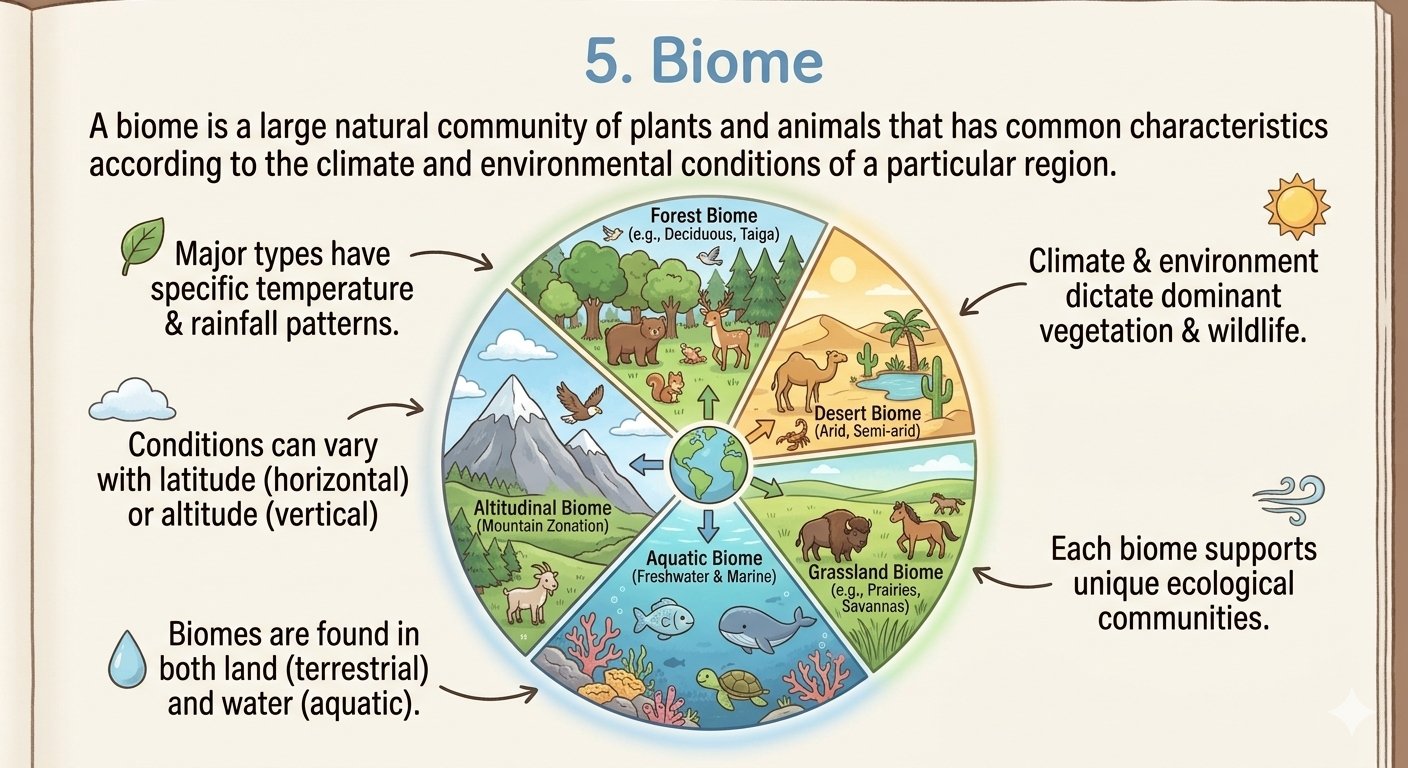
A biome is a large natural community of plants and animals that has common characteristics according to the climate and environmental conditions of a particular region.
Major Types of Biomes
There are five major types:
- Forest Biome
- Desert Biome
- Grassland Biome
- Aquatic Biome
- Altitudinal Biome
Brief Description
- Forest Biome: Dominated by trees and other vegetation.
- Desert Biome: Characterized by very low rainfall and limited vegetation.
- Grassland Biome: Mainly covered by grasses.
- Aquatic Biome: Includes water-based environments such as rivers, lakes, seas and oceans.
- Altitudinal Biome: Changes in vegetation and animal life according to changes in altitude.
6. Biogeochemical Cycles
Biogeochemical cycles are the cyclic movements of chemical elements between living organisms and the non-living environment.
The word biogeochemical consists of:
- Bio → Living organisms
- Geo → Earth, rocks, soil, air and water
- Chemical → Chemical elements and substances
Main Features
- Chemical elements continuously move between organisms and their environment.
- Plants absorb nutrients from the soil, air and water.
- Animals obtain these elements by eating plants or other animals.
- When plants and animals die, decomposers break them down.
- Nutrients are returned to the soil, air and water.
- These nutrients can again be used by living organisms.
Importance
Biogeochemical cycles help maintain the balance of chemical elements necessary for life.
7. Nitrogen Fixation
The atmosphere contains a large amount of nitrogen gas, but most organisms cannot directly use atmospheric nitrogen.
Nitrogen fixation is the process by which atmospheric nitrogen is converted into forms that can be used by plants and other organisms.
Main Agents of Nitrogen Fixation
1. Soil Microorganisms
- Certain microorganisms in the soil convert atmospheric nitrogen into usable forms.
- Some are associated with plant roots.
2. Lightning
- Lightning provides enough energy to help nitrogen combine with oxygen and form nitrogen compounds.
3. Cosmic Radiation
- Cosmic radiation can also contribute to the fixation of atmospheric nitrogen.
Importance
Nitrogen is essential for the growth of plants and for the formation of important biological substances.
8. Ecological Balance
Ecological balance is a state of dynamic equilibrium in which organisms and their environment remain relatively stable.
An ecosystem remains balanced when the populations of different organisms and their relationships with one another remain within suitable limits.
Importance of Ecological Balance
- Maintains stability in ecosystems.
- Supports the survival of different species.
- Maintains food chains and food webs.
- Helps maintain natural resources.
- Supports biodiversity.
- Allows organisms to depend on one another in a balanced way.
9. Interdependence of Organisms
Organisms in an ecosystem are interdependent. They depend on one another for food, shelter and other requirements.
Example
In grasslands:
Grass → Deer/Zebra/Buffalo → Tiger/Lion
- Herbivores depend on grass for food.
- Carnivores depend on herbivores for food.
- When plants and animals die, decomposers break down their remains.
- Nutrients are returned to the soil and become available to plants again.
Thus, every organism has an important role in maintaining the ecosystem.
10. Ecological Succession
Ecological succession is the gradual change in the composition and structure of a biological community over time.
Example
When a natural forest is cleared:
- The original plant species may disappear.
- Grasses, bamboos or other species may occupy the area.
- Over time, different plant communities may replace one another.
- This changes the original structure of the forest.
This gradual replacement of one community by another is known as ecological succession.
Theory Questions and Answers
Q1. What do you mean by Biosphere? Explain its importance.
Ans: The biosphere is the part of the Earth that supports life. It is also known as the organic realm of the Earth. It includes all living organisms such as human beings, animals, plants and microorganisms. The biosphere is found at the meeting point of the three major physical realms of the Earth: the lithosphere, atmosphere and hydrosphere. The lithosphere provides land and soil, the atmosphere provides air and gases, and the hydrosphere provides water. All living organisms depend on these components for survival. The biosphere is therefore an important life-supporting zone where living organisms interact with their physical environment.
Q2. What do you mean by an ecosystem? Explain its components.
Ans: An ecosystem is a system in which living organisms interact with one another and with their non-living surroundings. It consists of two major components: biotic components and abiotic components. Biotic components include plants, animals, human beings and microorganisms. Abiotic components include air, water, soil, sunlight, temperature and minerals. Green plants prepare their food using sunlight and form the base of the food chain. Animals depend directly or indirectly on plants for food. Decomposers break down dead organisms and return nutrients to the environment. Thus, all components of an ecosystem are interdependent and work together to maintain ecological balance.
Q3. What is the flow of energy in an ecosystem?
Ans: The flow of energy refers to the transfer of energy from one level of an ecosystem to another. The Sun is the main source of energy for most ecosystems. Green plants capture solar energy through photosynthesis and convert it into food energy. Herbivores obtain this energy by eating plants. Carnivores obtain energy by eating herbivores or other animals. When plants and animals die, decomposers break down their remains and obtain energy from them. In this way, energy passes through different organisms in an ecosystem. A simple sequence of energy flow is Sun → Plants → Herbivores → Carnivores → Decomposers.
Q4. What is a food chain? Explain with an example.
Ans: A food chain is a sequence of organisms through which food and energy pass as one organism eats another. It begins with producers, mainly green plants, which prepare their own food through photosynthesis. Plants are eaten by primary consumers, usually herbivores. These herbivores may then be eaten by secondary consumers, such as carnivorous animals. When organisms die, decomposers such as bacteria and fungi break down their remains. Thus, a food chain represents the relationship of eating and being eaten and shows the transfer of energy from one organism to another. For example: Grass → Deer → Tiger → Decomposers.
Q5. What is a biome? Describe its major types.
Ans: A biome is a large natural community of plants and animals that occurs in a particular region and has common characteristics according to its environmental conditions. Climate, temperature, rainfall and soil influence the type of biome found in an area. There are five major types of biomes: forest, desert, grassland, aquatic and altitudinal. Forest biomes are dominated by trees and vegetation. Desert biomes receive very little rainfall and have limited vegetation. Grasslands are mainly covered by grasses. Aquatic biomes include water environments such as rivers, lakes, seas and oceans. Altitudinal biomes change according to differences in altitude.
Q6. What are biogeochemical cycles? Explain their importance.
Ans: Biogeochemical cycles are the cyclic movements of chemical elements between living organisms and the non-living environment. The word “bio” refers to living organisms, while “geo” refers to the Earth, including soil, rocks, air and water. Plants absorb various elements and nutrients from the environment. Animals obtain these elements by eating plants or other animals. When plants and animals die, decomposers break down their remains and return nutrients to the soil, air and water. These nutrients are again taken up by plants and reused by living organisms. Thus, biogeochemical cycles help maintain the balance of essential chemical elements in the biosphere.
Q7. Explain how nitrogen is fixed in the atmosphere.
Ans: Nitrogen fixation is the process through which atmospheric nitrogen is converted into forms that can be used by plants and other organisms. Although the atmosphere contains a large amount of nitrogen, most plants cannot use atmospheric nitrogen directly. Certain soil microorganisms and microorganisms associated with plant roots play an important role in fixing nitrogen. Lightning also provides energy that helps atmospheric nitrogen combine with oxygen and form nitrogen compounds. Cosmic radiation can also contribute to nitrogen fixation. The fixed nitrogen becomes available to plants through the soil. Nitrogen is essential for plant growth and for the formation of important substances in living organisms.
Q8. What is ecological balance? Why is it important?
Ans: Ecological balance is a state of dynamic equilibrium in which living organisms and their environment remain relatively stable. It depends on the proper relationship between different organisms and the physical environment. Organisms in an ecosystem are interdependent for food and other requirements. For example, grass provides food for herbivores such as deer, zebras and buffaloes, while these herbivores provide food for carnivorous animals such as tigers and lions. Decomposers return nutrients to the soil after organisms die. Maintaining ecological balance is important because it supports biodiversity, maintains food chains and allows different species to survive. Human activities that disturb natural ecosystems can affect this balance.
Q9. Explain the interdependence of organisms in an ecosystem.
Ans: Organisms in an ecosystem are interdependent, meaning that they depend on one another for food, energy and other requirements. Green plants are producers and prepare food through photosynthesis. Herbivores depend on plants for food, while carnivores depend on herbivores or other animals. Decomposers depend on dead plants and animals and break down their remains. During decomposition, nutrients are returned to the soil and can again be absorbed by plants. For example, in a grassland, grass is eaten by deer and buffaloes, while carnivores such as lions may depend on these herbivores for food. This interdependence helps maintain the balance and functioning of an ecosystem.
Q10. What is ecological succession? Explain with an example.
Ans: Ecological succession is the gradual and natural change in the composition and structure of a biological community over time. Different species may replace one another as environmental conditions change. For example, when a natural forest is cleared, the original forest species may disappear. Grasses, shrubs, bamboos or other plants may first occupy the area. Later, other plant species may become established and gradually change the structure of the community. Competition between different species also influences this process. Therefore, ecological succession describes the gradual replacement of one biological community by another and represents a natural process of change in an ecosystem.
Multiple Choice Questions (MCQs)
1. What is the biosphere?
A. The layer of rocks around Earth
B. The part of Earth that supports life
C. The layer of gases only
D. The water present on Earth
Answer: B. The part of Earth that supports life
2. The biosphere is also known as the:
A. Physical realm
B. Organic realm
C. Atmospheric realm
D. Mineral realm
Answer: B. Organic realm
3. Which of the following is NOT a major realm associated with the biosphere?
A. Lithosphere
B. Atmosphere
C. Hydrosphere
D. Stratosphere
Answer: D. Stratosphere
4. The lithosphere mainly consists of:
A. Air
B. Water
C. Land and rocks
D. Living organisms
Answer: C. Land and rocks
5. The hydrosphere refers to:
A. Air
B. Water
C. Soil
D. Rocks
Answer: B. Water
6. The atmosphere provides:
A. Air and gases
B. Rocks only
C. Soil only
D. Minerals only
Answer: A. Air and gases
7. Which of the following is included in the biosphere?
A. Plants
B. Animals
C. Human beings
D. All of these
Answer: D. All of these
8. What is an ecosystem?
A. Only a group of animals
B. Only a group of plants
C. A system of living and non-living components interacting with each other
D. Only a physical environment
Answer: C. A system of living and non-living components interacting with each other
9. Which of the following is a biotic component?
A. Water
B. Soil
C. Plant
D. Sunlight
Answer: C. Plant
10. Which of the following is an abiotic component?
A. Animal
B. Plant
C. Bacteria
D. Water
Answer: D. Water
11. Biotic components are:
A. Non-living things
B. Living organisms
C. Rocks only
D. Minerals only
Answer: B. Living organisms
12. Which of the following is an abiotic factor?
A. Deer
B. Grass
C. Temperature
D. Bacteria
Answer: C. Temperature