CHAPTER 13
OCEANS
Why do we call the Earth a Blue Planet?
The Earth is called the Blue Planet because about 71% of its surface is covered with water.
Water is essential for all forms of life. Earth has a large amount of water compared with other planets in our Solar System. When seen from space, the large amount of water makes Earth appear blue.
Remember:
71% of Earth’s surface = Water → Earth looks Blue → Blue Planet
Hydrological Cycle
The hydrological cycle is the continuous movement of water between the Earth’s surface and the atmosphere.
Main Steps:
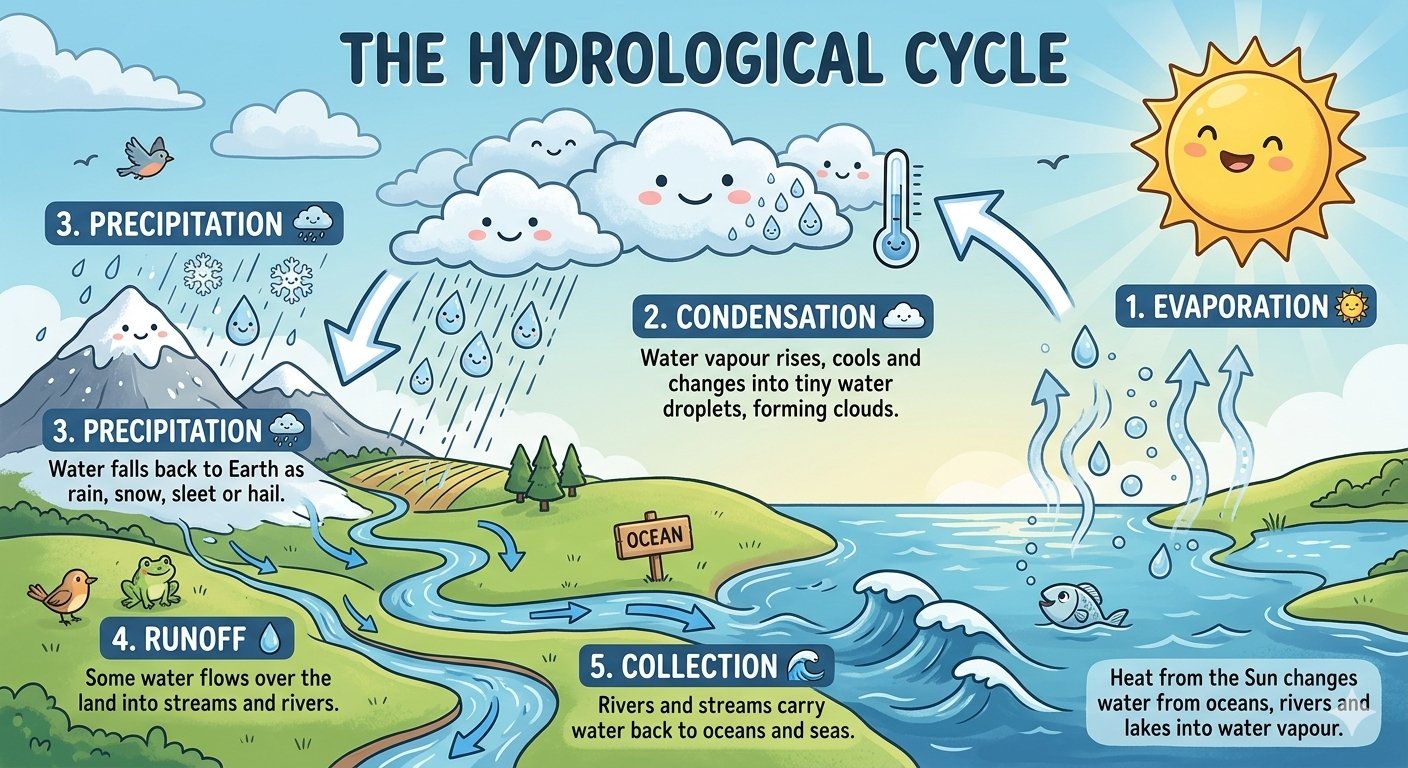
1. Evaporation ☀️
Heat from the Sun changes water from oceans, rivers and lakes into water vapour.
2. Condensation ☁️
Water vapour rises, cools and changes into tiny water droplets, forming clouds.
3. Precipitation 🌧️
Water falls back to Earth as rain, snow, sleet or hail.
4. Runoff 💧
Some water flows over the land into streams and rivers.
5. Collection 🌊
Rivers and streams carry water back to oceans and seas.
This process continues again and again, so it is called the Hydrological Cycle.
Deepest Trenches of Various Oceans
Ocean trenches are very deep and narrow depressions in the ocean floor.
According to the given text, 57 deeps have been explored:
- 32 in the Pacific Ocean
- 19 in the Atlantic Ocean
- 6 in the Indian Ocean
Important Ocean Trenches
| Trench | Ocean | Important Fact |
|---|---|---|
| Mariana Trench | Pacific Ocean | World’s deepest ocean trench |
| Puerto Rico Trench | Atlantic Ocean | Deepest trench in the Atlantic |
| Sunda Trench | Indian Ocean | Deepest trench in the Indian Ocean |
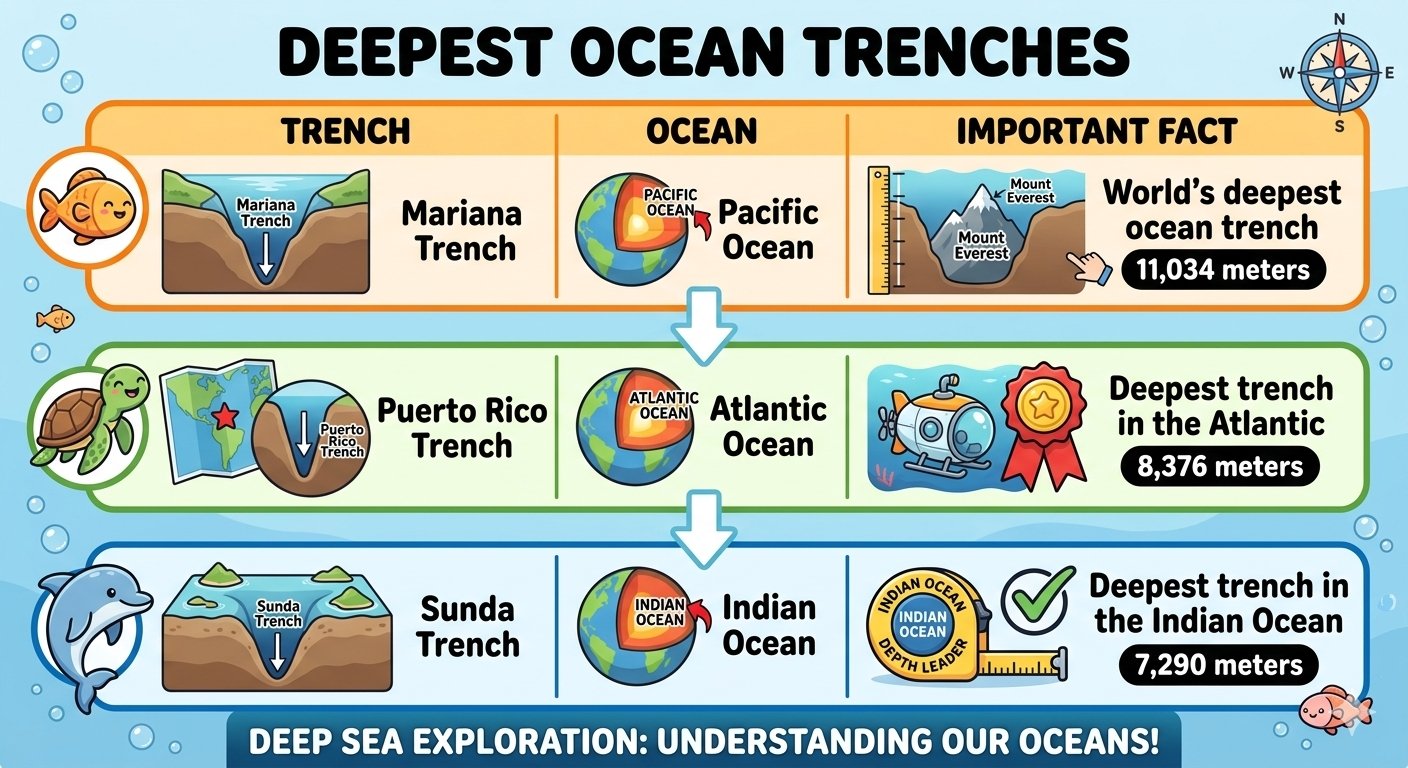
Mariana Trench
- Located in the Pacific Ocean.
- It is the deepest known ocean trench.
- Its deepest point is about 11,000 metres below sea level.
Thermocline
A thermocline is a layer in the ocean where the temperature decreases rapidly with increasing depth.
- Ocean water is generally warmer near the surface.
- Temperature decreases as we go deeper.
- A rapid decrease in temperature occurs in a particular layer.
- This layer is called the thermocline.
- It generally begins around 100–400 metres below the sea surface and may extend several hundred metres downward.
Salinity of Sea Water
Salinity means the amount of dissolved salts present in sea water.
It is usually measured as the amount of salt present in 1,000 grams of seawater and expressed in parts per thousand (‰).
Important Points:
- Sea water contains dissolved mineral salts.
- Salinity is an important property of sea water.
- Salinity varies from place to place.
- It can also change with depth.
- The salinity of 24.7‰ is considered the upper limit separating fresh water and brackish water in the given classification.
Example:
If 35 grams of salt are present in 1,000 grams of seawater, salinity is approximately 35‰.
Factors Influencing the Temperature Distribution of Oceans
The temperature of ocean water is not the same everywhere. It is affected by several factors.
1. Latitude
- Ocean temperature generally decreases from the Equator towards the poles.
- This happens because the amount of solar energy received decreases towards the poles.
- Low-latitude seas are generally warmer.
- High-latitude seas are generally colder.
2. Unequal Distribution of Land and Water
- Land and water are not equally distributed between the Northern and Southern Hemispheres.
- The Northern Hemisphere has more land.
- Land heats and cools faster than water.
- This affects the temperature of nearby ocean water.
3. Prevailing Winds
Prevailing winds can move surface ocean water.
- Winds blowing away from the coast can cause cold water from deeper layers to rise.
- Winds blowing towards the coast can push and collect warm surface water near the coast.
4. Ocean Currents
Ocean currents carry warm or cold water from one region to another.
- Warm currents increase temperatures in colder regions.
- Cold currents reduce temperatures in warmer regions.
5. Salinity
- Salinity affects the physical properties of seawater, including its heat behavior.
- Differences in salinity can contribute to differences in ocean-water temperature and circulation.
6. Ice Floes and Icebergs
- Ice floes are pieces of floating sea ice.
- Icebergs are large pieces of ice floating in the sea.
- They are mainly found in polar regions.
- They keep the surrounding ocean water very cold.
SHORT QUESTIONS & ANSWERS
Q1. Why is the Earth called the Blue Planet?
Ans: The Earth is called the Blue Planet because about 71% of its surface is covered with water. Water is essential for the survival of all living organisms. The large amount of water on Earth’s surface makes it appear blue when viewed from space. Earth has abundant water compared with other planets in the Solar System. Therefore, it is popularly known as the Blue Planet.
Q2. What is the hydrological cycle? Explain its main stages.
Ans: The hydrological cycle is the continuous movement of water between the Earth’s surface and the atmosphere. The main stages are evaporation, condensation, precipitation, runoff and collection. Water evaporates due to the Sun’s heat, forms clouds through condensation, and returns to Earth as rain, snow, sleet or hail. Water then flows through rivers and streams and finally returns to oceans.
Q3. What is evaporation and why is it important in the hydrological cycle?
Ans: Evaporation is the process by which water changes into water vapour due to the heat of the Sun. Water from oceans, rivers, lakes and other water bodies evaporates and rises into the atmosphere. It is an important first stage of the hydrological cycle because it supplies water vapour needed for cloud formation and later precipitation.
Q4. What is condensation? Why is it important?
Ans: Condensation is the process in which water vapour cools and changes into tiny water droplets. These droplets collect together to form clouds. Condensation is an important stage of the hydrological cycle because it prepares water to return to the Earth’s surface as precipitation. Without condensation, the formation of clouds and rainfall would not take place in the normal water cycle.
Q5. What are ocean trenches? Name some important ocean trenches.
Ans: Ocean trenches are very deep and narrow depressions found on the ocean floor. They are among the deepest parts of the oceans. Important trenches include the Mariana Trench in the Pacific Ocean, the Puerto Rico Trench in the Atlantic Ocean and the Sunda Trench in the Indian Ocean. The Mariana Trench is the deepest known ocean trench.
Q6. Write a short note on the Mariana Trench.
Ans: The Mariana Trench is located in the Pacific Ocean. It is the deepest known ocean trench in the world. Its deepest point, called the Challenger Deep, is about 11 kilometres below sea level. The trench is a long, narrow depression in the ocean floor. It is an important example of the great depths found in the world’s oceans.
Q7. What is a thermocline?
Ans: A thermocline is a layer of ocean water where the temperature decreases rapidly with increasing depth. Ocean water is generally warmer near the surface because it receives heat from the Sun. As we move deeper, the temperature decreases. The thermocline generally begins at about 100–400 metres below the sea surface and may extend several hundred metres downward.
Q8. What is salinity of seawater?
Ans: Salinity means the total amount of dissolved salts present in seawater. It is generally measured as the amount of salt dissolved in 1,000 grams of seawater and expressed in parts per thousand (‰). Salinity is an important property of seawater. It varies from place to place and can also change with depth depending upon local conditions.
Q9. Explain the effect of latitude on ocean temperature.
Ans: Latitude is an important factor affecting ocean temperature. Ocean surface temperature generally decreases from the Equator towards the poles. This happens because the Equator receives more direct solar energy, while the polar regions receive less solar energy. Therefore, tropical oceans are generally warmer, whereas oceans near the poles are much colder.
Q10. How do ocean currents affect the temperature of ocean water?
Ans: Ocean currents transport water from one region to another and affect ocean temperatures. Warm ocean currents carry warm water towards colder regions and increase their temperature. In contrast, cold ocean currents carry cold water towards warmer regions and reduce temperatures. Thus, ocean currents play an important role in controlling the distribution of temperature over the oceans.
MULTIPLE CHOICE QUESTIONS
1. Why is the Earth called the Blue Planet?
A. It has blue mountains
B. It has a blue atmosphere
C. About 71% of its surface is covered with water
D. It has blue soil
Answer: C
2. Approximately what percentage of Earth’s surface is covered by water?
A. 51%
B. 61%
C. 71%
D. 81%
Answer: C
3. What is the hydrological cycle?
A. Movement of rocks
B. Continuous movement of water
C. Movement of soil
D. Movement of air
Answer: B
4. Which process changes water into water vapour?
A. Condensation
B. Precipitation
C. Evaporation
D. Runoff
Answer: C
5. Which process changes water vapour into water droplets?
A. Evaporation
B. Condensation
C. Runoff
D. Collection
Answer: B
6. Which of the following is a form of precipitation?
A. Evaporation
B. Condensation
C. Rain
D. Water vapour
Answer: C
7. Which of the following is NOT a form of precipitation?
A. Rain
B. Snow
C. Hail
D. Evaporation
Answer: D
8. What happens to some rainwater after it reaches the ground?
A. It becomes sunlight
B. It flows into streams and rivers
C. It disappears completely
D. It becomes salt
Answer: B
9. Where does much of the water in the hydrological cycle finally return?
A. Mountains
B. Deserts
C. Oceans
D. Forests
Answer: C
10. What are ocean trenches?
A. High mountains in oceans
B. Deep and narrow depressions in the ocean floor
C. Floating islands
D. Coral reefs
Answer: B
11. Which is the deepest known ocean trench?
A. Sunda Trench
B. Puerto Rico Trench
C. Mariana Trench
D. Java Trench
Answer: C
12. The Mariana Trench is located in the:
A. Atlantic Ocean
B. Indian Ocean
C. Pacific Ocean
D. Arctic Ocean
Answer: C
13. Which trench is located in the Atlantic Ocean?
A. Mariana Trench
B. Puerto Rico Trench
C. Sunda Trench
D. Java Trench
Answer: B
14. Which is an important trench of the Indian Ocean?
A. Sunda Trench
B. Puerto Rico Trench
C. Mariana Trench
D. Peru Trench
Answer: A
15. The Mariana Trench is approximately:
A. 5,000 metres deep
B. 7,000 metres deep
C. 9,000 metres deep
D. 11,000 metres deep
Answer: D