CHAPTER 12
WORLD CLIMATE & CLIMATE CHANGE
–> Meaning of Climate
Climate means the average weather conditions of a place over a long period of time.
The two most important elements used to describe climate are:
- Temperature – how hot or cold a place is.
- Precipitation – rainfall, snowfall, etc.
–> Weather vs Climate
- Weather: Condition of the atmosphere at a particular time.
- Climate: Average weather condition of a place over many years.
–> Koeppen’s Classification of Climate
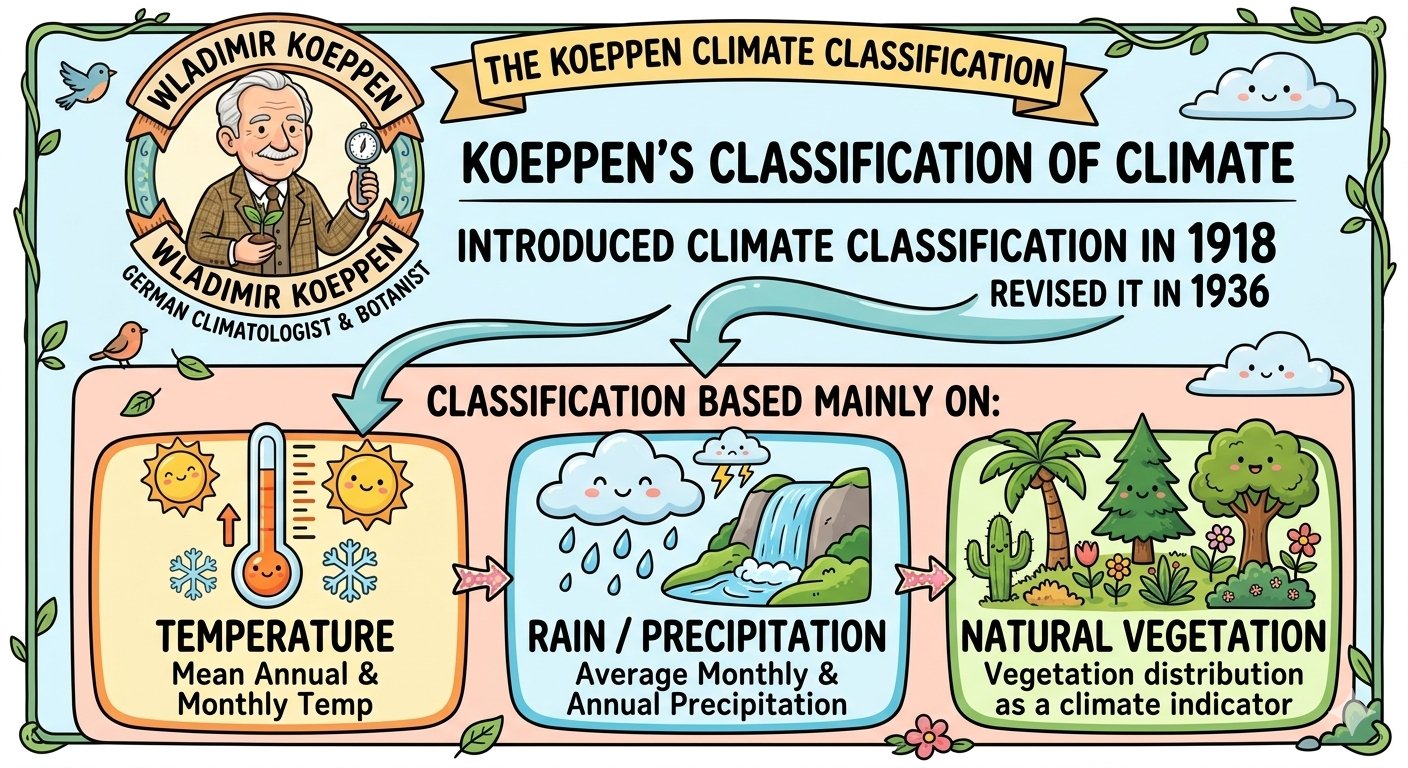
Wladimir Koeppen was a German climatologist and botanist. He introduced his climate classification in 1918 and revised it in 1936.
His classification was based mainly on:
- Temperature
- Rainfall/precipitation
- Natural vegetation
Koeppen believed that there is a close relationship between climate and vegetation.
He used capital and small letters to represent different climate types.
–> Five Major Climate Groups
| Group | Climate | Main Characteristic |
|---|---|---|
| A | Tropical | Coldest month has temperature 18°C or above |
| B | Dry | Evaporation is greater than precipitation |
| C | Warm Temperate | Coldest month is above -3°C but below 18°C |
| D | Cold Snow Forest | Coldest month is -3°C or below and warmest month is above 10°C |
| E | Polar | Very cold climate; summer is extremely short or absent |
- Found mainly between the Tropic of Cancer and Tropic of Capricorn.
- Temperature remains high throughout the year.
- The coldest month has a temperature of 18°C or above.
- These areas generally receive considerable rainfall.
- The climate is generally hot and humid.
- Dense forests are commonly found in areas with heavy rainfall.
Example: Amazon Basin, Congo Basin and parts of Southeast Asia.
B – Dry Climate
- These areas receive very little rainfall.
- Rainfall is not enough for the growth of many plants.
- Potential evaporation is greater than precipitation.
- Deserts and semi-deserts are common.
- These climates are found in many parts of the world.
Examples: Sahara Desert, Arabian Desert and parts of Australia.
C – Warm Temperate / Mid-Latitude Climate
- Mainly found in middle latitudes.
- Summers are generally warm.
- Winters are generally mild.
- These climates occur mainly in parts of the eastern and western margins of continents.
Examples: Parts of Europe, eastern China and the southeastern United States.
D – Cold Snow Forest Climate
- Mainly found in the Northern Hemisphere.
- Common between about 40° and 70° N.
- Winters are very cold.
- The coldest month has a temperature of -3°C or below.
- The warmest month has a temperature of above 10°C.
- Coniferous and other cold-region forests are common.
Examples: Canada, northern Europe and Siberia.
E – Polar Climate
- Found near the North and South Poles.
- Temperatures remain extremely low.
- There is no proper warm summer season.
- Even summer temperatures can remain very low.
- Tundra vegetation is found in some polar regions.
- Antarctica has an extremely cold polar climate.
Examples: Antarctica, Greenland and Arctic regions.
Highland Climate – H
Highland climate is mainly controlled by altitude/elevation.
- Temperature decreases as altitude increases.
- Mountain areas can be cold even when surrounding lowlands are warm.
- Climate changes with height.
- Snowfall may occur at higher elevations.
Examples: Himalayas, Alps and Andes.
–> World Climate According to Temperature
According to temperature, the world can broadly be divided into three major zones:
- Tropical Zone
- Sub-Tropical/Temperate Zone
- Polar Zone
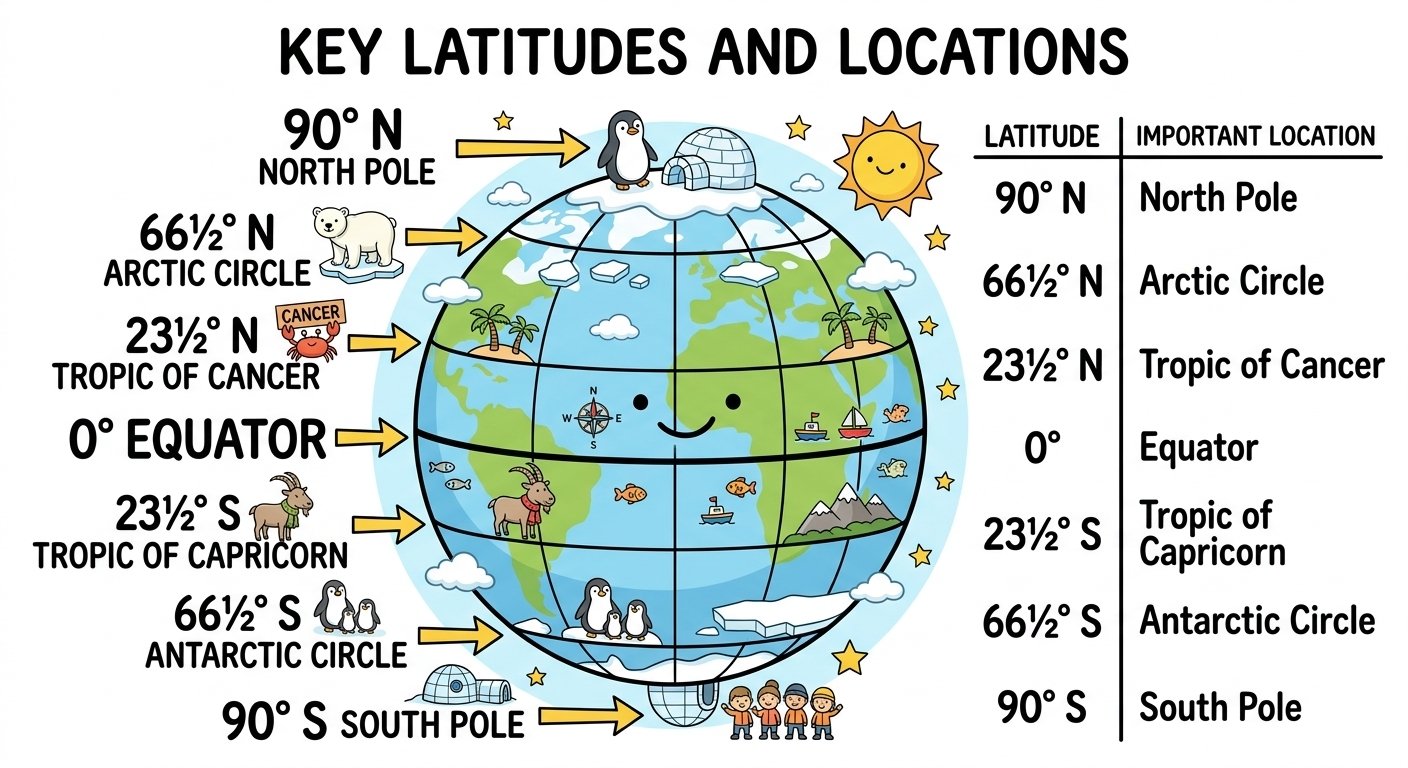
Important Latitudes
| Latitude | Important Location |
|---|---|
| 90° N | North Pole |
| 66½° N | Arctic Circle |
| 23½° N | Tropic of Cancer |
| 0° | Equator |
| 23½° S | Tropic of Capricorn |
| 66½° S | Antarctic Circle |
| 90° S | South Pole |
Tropical Zone
- Extends between 23½° N and 23½° S.
- It lies between the Tropic of Cancer and Tropic of Capricorn.
- The Sun’s rays are almost vertical.
- Temperatures are generally high throughout the year.
- The coldest month generally has a temperature of 18°C or above.
Main feature: ☀️ Hot throughout the year
Sub-Tropical / Temperate Zone
- Extends roughly from 23½° to 66½° in both hemispheres.
- The Sun’s rays are more inclined than in the tropical zone.
- Temperatures are neither extremely hot nor extremely cold in many areas.
- Seasonal changes are more noticeable.
Main feature: 🌤️ Moderate temperatures with seasons
Polar Zone
- Extends from 66½° to 90° in both hemispheres.
- Includes areas around the North and South Poles.
- The Sun’s rays are highly inclined.
- Winters are extremely cold.
- Summers are short and cool.
- Snow and ice are common.