CHAPTER 11
WATER IN ATMOSPHERE
1. Humidity
Humidity means the amount of water vapour present in the air at a particular temperature.
Air can hold only a certain amount of moisture. This limit is called the saturation point. Air containing the maximum possible amount of water vapour at a particular temperature is called saturated air.
The capacity of air to hold water vapour increases with an increase in temperature.
Types of Humidity
Humidity is generally expressed in three forms:
- Absolute Humidity
- Specific Humidity
- Relative Humidity
Absolute Humidity
It refers to the actual amount of water vapour present in a given volume of air.
Specific Humidity
Specific humidity is the weight of water vapour present per unit weight of air. Since it is based on weight, it is less affected by changes in pressure and temperature.
Relative Humidity
Relative humidity is the ratio between the amount of water vapour actually present in the air and the amount required to saturate the same air at the same temperature.
It is expressed as a percentage.
Formula:
Relative Humidity =
Amount of water vapour actually present
÷ Amount of water vapour required for saturation
× 100
Relative humidity is measured with a hygrometer.
2. Evaporation
Evaporation is the process by which water changes from a liquid into water vapour (gas).
It takes place from the surface of water bodies, wet soil, plants, etc.
Factors affecting evaporation
The rate of evaporation is affected by:
- Temperature
- Size of the water surface
- Movement of air
Generally:
Temperature ↑ → Evaporation ↑
Movement of air ↑ → Evaporation ↑
3. Condensation
Condensation is the process in which water vapour changes from a gaseous state into a liquid state.
It occurs when moist air cools and its temperature falls below the dew point.
During condensation, water vapour changes into tiny water droplets. These droplets may collect around very small particles present in the atmosphere.
Water vapour → Cooling → Condensation → Water droplets
Clouds, dew, fog and mist are associated with condensation.
4. Clouds
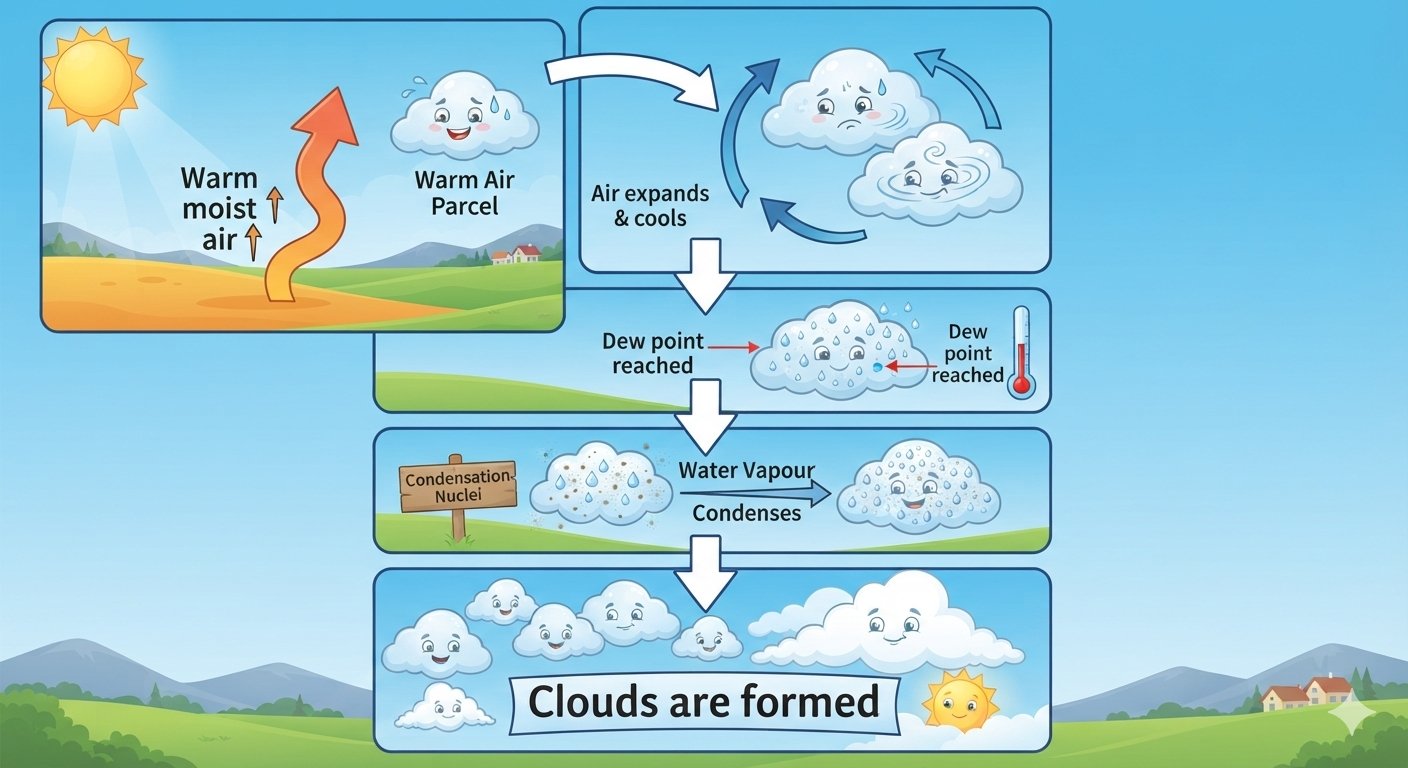
Clouds are formed when water vapour in the atmosphere condenses around tiny particles present in the air.
Most clouds consist of very small water droplets. When the temperature is below the freezing point, clouds may also contain ice particles.
Formation of Clouds
When warm and moist air rises:
5. Types of Clouds
Clouds are mainly classified according to their average height.
1. High Clouds
- Height → about 6–12 km
- Examples:
- Cirrus
- Cirrostratus
- Cirrocumulus
2. Medium Clouds
- Height → about 2–6 km
- Examples:
- Altostratus
- Altocumulus
3. Low Clouds
- Height → below about 2 km
- Examples:
- Stratus
- Stratocumulus
- Nimbostratus
- Cumulus
6. Dew
Dew forms when moisture in the air is deposited as water droplets on cool solid surfaces, such as grass, leaves and stones.
Dew commonly forms when:
- Sky is clear
- Air has high relative humidity
- Night is cold
- There is little cloud cover
When the surface temperature falls to the dew point, water vapour condenses into droplets.
Water vapour → Cooling → Condensation → Dew
7. Frost
Frost forms on cold surfaces when condensation takes place at or below the freezing point (0°C).
Instead of forming liquid water droplets, excess moisture is deposited as tiny ice crystals.
Conditions for Frost
- Temperature → 0°C or below
- Cold surface
- Moisture present in the air
- Clear and suitable night-time conditions
Frost = Ice crystals on cold surfaces
8. Fog
Fog is basically a cloud near or close to the ground.
It forms when air containing sufficient moisture is cooled and water vapour condenses into very small water droplets around fine particles.
Characteristics of Fog
- Forms near the ground
- Contains tiny water droplets
- Reduces visibility
- Often occurs during winter nights
- Usually disappears after sunrise
Fog = Cloud near the ground
9. Mist
Mist consists of tiny water droplets suspended in the air.
It forms when warm, moist air is rapidly cooled and changes from invisible water vapour into tiny visible water droplets.
Mist may form when warm air over a water surface comes into contact with cooler air or a cooler land surface.
Fog vs Mist
- Fog → denser and reduces visibility considerably.
- Mist → less dense and generally allows better visibility.
10. Precipitation
Precipitation is the process by which water in liquid or solid form falls from the atmosphere back to the Earth’s surface.
It occurs after water droplets or ice particles in clouds become sufficiently large and heavy.
Forms of Precipitation
The main forms are:
- Rainfall
- Snowfall
- Sleet
- Hail
11. Rainfall
When moist air rises, it cools and condensation of water vapour takes place. Tiny water droplets join together and become larger. When the droplets become sufficiently heavy, they fall towards the Earth as rain.
Conditions necessary for rainfall
- There should be sufficient moisture/humidity in the air.
- The moist air should rise and cool, causing condensation.
Moist air ↑ → Cooling → Condensation → Larger droplets → Rainfall
12. Forms of Precipitation
1. Rainfall
Liquid water droplets fall from clouds to the Earth’s surface.
2. Snowfall
Precipitation falls in the form of ice crystals or snowflakes when temperatures are sufficiently low.
3. Sleet
Sleet consists of small ice particles or partly melted snow/ice pellets that fall from the atmosphere.
4. Hail
Hail consists of hard balls or lumps of ice that fall from clouds, generally during strong thunderstorms.
13. Classification of Rainfall
Rainfall is classified into three main types according to the way moist air rises:
- Convectional Rainfall
- Orographic Rainfall
- Cyclonic Rainfall
Convectional Rainfall
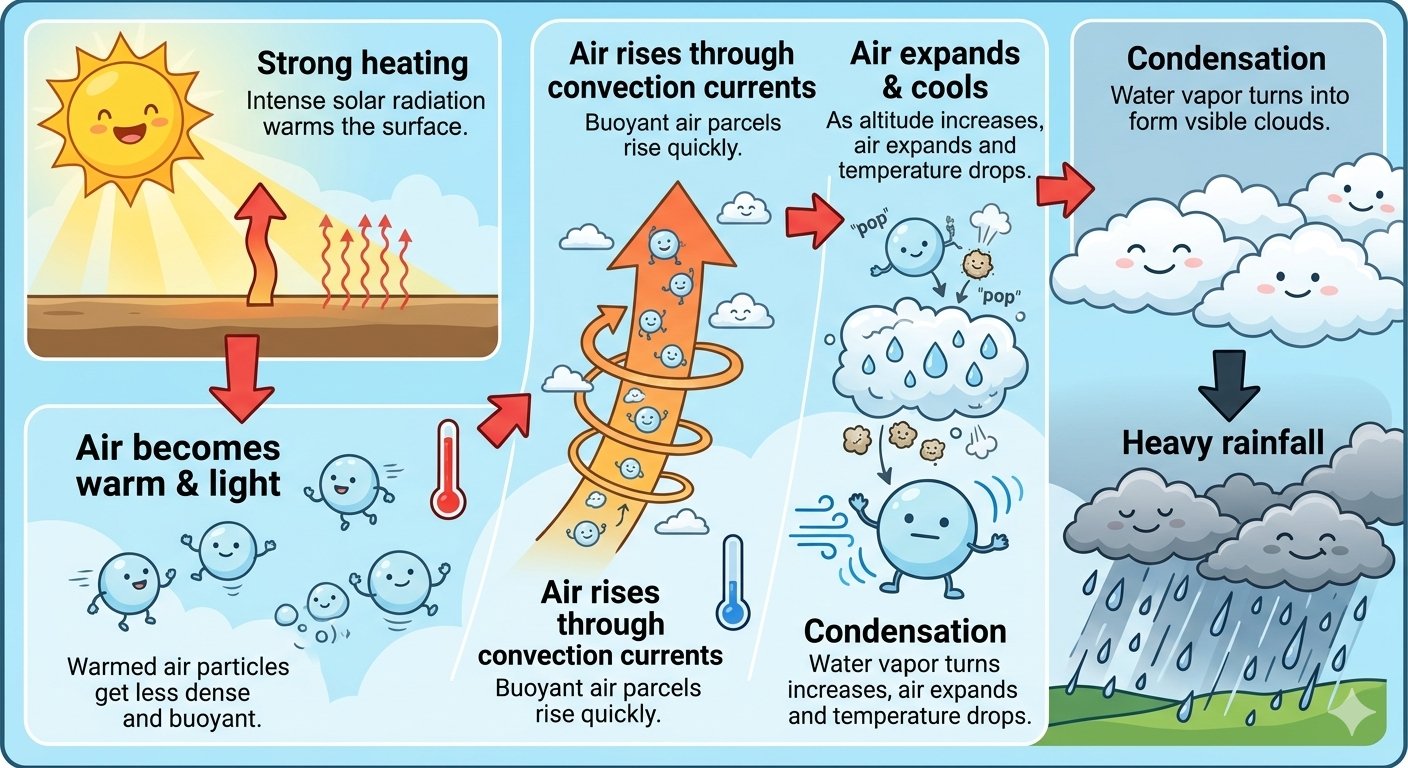
Convectional rainfall occurs because of the strong heating of the Earth’s surface.
Orographic Rainfall
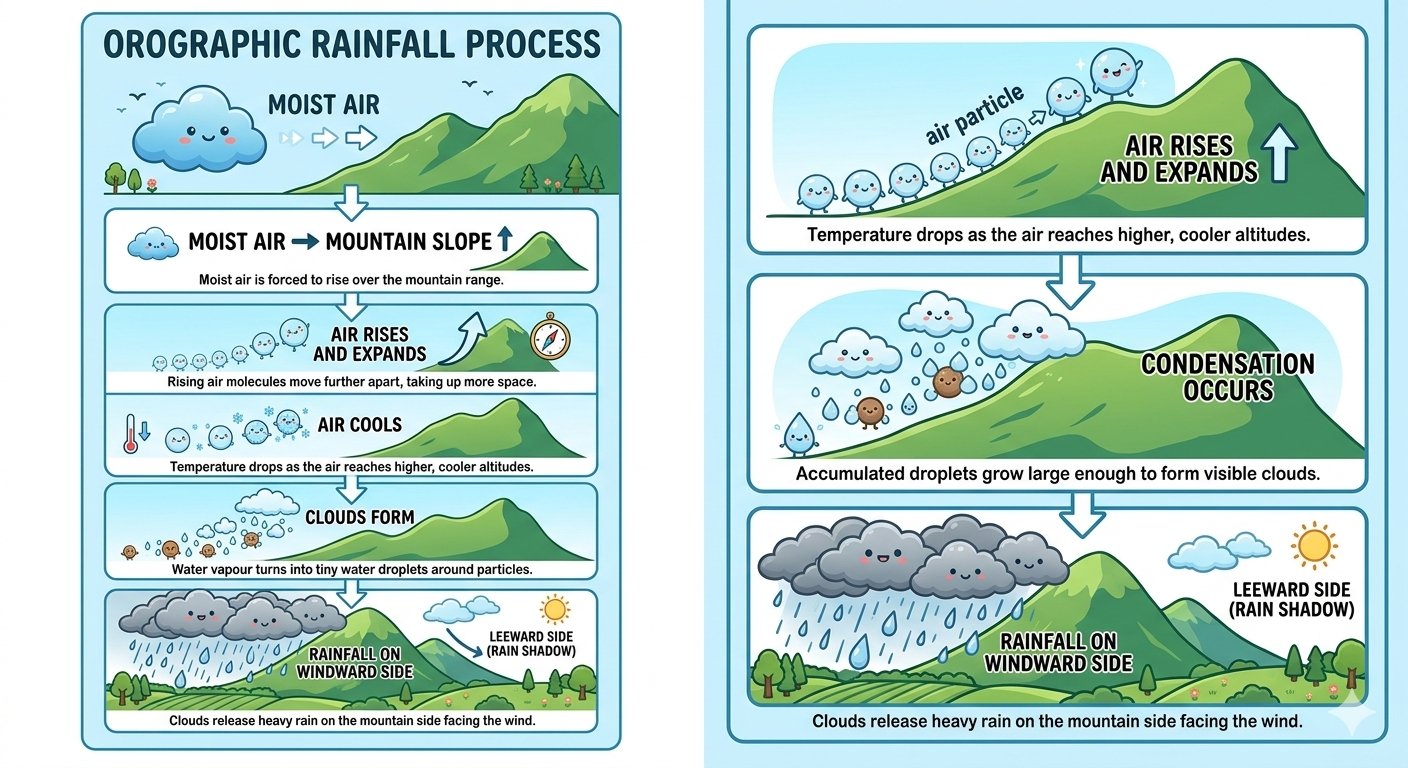
Orographic rainfall occurs when moist air is forced to rise over a mountain barrier.
Cyclonic Rainfall
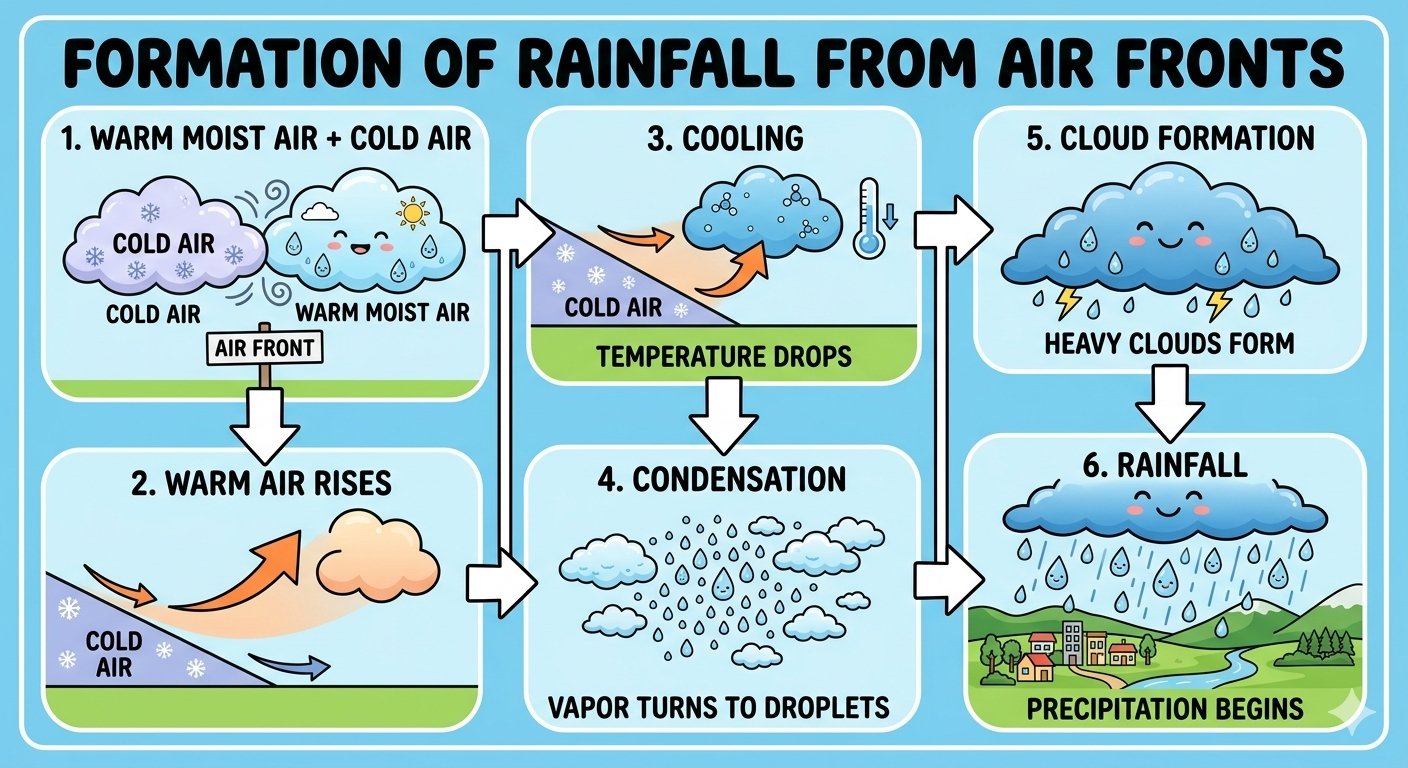
Cyclonic rainfall is associated with cyclones.It occurs when warm and moist air meets or interacts with cold air. The warm air is forced to rise, cools and undergoes condensation. Clouds form and rainfall occurs.