CHAPTER 5
MINERALS & ROCKS
Minerals and Rocks
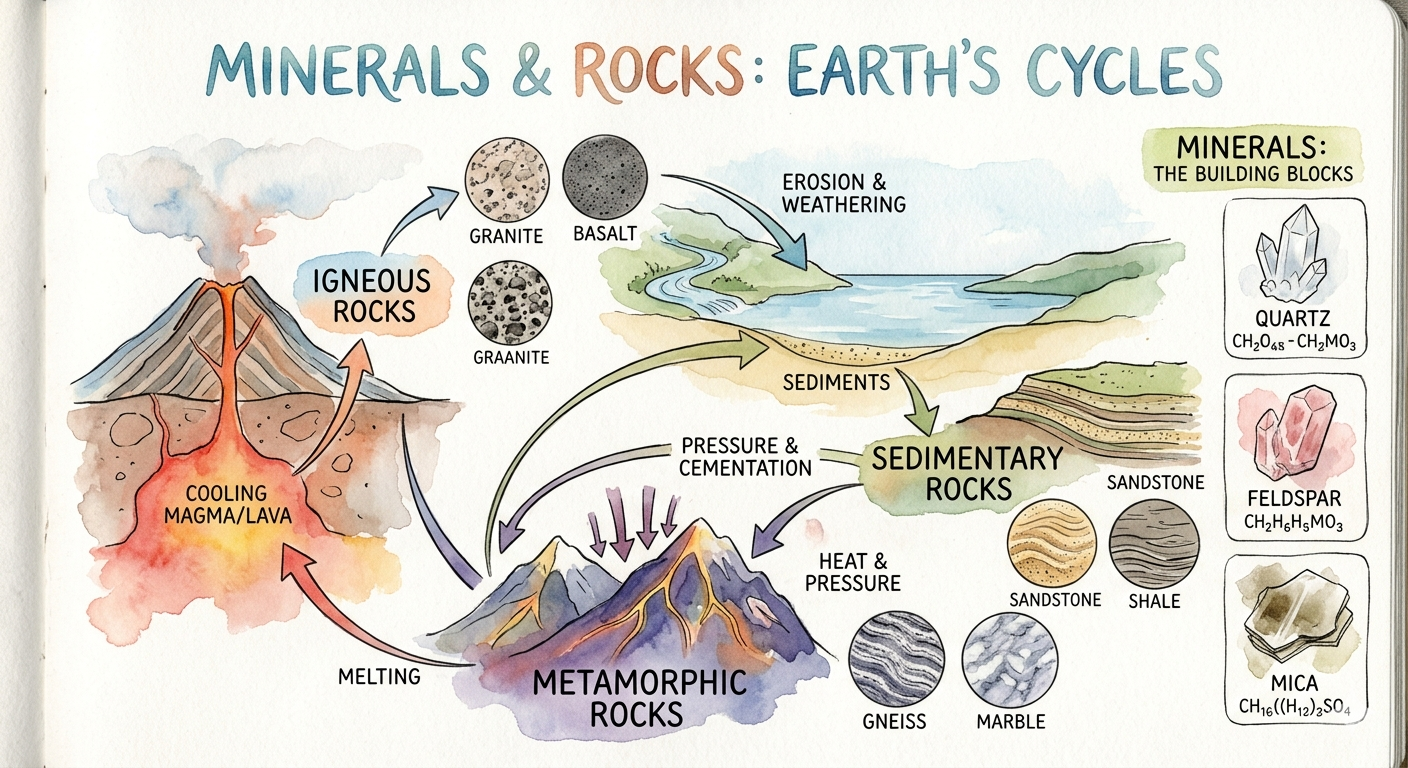
The Earth’s crust is mainly made up of minerals and rocks. Minerals are the basic building blocks of rocks, while rocks form the outer solid layer of the Earth. Different geological processes such as cooling, weathering, deposition, heat, and pressure continuously change rocks from one type to another through the rock cycle.
Rocks
A rock is a naturally occurring solid mass made up of one or more minerals. Rocks form the Earth’s crust and vary greatly in color, texture, hardness, and composition. They may be hard like granite or soft like clay and sandstone.
Characteristics of Rocks
- Made up of one or more minerals.
- Form the Earth’s crust.
- Can be hard or soft.
- Classified into three major types:
- Igneous Rocks
- Sedimentary Rocks
- Metamorphic Rocks
Minerals
A mineral is a naturally occurring, inorganic, homogeneous solid substance with a definite chemical composition and an orderly atomic structure. Minerals possess definite physical and chemical properties.
About 2,000 minerals are known, but only about 12 major minerals are responsible for forming most rocks.
Characteristics of Minerals
- Naturally occurring.
- Inorganic in origin.
- Definite chemical composition.
- Crystalline structure.
- Basic building blocks of rocks.
Igneous Rocks (Primary Rocks)
The word Igneous comes from the Latin word “Ignis”, meaning Fire.
Igneous rocks are formed by the cooling and solidification of molten magma or lava. Since they are the first rocks formed on the Earth and all other rocks are ultimately derived from them, they are called Primary Rocks.
Characteristics of Igneous Rocks
- Formed from magma or lava.
- Hard and compact.
- Non-layered (massive).
- Generally contain no fossils.
- Rich in mineral crystals.
Intrusive Forms of Igneous Rocks
When magma cools below the Earth’s surface, it forms different intrusive structures.
1. Batholith
- Largest intrusive body.
- Dome-shaped.
- Forms deep inside the Earth.
2. Stock
- Smaller than a batholith.
- Irregular-shaped intrusive body.
3. Laccolith
- Mushroom-shaped intrusion.
- Flat base with a dome-like top.
4. Dyke (Dike)
- Vertical wall-like sheet.
- Cuts across rock layers.
5. Sill
- Horizontal sheet of magma.
- Forms between existing rock layers.
Question & Answers
- First, Igneous rocks are formed from solidified magma.
- When exposed to the elements of nature, they undergo weathering and denudation, breaking down into particles that accumulate to form Sedimentary rocks.
- Under the intense influence of high temperature and pressure, both igneous and sedimentary rocks transform into Metamorphic rocks.
- If these rocks are buried deep enough down into the mantle, they melt down once again into molten magma, eventually cooling back into igneous rocks.
- Batholith: Large, deep-seated dome-shaped bodies of magma.
- Stock: A smaller, discordant intrusive feature similar to a batholith.
- Laccolith: Large mushroom-shaped intrusive bodies with a flat floor.
- Dyke (Dike): Vertical, wall-like discordant sheets of rock cutting across older layers.
- Sill: Horizontal, sheet-like concordant bodies injected between older rock layers.
- Clastic Sedimentary Rocks: The term “clastic” comes from the Greek word ‘klastos’, which means “broken”. These rocks are composed of solid mineral fragments and individual grains derived mechanically from pre-existing parent rocks. Their formal naming depends heavily on the grain size of these components.
- Examples: Sandstone, Shale, Limestone, and Loess.
- Non-Clastic Sedimentary Rocks: These are formed without direct mechanical rock fragmentation and are split into two groups:
- Chemical Precipitates: Formed when dissolved mineral matter solidifies and settles directly out of an aqueous (water) solution. Examples: Rock Salt (Halite), Chert, and Gypsum.
- Organically Derived Sediments: Formed from the accumulated skeletal debris, shells, or organic remains of ancient plants and animals. Examples: Coal, Chalk, Geyserite, and organic Limestone.
- Mechanical Disruption (Dynamic Metamorphism): Rocks are broken and ground down mechanically due to immense structural pressures without significant chemical alterations. For instance, under high pressure, granite changes into gneiss, while clay and shale convert into schist.
- Recrystallized Rocks: Formed when the internal crystals of the original minerals organize into new structures. This is divided into two subclasses:
- Contact Metamorphism: Changes occur locally on a small scale when cool surrounding rocks come into direct contact with hot, intruding magma vents. New mineral components emanating from the magma are added directly into the host rock.
- Regional Metamorphism: Occurs on a vast, widespread scale when tectonic plate movements, massive deep-burial mountain building, and heat combine to alter rocks across an entire region.
- a) Gypsum
- b) Topaz
- c) Calcite
- d) Diamond (Correct Answer)
- a) Copper
- b) Lead
- c) Sulphur (Correct Answer)
- d) Aluminum
- a) Sandstone (Correct Answer)
- b) Mica
- c) Granite
- d) Gneiss
- a) Iron & Nickel
- b) Iron & Silver
- c) Silica & Aluminum (Correct Answer)
- d) Iron oxide & Potassium
- a) Changeable
- b) Quite crystalline
- c) Crystalline
- d) Foliation (Correct Answer)
- a) Gold
- b) Silver
- c) Mica (Correct Answer – It is a complex silicate compound)
- d) Graphite
- a) Tillite
- b) Borax
- c) Breccia
- d) Marble (Correct Answer – Marble is a metamorphic rock)