CHAPTER 3
INTERIOR OF THE EARTH
Interior of the Earth
The Earth has a radius of about 6,366 km, but humans have explored only a small part of its interior. Since direct observation is not possible, most information about the Earth’s interior is obtained through indirect sources such as the study of density, temperature, pressure, meteors, and earthquake waves.
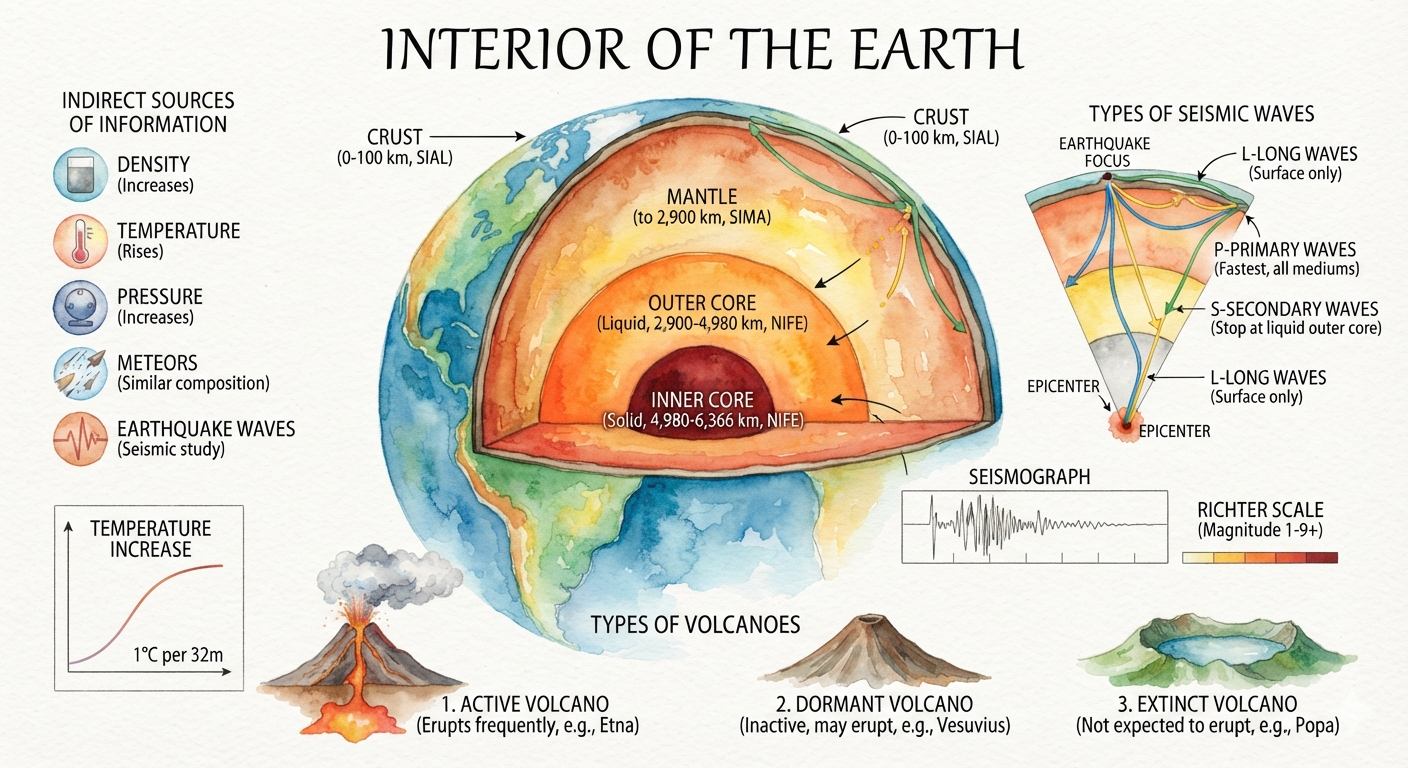
Indirect Sources of Information
Scientists study the Earth’s interior using the following indirect sources:
- Density: Density increases from the crust towards the core, indicating that the inner layers contain heavier materials.
- Temperature: The temperature rises with increasing depth inside the Earth.
- Pressure: Pressure also increases with depth due to the weight of overlying rocks.
- Meteors: Meteors have a composition similar to that of the Earth and suggest that the Earth also has a layered structure.
- Earthquake Waves: The behavior of seismic waves helps scientists determine the composition and state of the Earth’s interior.
Temperature Inside the Earth
The Earth’s interior is extremely hot. The temperature increases by about 1°C for every 32 meters or 12°C per kilometer (up to about 100 km depth). This is confirmed by deep mines, hot springs, and volcanic eruptions.
Earthquake (Seismic) Waves
Earthquakes produce seismic waves that travel through the Earth’s interior.
Types of Seismic Waves
1. Primary Waves (P-Waves)
- Fastest earthquake waves.
- Travel through solids, liquids, and gases.
- Reach the surface first.
2. Secondary Waves (S-Waves)
- Slower than P-waves.
- Travel only through solids.
- Their inability to pass through liquids helped scientists discover that the outer core is liquid.
3. Long Waves (L-Waves)
- Travel along the Earth’s surface.
- Cause the maximum destruction during an earthquake.
Seismograph and Richter Scale
A Seismograph is an instrument used to detect and record earthquake vibrations. It records the movement of seismic waves during an earthquake.
The Richter Scale, developed by Charles Francis Richter in 1935, is used to measure the magnitude or intensity of earthquakes. The higher the magnitude, the stronger the earthquake.
Interior Structure of the Earth
Based on seismic studies and other indirect evidence, the Earth is divided into three main layers.
1. Crust
The crust is the outermost and thinnest layer of the Earth. Its thickness varies from 0 to 100 km. It is thicker beneath continents and thinner beneath oceans. It is mainly made of silica and aluminum (SIAL) and has a density of about 2.75–2.9 g/cm³.
2. Mantle
The mantle lies below the crust and extends to a depth of 2,900 km. It occupies about 83% of the Earth’s volume. It is mainly composed of silica and magnesium (SIMA). The mantle is divided into the upper mantle and lower mantle and contains hot semi-molten rocks that help move tectonic plates.
3. Core
The core is the innermost layer of the Earth and is mainly composed of nickel and iron (NIFE). It makes up about 16.5% of the Earth’s volume.
- Outer Core: Extends from 2,900 km to 4,980 km and is in a liquid state.
- Inner Core: Extends from 4,980 km to 6,366 km and is solid because of extremely high pressure.
Earthquakes
An earthquake is the sudden shaking of the Earth’s surface caused by the release of energy inside the Earth’s crust. The point inside the Earth where the earthquake begins is called the focus, while the point directly above it on the Earth’s surface is called the epicenter. The strongest shaking occurs near the epicenter.
Causes of Earthquakes
The main causes of earthquakes are:
- Tectonic or Fault Movements: Sudden movement of rocks along faults due to plate movement.
- Volcanic Activity: Violent volcanic eruptions.
- Collapse of Underground Mines: Causes minor tremors.
- Chemical or Nuclear Explosions: Artificial earthquakes.
- Plate Tectonics: Movement and collision of lithospheric plates.
- Reservoir-Induced Earthquakes: Caused by pressure from large dams and reservoirs, such as the Koyna Earthquake (1967).
Volcanoes
A volcano is an opening in the Earth’s crust through which magma, lava, gases, volcanic ash, smoke, and rock fragments are ejected. Molten rock beneath the Earth’s surface is called magma, while it is known as lava after reaching the surface.
Types of Volcanoes
1. Active Volcanoes
These erupt frequently or continuously.
Examples: Mount Etna and Stromboli (Italy).
2. Dormant Volcanoes
These remain inactive for long periods but may erupt again.
Example: Mount Vesuvius (Italy).
3. Extinct Volcanoes
These have not erupted in recorded history and are not expected to erupt again. Their craters often become lakes.
Example: Mount Popa (Myanmar).
Questions & Answers
- Based on density
- Based on temperature
- Based on pressure
- Based on meteors
- Based on earthquakes
- Primary waves (P-waves): P-waves can travel through all media (solids, liquids, and gases).
- Secondary waves (S-waves): S-waves can travel through solid mediums only.
- Long waves (L-waves): L-waves can travel through all three media (solids, liquids, and gases).
- The Richter Scale: Earthquakes are scaled according to their magnitude or intensity using the Richter Scale. This scale was invented in 1935 by an American scientist named Charles Francis Richter. The magnitude scale measures intensity using units from one to nine.
- Upper Mantle: Density ranges from 3.10 to 4.75 g/cm cube.
- Lower Mantle: Density ranges from 4.75 to 5.0 g/cm cube.
- Outer Core: Found from 2,900 km downwards; it exists in a liquid state.
- Inner Core: Extends from about 4,980 km to 6366 km it exists in a solid state.
- The overall density of the core layer ranges from 5.10 to 13.60 g/cm cube.
- Focus: The exact place inside the earth where the earthquake originates is called its focus.
- Epicenter: The point on the earth’s surface vertically above the focus is called the epicenter. Shockwaves travel outward in all directions from the focus, and the shaking is strongest near the epicenter.
- Tectonic / Fault Earthquakes: These are the most common types of earthquakes, generated by the sudden sliding of rock strata along a fault plane.
- Volcanic Earthquakes: Caused by violent volcanic eruptions. These are highly devastating but are generally confined to areas near active volcanoes.
- Collapse Earthquakes: In areas of intense underground mining activity, the roofs of underground mines sometimes collapse, causing minor ground tremors.
- Explosion Earthquakes: Ground shaking caused by the detonation of chemical or nuclear devices.
- Plate Tectonics: This is the most widely accepted scientific theory explaining earthquakes. The rigid lithospheric shell of the earth is broken into massive solid sections called crustal plates. These plates are constantly moving at different speeds and directions. Their convergence (colliding) and divergence (separating) build up immense stress, leading to earthquakes.
- Reservoir-Induced Earthquakes: Earthquakes caused by the heavy structural pressure of water collected in large artificial reservoirs. For example, the Koyna earthquake of 1967 in India was caused by the Koyna reservoir.
- Active Volcanoes: These volcanoes continuously or frequently eject volcanic materials. For example, Mount Etna in Italy has been active for the last 2,500 years, and the Stromboli volcano (Sicily) erupts roughly every 15 minutes.
- Dormant Volcanoes: These are volcanoes that have not erupted for a very long time but can suddenly become active without warning, causing massive damage to life and property. For example, Mount Vesuvius in Italy has erupted only about 10 times in the span of 1,500 years.
- Extinct / Dead Volcanoes: Volcanoes that have no recorded eruptions in historic times. The volcanic vent is usually blocked, and the crater often fills up with rainwater over time to form a lake. Future eruptions are highly unlikely. Mount Popa in Myanmar is an outstanding example.
- i) Gases: Gaseous substances mainly consist of steam along with hydrochloric acid, ammonia, Sulphur, hydrogen sulphide, hydrogen, and carbon dioxide. Water vapour is the most abundant gas, accounting for 80–90% of the total gases emitted.
- ii) Liquids: The molten liquid material is called lava. The temperature of freshly ejected lava ranges between 600 degree Celsius to 1200 degree Celsius. The speed of a lava flow depends on its viscosity/mobility and the slope of the terrain. Usually, it moves slowly at about 15 km/hr., but it can reach speeds as high as 80 km/hr.
- iii) Solids: Often, lava solidifies inside the vertical volcanic vent and is blasted out as fragments. These materials consist of fine ash, dust particles, and angular rock fragments:
- Volcanic Blocks/Bombs: Solid fragments larger than 32mm in diameter. Some massive volcanic bombs can weigh up to 60 tons.
- Lapilli: Rock fragments ranging between 4 mm and 32 mm in diameter.
- Volcanic Dust/Ash: Fine particles smaller than4 mm in diameter.
MULTIPLE CHOICE QUESTIONS
- a) Upper and lower mantle
- b) Crust and core
- c) Crust and upper mantle (Correct Answer)
- d) Mantle and core
- a) Earthquake waves
- b) Gravitational force
- c) Volcanoes (Correct Answer)
- d) Earth magnetism
- a) P-waves
- b) S-waves
- c) L-waves (Correct Answer – Note: Your notes ticked P-waves, but L-waves/surface waves cause the most severe destruction on the surface)
- d) None of these
- a) Shield
- b) Composite
- c) Flood (Correct Answer)
- d) Caldera
- a) Tide waves
- b) Sea waves
- c) Tsunami
- d) Earthquake waves (Correct Answer)
- a) 5.33
- b) 3 to 3.8
- c) 11 to 13
- d) 2.75 to 2.9 (Correct Answer)
- a) Ocean waves
- b) Tide waves
- c) Tsunami (Correct Answer)
- d) Land waves