Trial Balance and Rectification of Errors – Class 11 Accountancy Notes
Chapter – 6
Trial Balance and Rectification of Errors
1. Meaning of Trial Balance
A Trial Balance is a statement prepared to check the arithmetical accuracy of the accounts recorded in the Ledger.
It contains the debit and credit balances or totals of different ledger accounts on a particular date.
In simple words, Trial Balance is prepared to check whether the total of debit balances is equal to the total of credit balances.
Example:
A business has the following balances:
Account | Debit (₹) | Credit (₹) |
|---|---|---|
Cash | 10,000 | — |
Purchases | 20,000 | — |
Capital | — | 25,000 |
Sales | — | 5,000 |
Total | 30,000 | 30,000 |
Since both totals are equal, the Trial Balance agrees.
Important: Agreement of Trial Balance does not mean that all accounting entries are correct. Some errors may still remain.
2. Features of Trial Balance
The main features are:
Statement: Trial Balance is a statement, not a ledger account.
Prepared from Ledger: It is prepared using ledger balances or totals.
Two columns: It normally contains debit and credit amount columns.
Checks accuracy: It checks the arithmetical accuracy of ledger posting.
Prepared on a particular date: It may be prepared monthly, quarterly or at the end of the accounting year.
Based on double-entry system: It follows the principle that total debits must equal total credits.
Helps in final accounts: It provides the balances required to prepare financial statements.
3. Objectives of Trial Balance
The main objectives of preparing a Trial Balance are:
1. To Check Arithmetical Accuracy
It helps to check whether debit and credit amounts recorded in the ledger are equal.
2. To Detect Errors
It helps in identifying certain errors made while recording or posting transactions.
3. To Prepare Final Accounts
It provides information for preparing the Trading Account, Profit and Loss Account and Balance Sheet.
4. To Summarise Ledger Accounts
It brings the balances of different ledger accounts into one statement.
5. To Save Time
It makes it easier for accountants to check ledger balances without examining every account separately.
6. To Ensure Debit-Credit Equality
It helps check whether the double-entry principle has been followed arithmetically.
4. Importance of Trial Balance
Helps verify the arithmetical accuracy of ledger accounts.
Makes preparation of final accounts easier.
Helps locate certain accounting errors.
Provides a summary of ledger balances.
Saves time and effort.
Helps organize accounting information systematically.
5. Preparation of Trial Balance
Trial Balance is prepared after posting transactions into the Ledger.
Steps to prepare Trial Balance:
Step 1: Prepare all Ledger Accounts.
Step 2: Calculate the balance or total of each Ledger Account.
Step 3: Write the names of accounts in the Trial Balance.
Step 4: Enter debit balances in the debit column.
Step 5: Enter credit balances in the credit column.
Step 6: Calculate the total of both columns.
Step 7: Compare the debit and credit totals.
If both totals are equal, the Trial Balance agrees.
Format of Trial Balance
Trial Balance
As on 31 March 2026
S. No. | Particulars | Debit (₹) | Credit (₹) |
|---|---|---|---|
1 | Cash Account | 15,000 | — |
2 | Purchases Account | 20,000 | — |
3 | Furniture Account | 10,000 | — |
4 | Capital Account | — | 30,000 |
5 | Sales Account | — | 15,000 |
Total | 45,000 | 45,000 |
Both sides are equal. Therefore, the Trial Balance agrees.
6. Methods of Preparing Trial Balance
There are three main methods of preparing Trial Balance.
Balance Method
Total Amount Method
Balance and Total Method
A. Balance Method
Under this method, only the closing balances of Ledger Accounts are entered in the Trial Balance.
Debit balances are entered in the debit column and credit balances in the credit column.
Example:
Account | Debit (₹) | Credit (₹) |
|---|---|---|
Cash | 12,000 | — |
Purchases | 8,000 | — |
Capital | — | 15,000 |
Sales | — | 5,000 |
Total | 20,000 | 20,000 |
Features:
Only ledger balances are recorded.
It is simple and easy to prepare.
It is the most commonly used method.
It is useful for preparing financial statements.
B. Total Amount Method
Under this method, the total of the debit side and the total of the credit side of every Ledger Account are entered in the Trial Balance.
In simple words, we record the total amounts of both sides instead of their balances.
Example:
Account | Debit Total (₹) | Credit Total (₹) |
|---|---|---|
Cash | 25,000 | 10,000 |
Capital | — | 25,000 |
Purchases | 10,000 | — |
Total | 35,000 | 35,000 |
Features:
Records totals of both sides of ledger accounts.
Provides more information about ledger postings.
Can help in identifying certain posting mistakes.
It is less commonly used than the Balance Method.
C. Balance and Total Method
Under this method, both the totals and balances of Ledger Accounts are entered in the Trial Balance.
It combines the Balance Method and the Total Amount Method.
Example:
Account | Debit Total (₹) | Credit Total (₹) | Debit Balance (₹) | Credit Balance (₹) |
|---|---|---|---|---|
Cash | 25,000 | 10,000 | 15,000 | — |
Capital | — | 25,000 | — | 25,000 |
Purchases | 10,000 | — | 10,000 | — |
Total | 35,000 | 35,000 | 25,000 | 25,000 |
Features:
Includes both ledger totals and balances.
Provides detailed accounting information.
Requires more time and effort.
It is not commonly used in practice.
7. Difference Between Methods of Trial Balance
Basis | Balance Method | Total Method | Balance and Total Method |
|---|---|---|---|
Meaning | Records closing balances | Records debit and credit totals | Records totals and balances |
Information | Limited | More detailed | Most detailed |
Preparation | Easy | Comparatively lengthy | More lengthy |
Columns for amounts | 2 | 2 | 4 |
Common use | Most common | Less common | Rarely used |
8. Accounts Normally Having Debit and Credit Balances
Debit Balance | Credit Balance |
|---|---|
Cash Account | Capital Account |
Bank Account (favourable) | Sales Account |
Purchases Account | Creditors Account |
Furniture Account | Bank Overdraft |
Machinery Account | Loans Taken |
Debtors Account | Commission Received |
Salary Account | Rent Received |
Rent Paid Account | Purchase Returns Account |
Sales Returns Account | Discount Received Account |
Drawings Account | Outstanding Expenses Account |
Discount Allowed Account |
Remember: Assets, expenses and drawings generally have debit balances, whereas liabilities, capital and incomes generally have credit balances.
RECTIFICATION OF ERRORS
9. Meaning of Accounting Errors
Accounting Errors are mistakes made while recording, posting, calculating or summarising business transactions in the books of accounts.
In simple words, when a transaction is recorded incorrectly or is not recorded at all, it is called an accounting error.
Example:
A business purchases furniture worth ₹5,000, but the accountant records it as ₹500.
The difference of ₹4,500 is an accounting error.
10. Meaning of Rectification of Errors
Rectification of Errors means finding and correcting mistakes made in the books of accounts.
In simple words, rectification means correcting wrong accounting entries so that the accounts show the correct information.
Example:
Salary paid = ₹6,000
But recorded = ₹600
The mistake of ₹5,400 must be corrected.
This process is called rectification of errors.
11. Objectives of Rectification of Errors
To correct mistakes in the books of accounts.
To maintain accurate accounting records.
To ensure the correct balances of Ledger Accounts.
To prepare reliable financial statements.
To calculate correct profit or loss.
To improve the reliability of accounting information.
To remove differences in Trial Balance caused by errors.
12. Types of Accounting Errors
Accounting errors are mainly classified into four types.
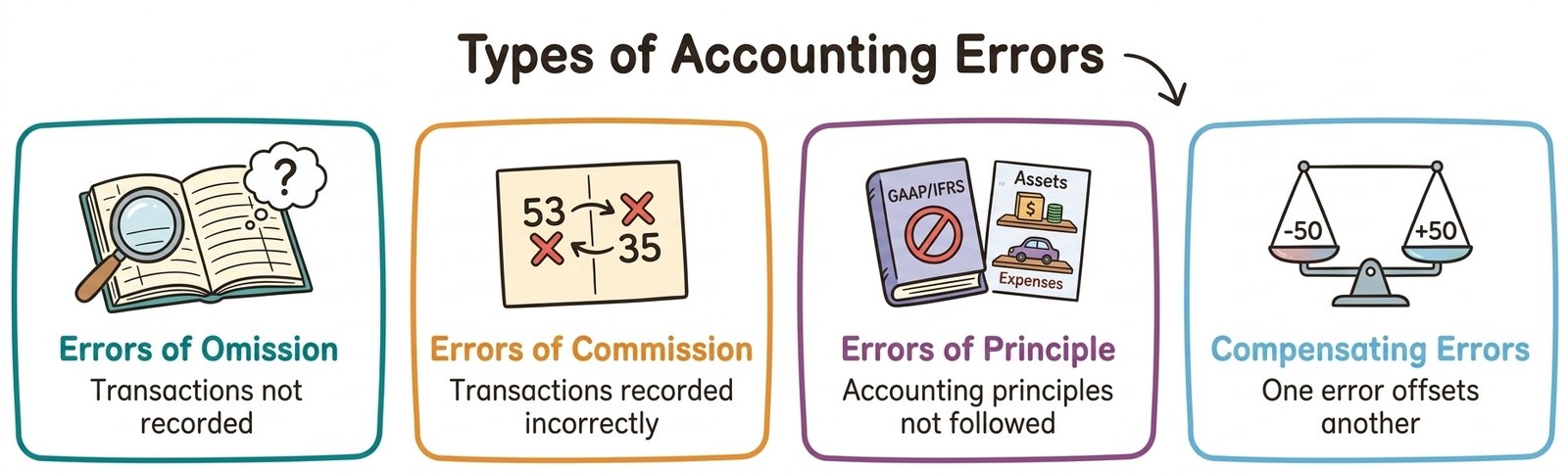
A. Errors of Omission
Errors of Omission occur when a transaction is completely or partially left out from the books of accounts.
These errors are of two types.
1. Complete Omission
When a transaction is not recorded anywhere in the books of accounts.
Example:
Goods purchased for ₹4,000 are not recorded in the Purchases Book.
Effect: Trial Balance will still agree because neither debit nor credit is recorded.
2. Partial Omission
When a transaction is recorded in one book or account but not posted to another required account.
Example:
Goods sold to Rahul for ₹3,000 are recorded in the Sales Book but not posted to Rahul’s Account.
Effect: Trial Balance will not agree because one side is missing.
B. Errors of Commission
Errors of Commission occur when a transaction is recorded incorrectly due to mistakes in amounts, posting or calculations.
Examples:
Posting ₹5,000 as ₹500.
Posting an amount to the wrong customer’s account.
Recording an amount on the wrong side.
Making mistakes while adding ledger accounts.
Example:
Goods sold to Mohan for ₹2,000 are wrongly posted to Sohan’s Account.
This is an Error of Commission.
Effect: Some Errors of Commission affect Trial Balance, while others do not.
C. Errors of Principle
Errors of Principle occur when accounting principles are not followed while recording transactions.
In simple words, these errors happen when an amount is recorded under the wrong type of account.
Example:
Furniture purchased for ₹10,000 is recorded in Purchases Account instead of Furniture Account.
Furniture is an asset, but Purchases Account is normally used for goods purchased for resale.
Therefore, it is an Error of Principle.
Effect: Trial Balance generally still agrees because equal debit and credit entries may have been made.
D. Compensating Errors
Compensating Errors occur when two or more errors cancel out the effect of each other.
In simple words, one mistake is balanced by another mistake.
Example:
Sales Account is under-credited by ₹1,000.
Purchases Account is under-debited by ₹1,000.
Both errors cancel each other’s effect on the difference between debit and credit totals.
Effect: Trial Balance agrees even though errors exist.
13. Errors Affecting Trial Balance
Errors Affecting Trial Balance are those errors that cause a difference between the debit and credit totals of the Trial Balance.
These generally occur when only one side of a transaction is recorded incorrectly.
Examples:
Posting an amount only to the debit side.
Posting an amount only to the credit side.
Posting ₹5,000 instead of ₹500 on one side.
Adding one Ledger Account incorrectly.
Posting an amount to the wrong side of a Ledger Account.
Omitting a ledger balance from Trial Balance.
Writing an incorrect account balance in Trial Balance.
Example:
Goods sold for ₹5,000 are correctly credited to Sales Account, but only ₹500 is debited to the customer’s account.
Difference = ₹4,500.
Therefore, Trial Balance will not agree.
14. Errors Not Affecting Trial Balance
Errors Not Affecting Trial Balance are those errors that do not create a difference between the debit and credit totals.
In simple words, both sides remain equal even though mistakes exist.
Examples:
Complete omission of a transaction.
Recording an incorrect amount on both sides.
Posting an amount to the wrong account on the correct side.
Errors of Principle.
Compensating Errors.
Recording the same transaction twice on both sides.
Example:
Furniture purchased for ₹8,000 is incorrectly recorded in Purchases Account.
The debit entry is wrong, but the credit entry is correct.
Trial Balance will still agree because the total debit and credit amounts are equal.
15. Difference Between Errors Affecting and Not Affecting Trial Balance
Errors Affecting Trial Balance | Errors Not Affecting Trial Balance |
|---|---|
Cause differences in debit and credit totals | Do not cause differences in totals |
Generally involve unequal debit and credit effects | Debit and credit effects remain equal |
Can be indicated by a disagreement in Trial Balance | Cannot be detected merely by Trial Balance agreement |
May require Suspense Account temporarily | Generally do not require Suspense Account |
Example: One-sided posting omitted | Example: Complete omission |
16. Detection of Errors
Detection of Errors means finding mistakes made while recording or posting transactions.
Errors can be detected through the following methods.
1. Checking Trial Balance
If debit and credit totals do not agree, an accounting error may have occurred.
2. Checking Ledger Accounts
All postings and balances of Ledger Accounts should be checked carefully.
3. Checking Journal Entries
Journal entries should be verified to ensure correct debit and credit accounts.
4. Checking Subsidiary Books
Purchases Book, Sales Book, Cash Book and other books should be checked.
5. Checking Calculations
Totals, balances and carried-forward amounts should be recalculated.
6. Comparing with Source Documents
Invoices, receipts, bills and vouchers can help identify mistakes.
7. Comparing Previous Records
Current records can be compared with previous records to identify unusual differences.
8. Checking Suspense Account
If a Suspense Account exists, its entries must be investigated to identify the errors responsible.
17. Rectification of Errors
Rectification means correcting the accounting mistakes after they are detected.
Errors may be rectified at different stages:
Before preparation of Trial Balance.
After preparation of Trial Balance.
After preparation of Final Accounts.
A. Rectification Before Preparation of Trial Balance
When errors are detected before preparing Trial Balance, they can often be corrected directly in the relevant accounts.
Example:
Rent paid ₹2,000 is wrongly posted to Rent Account as ₹200.
Correction: Additional ₹1,800 should be debited to Rent Account.
B. Rectification After Preparation of Trial Balance
When Trial Balance has been prepared and does not agree, the difference may be temporarily placed in a Suspense Account.
The errors are then corrected through proper rectification entries.
C. Rectification After Preparation of Final Accounts
Sometimes errors are discovered after financial statements have been prepared.
In such cases, necessary adjustment entries are passed. A Profit and Loss Adjustment Account may be used in certain textbook situations where nominal accounts of the previous year have already been closed.
18. One-Sided Errors
One-Sided Errors are errors that affect only one account or one side of the accounting records.
These errors generally cause disagreement in Trial Balance.
Examples:
Failure to post an amount to one Ledger Account.
Posting an incorrect amount on one side.
Incorrect totaling of an account.
Recording an amount on the wrong side of one account.
Example:
Goods sold to Rahul for ₹4,000 are recorded in Sales Account but not posted to Rahul’s Account.
Correct entry should be:
Account | Debit (₹) | Credit (₹) |
|---|---|---|
Rahul A/c | 4,000 | — |
Sales A/c | — | 4,000 |
But Rahul’s Account was not debited.
If the difference has been transferred to Suspense Account, the rectification entry will be:
Particulars | Debit (₹) | Credit (₹) |
|---|---|---|
Rahul A/c Dr. | 4,000 | — |
To Suspense A/c | — | 4,000 |
The missing debit is corrected through this entry.
19. Two-Sided Errors
Two-Sided Errors are errors that affect two or more accounts but do not disturb the equality of total debits and credits.
These errors usually do not affect Trial Balance.
Examples:
Recording furniture purchased in Purchases Account.
Recording a transaction for an incorrect amount on both sides.
Completely omitting a transaction.
Posting an amount to the wrong account on the correct side.
Example:
Furniture purchased for ₹5,000 was wrongly debited to Purchases Account.
Wrong Entry:
Purchases A/c Dr. ₹5,000
To Cash A/c ₹5,000
Correct Entry:
Furniture A/c Dr. ₹5,000
To Cash A/c ₹5,000
Rectification Entry:
Particulars | Debit (₹) | Credit (₹) |
|---|---|---|
Furniture A/c Dr. | 5,000 | — |
To Purchases A/c | — | 5,000 |
This entry corrects the mistake without affecting Cash Account again.
20. Difference Between One-Sided and Two-Sided Errors
Basis | One-Sided Errors | Two-Sided Errors |
|---|---|---|
Meaning | Errors having an incorrect effect on only one side/account | Errors requiring correction between two or more accounts |
Trial Balance | Generally does not agree | Generally agrees |
Suspense Account | May be required | Usually not required |
Correction | Often corrects one-sided posting, sometimes through Suspense Account | Rectification entry adjusts affected accounts |
Example | Amount posted only to credit side | Furniture recorded as purchases |
SUSPENSE ACCOUNT
21. Meaning of Suspense Account
A Suspense Account is a temporary account opened when the debit and credit totals of the Trial Balance do not agree and the difference cannot be found immediately.
In simple words, Suspense Account is used to temporarily record the difference in Trial Balance until the mistakes are identified and corrected.
Example:
Total Debit = ₹50,000
Total Credit = ₹48,000
Difference = ₹2,000
The Trial Balance has a shortage of ₹2,000 on the credit side.
Therefore, a Suspense Account with a credit balance of ₹2,000 is opened temporarily.
Important: Suspense Account is a temporary account. It should be closed after the errors responsible for the difference are fully rectified.
22. Need for Suspense Account
The following are the main reasons for preparing a Suspense Account:
To temporarily record the difference in Trial Balance.
To allow accounting work to continue while errors are investigated.
To help identify and rectify one-sided errors.
To maintain a record of the unexplained difference.
To assist in preparing a balanced Trial Balance temporarily.
To close the difference after necessary corrections.
23. Features of Suspense Account
It is a temporary account.
It is opened when Trial Balance does not agree and the difference remains unidentified.
It may have a debit or credit balance.
It is used for rectification of certain errors.
It is closed when the related errors have been corrected.
It does not itself correct accounting mistakes.
24. Preparation of Suspense Account
Suspense Account is prepared according to the difference between debit and credit totals of Trial Balance.
Case 1: When Debit Total is More Than Credit Total
Example:
Debit Total = ₹60,000
Credit Total = ₹55,000
Difference = ₹5,000
Since the credit side is smaller, the difference will be placed on the credit side of Trial Balance.
Therefore, Suspense Account will have a credit balance of ₹5,000.
Case 2: When Credit Total is More Than Debit Total
Example:
Debit Total = ₹45,000
Credit Total = ₹50,000
Difference = ₹5,000
Since the debit side is smaller, the difference will be placed on the debit side of Trial Balance.
Therefore, Suspense Account will have a debit balance of ₹5,000.
Rules for Suspense Account
Situation | Treatment |
|---|---|
Debit total is greater than credit total | Credit balance in Suspense Account |
Credit total is greater than debit total | Debit balance in Suspense Account |
Both totals are equal | No Suspense Account is needed for a Trial Balance difference |
25. Format of Suspense Account
Suspense Account
Dr. Particulars | Amount (₹) | Cr. Particulars | Amount (₹) |
|---|---|---|---|
To Rectification Entry | 2,000 | By Balance b/d | 2,000 |
Total | 2,000 | Total | 2,000 |
This example shows an opening credit balance of ₹2,000 being cleared by a rectification entry. The actual account named in a rectification entry depends on the error discovered.
26. Example of Suspense Account and Rectification
A Trial Balance shows:
Debit total = ₹40,000
Credit total = ₹43,000
Difference = ₹3,000
The difference is placed in the Suspense Account on the debit side.
Later, it is discovered that Sales Account was over-credited by ₹3,000.
Rectification Entry:
Particulars | Debit (₹) | Credit (₹) |
|---|---|---|
Sales A/c Dr. | 3,000 | — |
To Suspense A/c | — | 3,000 |
Suspense Account:
Dr. Particulars | Amount (₹) | Cr. Particulars | Amount (₹) |
|---|---|---|---|
To Balance b/d | 3,000 | By Sales A/c | 3,000 |
Total | 3,000 | Total | 3,000 |
After rectification, the Suspense Account is closed because both sides are equal.
27. Difference Between Trial Balance and Suspense Account
Trial Balance | Suspense Account |
|---|---|
It is a statement | It is a temporary ledger account |
Prepared to check arithmetical accuracy | Opened to temporarily record unexplained differences |
Contains many Ledger Accounts | Contains entries relating to differences and their correction |
Generally prepared at the end of an accounting period or when required | Prepared when Trial Balance does not agree and the difference remains unresolved |
Helps check debit-credit equality | Helps manage temporary differences during rectification |
28. Difference Between Error of Principle and Error of Commission
Error of Principle | Error of Commission |
|---|---|
Occurs when accounting principles are violated | Occurs due to clerical or recording mistakes |
Often involves wrong classification of accounts | Often involves wrong posting, amount or calculation |
Usually does not affect Trial Balance | May or may not affect Trial Balance |
Example: Furniture purchased recorded as Purchases | Example: Amount posted to the wrong customer’s account |