Chapter – 4
Recording of Business Transactions-II
1. Introduction to Recording of Business Transactions–II
Recording of Business Transactions–II deals with the different books used by a business to record financial transactions separately and systematically.
In the previous unit, we studied the Journal and Ledger. In this unit, we learn about Special Purpose Books, also called Subsidiary Books.
In simple words, instead of recording every transaction in one journal, a business maintains separate books for cash, purchases, sales and returns.
Example: A shopkeeper makes 100 transactions daily. Recording all transactions in one journal becomes difficult. Therefore, separate books are maintained for different types of transactions.
Objectives
To record transactions systematically.
To save time and effort.
To reduce accounting errors.
To divide accounting work among employees.
To make ledger posting easier.
To provide detailed information about transactions.
2. Special Purpose Books
Special Purpose Books are books of original entry used to record transactions of a particular nature.
They are also known as Subsidiary Books or Special Journals.
For example, cash transactions are recorded in the Cash Book, while credit sales of goods are recorded in the Sales Book.
Types of Special Purpose Books
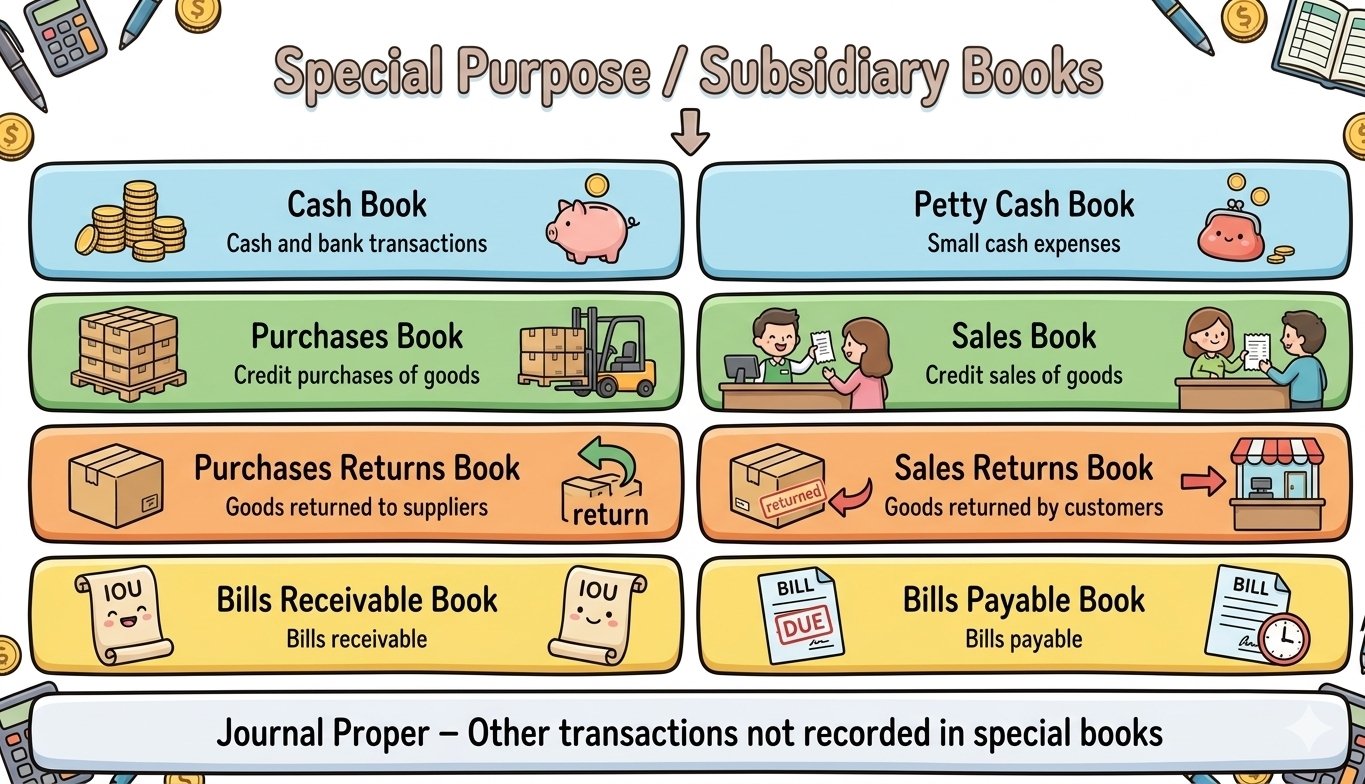
Advantages of Special Purpose Books
Division of Work: Different employees can maintain different books.
Saving of Time: Similar transactions are recorded together.
Easy Posting: Transactions can be posted conveniently to the ledger.
Reduced Errors: Specialised records help in checking mistakes.
Detailed Information: Purchases, sales, receipts and payments can be analyzed separately.
Better Control: Management can monitor different transactions easily.
3. Cash Book
A Cash Book is a book of original entry used to record all cash receipts, cash payments and, where applicable, bank transactions.
In simple words, whenever money comes into or goes out of the business, it is recorded in the Cash Book.
Example:
Received cash from a customer ₹10,000.
Paid office rent ₹3,000.
Deposited ₹5,000 into the bank.
These transactions are recorded in the appropriate Cash Book.
Features of Cash Book
It records cash and relevant bank transactions.
It is both a book of original entry and a ledger account.
Receipts are recorded on the debit side.
Payments are recorded on the credit side.
Cash balance cannot normally be negative.
It helps determine the cash and bank balances.
Types of Cash Book
There are three main types:
Single Column Cash Book.
Double Column Cash Book.
Triple Column Cash Book.
The Petty Cash Book is maintained separately for small payments.
Single Column Cash Book
A Single Column Cash Book contains only one amount column on each side for cash transactions.
It records cash receipts and cash payments.
Example: A business receives ₹20,000 and pays ₹5,000 as salary.
Format and Solved Example
Transactions:
April 1: Started business with cash ₹50,000.
April 3: Purchased goods for cash ₹10,000.
April 5: Cash sales ₹15,000.
April 8: Paid rent ₹5,000.
Single Column Cash Book
Date | Debit (Receipts) | Amount (₹) | Date | Credit (Payments) | Amount (₹) |
|---|---|---|---|---|---|
Apr 1 | To Capital A/c | 50,000 | Apr 3 | By Purchases A/c | 10,000 |
Apr 5 | To Sales A/c | 15,000 | Apr 8 | By Rent A/c | 5,000 |
Apr 30 | By Balance c/d | 50,000 | |||
Total | 65,000 | Total | 65,000 |
Closing Cash Balance:
Remember:
Cash received → Debit side.
Cash paid → Credit side.
Double Column Cash Book
A Double Column Cash Book has two amount columns on each side.
There are different forms of Double Column Cash Book, such as:
Cash and Bank columns.
Cash and Discount columns.
The Cash and Bank form is commonly used when learning bank transactions.
Example: Cash and Bank Double Column Cash Book
Transactions:
April 1: Cash ₹30,000 and bank balance ₹20,000.
April 3: Deposited cash into bank ₹10,000.
April 5: Paid salary by cheque ₹5,000.
April 8: Received cash from sales ₹8,000.
Double Column Cash Book
Date | Particulars | Cash Dr. (₹) | Bank Dr. (₹) | Cash Cr. (₹) | Bank Cr. (₹) |
|---|---|---|---|---|---|
Apr 1 | Balance b/d | 30,000 | 20,000 | — | — |
Apr 3 | Cash deposited (C) | — | 10,000 | 10,000 | — |
Apr 5 | Salary paid | — | — | — | 5,000 |
Apr 8 | Cash sales | 8,000 | — | — | — |
Closing Balances:
Cash Balance = ₹30,000 − ₹10,000 + ₹8,000 = ₹28,000
Bank Balance = ₹20,000 + ₹10,000 − ₹5,000 = ₹25,000
Contra Entry
A Contra Entry is a transaction that affects both cash and bank accounts within the same Cash Book.
Examples:
Cash deposited into bank.
Cash withdrawn from bank for office use.
Such transactions are usually marked with C in the ledger folio column.
Triple Column Cash Book
A Triple Column Cash Book contains three amount columns on each side:
Cash Column.
Bank Column.
Discount Column.
It records cash, bank and cash discount transactions.
Example
A business receives ₹9,800 from a debtor in full settlement of ₹10,000.
Cash received = ₹9,800.
Discount allowed = ₹200.
The debit side of the Triple Column Cash Book records ₹9,800 in the Cash Column and ₹200 in the Discount Allowed Column.
Another example:
A business pays ₹4,900 to a creditor in full settlement of ₹5,000.
Cash paid = ₹4,900.
Discount received = ₹100.
The credit side records ₹4,900 in the Cash Column and ₹100 in the Discount Received Column.
Format
Side | Discount Column | Cash Column | Bank Column |
|---|---|---|---|
Debit (Receipts) | Discount Allowed | Cash Received | Bank Receipts |
Credit (Payments) | Discount Received | Cash Paid | Bank Payments |
Important: Discount columns are totalled periodically but are not balanced like the Cash and Bank columns.
Difference Between Types of Cash Book
Single Column | Double Column | Triple Column |
|---|---|---|
One amount column on each side | Two amount columns on each side | Three amount columns on each side |
Usually cash only | Cash + Bank or Cash + Discount | Cash + Bank + Discount |
Simplest format | More detailed | Most comprehensive of the three |
4. Petty Cash Book
A Petty Cash Book is a book used to record small and routine cash expenses.
Petty means small.
A business makes many small payments every day. Instead of recording each one in the main Cash Book, these expenses may be entered in a Petty Cash Book.
Examples of Petty Expenses
Tea and refreshments.
Postage.
Stationery.
Local transportation.
Small repair expenses.
Cleaning materials.
Petty Cashier
The employee responsible for maintaining petty cash and making small payments is called the Petty Cashier.
Imprest System of Petty Cash
The Imprest System is a method under which the petty cashier receives a fixed amount of money at the beginning of a period.
At the end of the period, the amount spent is reimbursed to restore the original petty cash amount.
Example
A petty cashier receives ₹2,000.
During the week:
Expense | Amount (₹) |
|---|---|
Postage | 200 |
Stationery | 350 |
Tea | 150 |
Local Transport | 300 |
Cleaning | 100 |
Total | 1,100 |
Cash remaining:
At the end of the week, the petty cashier receives ₹1,100 as reimbursement.
Therefore:
The petty cash amount is restored to ₹2,000.
Petty Cash Book Format
Date | Particulars | Total Paid (₹) | Postage | Stationery | Travelling | Miscellaneous |
|---|---|---|---|---|---|---|
May 2 | Postage stamps | 200 | 200 | — | — | — |
May 3 | Stationery | 350 | — | 350 | — | — |
May 4 | Tea | 150 | — | — | — | 150 |
May 5 | Local transport | 300 | — | — | 300 | — |
May 6 | Cleaning | 100 | — | — | — | 100 |
Total | 1,100 | 200 | 350 | 300 | 250 |
Advantages of Petty Cash Book
Saves time of the main cashier.
Provides proper records of small expenses.
Reduces the burden on the main Cash Book.
Helps control unnecessary expenses.
Makes verification easier.
5. Purchases Book
The Purchases Book is a subsidiary book used to record credit purchases of goods.
Goods means items purchased for resale in the normal course of business.
Important: Cash purchases and purchases of fixed assets are not recorded in the Purchases Book.
Example
A furniture dealer purchases:
Furniture for resale from Mohan on credit ₹20,000.
A computer for office use on credit ₹30,000.
Furniture for resale for cash ₹10,000.
Only the first transaction is recorded in the Purchases Book.
Format of Purchases Book
Date | Particulars | Invoice No. | L.F. | Amount (₹) |
|---|---|---|---|---|
Jun 3 | Mohan Traders | P101 | 20,000 | |
Jun 8 | Sharma Furniture | P102 | 15,000 | |
Jun 12 | Gupta Traders | P103 | 10,000 | |
Total Credit Purchases | 45,000 |
Posting of Purchases Book
At the end of the period:
The Purchases Account is debited with ₹45,000.
Each supplier’s account is credited with the amount purchased from that supplier.
Entry:
Purchases A/c Dr. ₹45,000
To Sundry Creditors / Individual Suppliers ₹45,000
Features of Purchases Book
Records only credit purchases of goods.
Transactions are entered date-wise.
Helps determine total credit purchases.
Uses purchase invoices as supporting documents.
Makes posting to suppliers’ accounts easier.
6. Sales Book
The Sales Book is a subsidiary book used to record credit sales of goods.
It is also known as the Sales Journal.
Only goods sold on credit are recorded in this book.
Example
A clothing shop sells:
Clothes worth ₹15,000 to Rahul on credit.
Clothes worth ₹8,000 for cash.
Old office furniture worth ₹5,000 on credit.
Only the first transaction is recorded in the Sales Book.
Format of Sales Book
Date | Particulars | Invoice No. | L.F. | Amount (₹) |
|---|---|---|---|---|
Jul 2 | Rahul | S101 | 15,000 | |
Jul 6 | Aman | S102 | 12,000 | |
Jul 10 | Neha | S103 | 8,000 | |
Total Credit Sales | 35,000 |
Posting of Sales Book
At the end of the period:
The Sales Account is credited with ₹35,000.
Individual customers’ accounts are debited with their respective amounts.
Entry:
Sundry Debtors / Individual Customers A/c Dr. ₹35,000
To Sales A/c ₹35,000
Features of Sales Book
Records only credit sales of goods.
Cash sales are excluded.
Credit sales of fixed assets are excluded.
Provides details of debtors.
Helps calculate total credit sales.
7. Purchases Returns Book
The Purchases Returns Book records goods returned by a business to its suppliers out of goods previously purchased on credit.
It is also known as the Returns Outward Book.
Reasons for Purchases Returns
Defective goods.
Damaged goods.
Wrong items supplied.
Goods not matching the order.
Excess quantity received.
Example
Purchased goods worth ₹20,000 from Mohan on credit.
Later, goods worth ₹5,000 were found defective and returned.
The return of ₹5,000 is recorded in the Purchases Returns Book.
Format of Purchases Returns Book
Date | Particulars | Debit Note No. | L.F. | Amount (₹) |
|---|---|---|---|---|
Aug 4 | Mohan | DN01 | 5,000 | |
Aug 9 | Aman Traders | DN02 | 2,000 | |
Aug 12 | Gupta Traders | DN03 | 3,000 | |
Total Returns Outward | 10,000 |
Posting
Individual suppliers’ accounts are debited, and the Purchases Returns Account is credited.
Entry:
Mohan A/c Dr. ₹5,000
To Purchases Returns A/c ₹5,000
Reason: The amount payable to Mohan decreases.
Importance
Records returns to suppliers.
Helps calculate net purchases.
Reduces the amount payable to suppliers.
Provides evidence for supplier adjustments.
Formula
If purchases are ₹50,000 and returns are ₹5,000:
Net Purchases = ₹45,000.
8. Sales Returns Book
The Sales Returns Book records goods returned by customers out of goods previously sold on credit.
It is also known as the Returns Inward Book.
Reasons for Sales Returns
Damaged goods.
Poor-quality goods.
Incorrect delivery.
Wrong size or design.
Goods not matching customer requirements.
Example
Sold goods worth ₹15,000 to Rahul on credit.
Rahul returned defective goods worth ₹3,000.
The return is recorded in the Sales Returns Book.
Format of Sales Returns Book
Date | Particulars | Credit Note No. | L.F. | Amount (₹) |
|---|---|---|---|---|
Sep 3 | Rahul | CN01 | 3,000 | |
Sep 6 | Neha | CN02 | 2,000 | |
Sep 9 | Aman | CN03 | 1,000 | |
Total Returns Inward | 6,000 |
Posting
The Sales Returns Account is debited and the customer account is credited.
Entry:
Sales Returns A/c Dr. ₹3,000
To Rahul A/c ₹3,000
Reason: The amount receivable from Rahul decreases.
Importance
Records returned goods from customers.
Helps calculate net sales.
Reduces the amount receivable from customers.
Helps identify problems with goods.
Formula
If total sales are ₹80,000 and sales returns are ₹6,000:
Net Sales = ₹74,000.
9. Difference Between Purchases Returns and Sales Returns
Basis | Purchases Returns | Sales Returns |
|---|---|---|
Meaning | Goods returned to suppliers | Goods returned by customers |
Other Name | Returns Outward | Returns Inward |
Related to | Purchases | Sales |
Document | Debit Note | Credit Note |
Account Effect | Purchases Returns credited | Sales Returns debited |
Amount Affected | Reduces amount payable | Reduces amount receivable |
10. Ledger
A Ledger is the principal book of accounts in which transactions from the journal and subsidiary books are classified into separate accounts.
In simple words, the ledger collects all transactions related to a particular account in one place.
Example: All transactions related to Mohan are recorded in Mohan’s Account.
Features of Ledger
It is the principal book of accounts.
It contains separate accounts for different items.
Accounts have debit and credit sides.
Transactions are classified account-wise.
It helps prepare the trial balance.
Ledger balances are used in preparing financial statements.
Posting from Subsidiary Books to Ledger
Subsidiary Book | Ledger Posting |
|---|---|
Purchases Book | Debit Purchases A/c; credit individual suppliers |
Sales Book | Credit Sales A/c; debit individual customers |
Purchases Returns Book | Credit Purchases Returns A/c; debit individual suppliers |
Sales Returns Book | Debit Sales Returns A/c; credit individual customers |
Cash Book | Post the other accounts affected; avoid duplicating the Cash/Bank A/c already represented in the Cash Book |
Example
Goods purchased from Mohan on credit = ₹10,000.
Goods returned to Mohan = ₹2,000.
Mohan Account
Debit Particulars | Amount (₹) | Credit Particulars | Amount (₹) |
|---|---|---|---|
To Purchases Returns A/c | 2,000 | By Purchases A/c | 10,000 |
To Balance c/d | 8,000 | ||
Total | 10,000 | Total | 10,000 |
Closing Balance = ₹8,000 (Credit)
This represents the amount still payable to Mohan.
11. Other Subsidiary Books
Apart from the Cash Book, Purchases Book, Sales Book and Returns Books, businesses may maintain other subsidiary books.
A. Bills Receivable Book
Meaning: A Bills Receivable Book records bills of exchange accepted by customers in favor of the business.
In simple words, it records amounts that the business is entitled to receive through bills.
Example: Rahul accepts a bill of ₹10,000 payable after three months.
The bill is recorded in the Bills Receivable Book.
Format:
Date | From Whom Received | Bill No. | Due Date | Amount (₹) |
|---|---|---|---|---|
Oct 1 | Rahul | BR01 | Jan 4 | 10,000 |
Oct 5 | Mohan | BR02 | Jan 8 | 15,000 |
Illustrative due dates assume a three-month bill with three days of grace, ignoring holidays.
Importance: Helps track bills held and their due dates.
B. Bills Payable Book
Meaning: A Bills Payable Book records bills accepted by the business in favor of its creditors.
In simple words, it records amounts the business promises to pay through bills.
Example: A business accepts a bill of ₹20,000 drawn by a supplier.
The bill is recorded in the Bills Payable Book.
Format:
Date | To Whom Given | Bill No. | Due Date | Amount (₹) |
|---|---|---|---|---|
Oct 1 | Gupta Traders | BP01 | Jan 4 | 20,000 |
Oct 5 | Mohan | BP02 | Jan 8 | 12,000 |
Importance: Helps the business track future payment obligations.
Difference Between Bills Receivable and Bills Payable
Bills Receivable | Bills Payable |
|---|---|
Amount to be received | Amount to be paid |
Generally an asset | Generally a liability |
Recorded in Bills Receivable Book | Recorded in Bills Payable Book |
Business is entitled to payment | Business is obliged to make payment |
12. Journal Proper
Journal Proper is a book of original entry used to record transactions that cannot be recorded in other special purpose books.
In simple words, transactions that do not belong to the Cash Book, Purchases Book, Sales Book or other subsidiary books are recorded in the Journal Proper.
Transactions Recorded in Journal Proper
1. Opening Entries
Used to bring opening assets, liabilities and capital into the books.
Example: Business has opening cash ₹20,000, furniture ₹10,000 and creditors ₹5,000.
Particulars | Debit (₹) | Credit (₹) |
|---|---|---|
Cash A/c Dr. | 20,000 | — |
Furniture A/c Dr. | 10,000 | — |
To Creditors A/c | — | 5,000 |
To Capital A/c | — | 25,000 |
2. Closing Entries
Used at the end of an accounting period to transfer nominal account balances to the appropriate final accounts.
3. Adjustment Entries
Used for items such as outstanding expenses, prepaid expenses, depreciation and accrued income.
Example: Salary outstanding ₹5,000.
Particulars | Debit (₹) | Credit (₹) |
|---|---|---|
Salary A/c Dr. | 5,000 | — |
To Outstanding Salary A/c | — | 5,000 |
4. Rectification Entries
Used to correct accounting mistakes.
Example: Furniture purchased on credit for ₹10,000 from Mohan was wrongly debited to Purchases Account. Assuming Mohan was correctly credited, the correcting entry is:
Furniture A/c Dr. ₹10,000
To Purchases A/c ₹10,000
5. Transfer Entries
Used to transfer amounts from one account to another.
6. Credit Purchase or Sale of Fixed Assets
Credit purchases or sales of fixed assets are generally recorded in Journal Proper rather than the Purchases Book or Sales Book.
Example: Purchased machinery from Mohan for ₹50,000 on credit.
Machinery A/c Dr. ₹50,000
To Mohan A/c ₹50,000
Importance of Journal Proper
Records transactions not covered by other subsidiary books.
Helps record adjustments and corrections.
Supports accurate final accounts.
Helps maintain complete accounting records.
Provides explanations through narrations.
13. Difference Between Journal Proper and Subsidiary Books
Basis | Journal Proper | Subsidiary Books |
|---|---|---|
Meaning | Records miscellaneous transactions | Records specific types of transactions |
Nature | General journal | Special journals |
Examples | Adjustments, rectifications | Cash, Purchases, Sales |
Purpose | Records entries not covered elsewhere | Records similar transactions together |
Narration | Usually written | Generally not required for every entry |
14. Comprehensive Solved Numerical Question
Prepare the necessary subsidiary books from the following transactions of Sharma Traders:
Date | Transaction | Amount (₹) |
|---|---|---|
May 1 | Started business with cash | 80,000 |
May 3 | Purchased goods from Mohan on credit | 20,000 |
May 5 | Sold goods to Rahul on credit | 15,000 |
May 7 | Purchased goods for cash | 10,000 |
May 10 | Returned goods to Mohan | 3,000 |
May 12 | Rahul returned goods | 2,000 |
May 15 | Paid office rent in cash | 5,000 |
May 20 | Sold goods for cash | 12,000 |
Solution
A. Purchases Book
Date | Particulars | Amount (₹) |
|---|---|---|
May 3 | Mohan | 20,000 |
Total | 20,000 |
B. Sales Book
Date | Particulars | Amount (₹) |
|---|---|---|
May 5 | Rahul | 15,000 |
Total | 15,000 |
C. Purchases Returns Book
Date | Particulars | Amount (₹) |
|---|---|---|
May 10 | Mohan | 3,000 |
Total | 3,000 |
D. Sales Returns Book
Date | Particulars | Amount (₹) |
|---|---|---|
May 12 | Rahul | 2,000 |
Total | 2,000 |
E. Cash Book
Debit Particulars | Amount (₹) | Credit Particulars | Amount (₹) |
|---|---|---|---|
To Capital A/c | 80,000 | By Purchases A/c | 10,000 |
To Sales A/c | 12,000 | By Rent A/c | 5,000 |
By Balance c/d | 77,000 | ||
Total | 92,000 | Total | 92,000 |
Cash Balance = ₹80,000 + ₹12,000 − ₹10,000 − ₹5,000 = ₹77,000.
Ledger Balances
Mohan A/c = ₹20,000 − ₹3,000 = ₹17,000 Credit
Rahul A/c = ₹15,000 − ₹2,000 = ₹13,000 Debit