Recording of Business Transaction-I – Class 11 Accountancy Notes
Chapter – 3
Recording of Business Transaction-I
1. Introduction to Recording of Business Transactions
Recording of Business Transactions means writing down all financial activities of a business in accounting books in a systematic manner.
In simple words, whenever a business buys goods, sells goods, receives money or makes payments, these transactions are recorded in accounting books.
Example:
Started a business with ₹50,000.
Purchased goods for ₹10,000.
Sold goods for ₹15,000.
Paid rent ₹2,000.
All these transactions are recorded according to accounting rules.
Objectives
To maintain a permanent record of business transactions.
To know the income and expenses of a business.
To find out profit or loss.
To know the financial position of a business.
To prevent errors and fraud.
To provide useful financial information.
2. Accounting Process
The Accounting Process is a series of steps followed to identify, record, classify, summaries and communicate financial transactions.
In simple words, it explains how a business transaction is converted into useful accounting information.
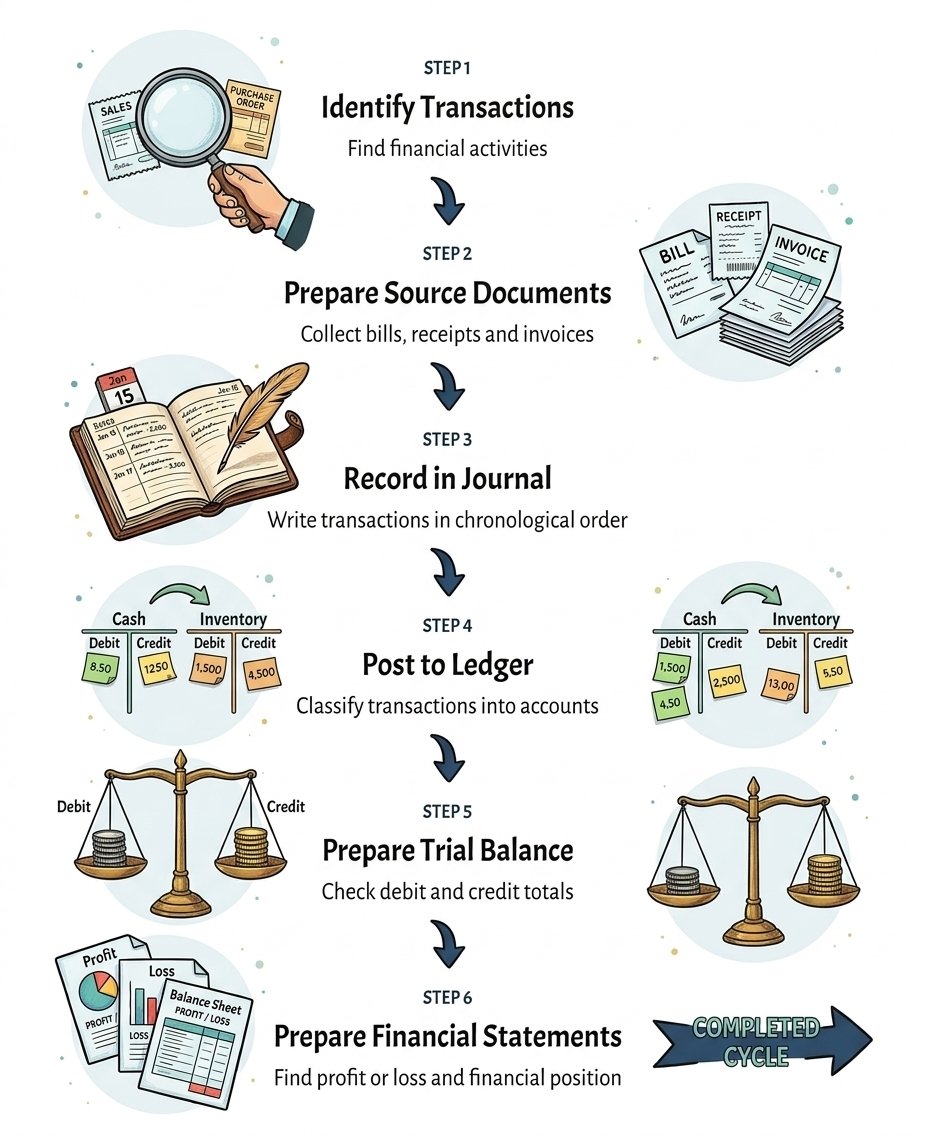
Example: A business purchases goods for ₹5,000 in cash.
First, the accountant identifies the transaction. Then the purchase invoice or bill is checked. The transaction is recorded in the journal, posted to the ledger, and later included in the trial balance and financial statements.
Importance of Accounting Process
Provides systematic accounting records.
Helps in preparing financial statements.
Makes transactions easy to understand.
Helps identify and correct errors.
Provides information for business decisions.
3. Books of Original Entry
Books of Original Entry are accounting books in which business transactions are recorded for the first time.
They are also known as Books of Prime Entry.
The Journal is the principal book of original entry.
Types of Books of Original Entry
Book | Purpose |
|---|---|
Journal Proper | Records transactions not entered in special journals |
Cash Book | Records cash and bank transactions |
Purchases Book | Records credit purchases of goods |
Sales Book | Records credit sales of goods |
Purchases Returns Book | Records goods returned to suppliers |
Sales Returns Book | Records goods returned by customers |
Bills Receivable Book | Records bills receivable |
Bills Payable Book | Records bills payable |
Example: If a business purchases goods worth ₹10,000 on credit, the transaction is recorded in the Purchases Book when that special journal is maintained.
Important: Cash purchases of goods are recorded in the Cash Book, not the Purchases Book.
Importance
Transactions are recorded in date order.
Provides permanent accounting records.
Reduces the chances of missing transactions.
Makes ledger posting easier.
Helps divide accounting work.
4. Double Entry System
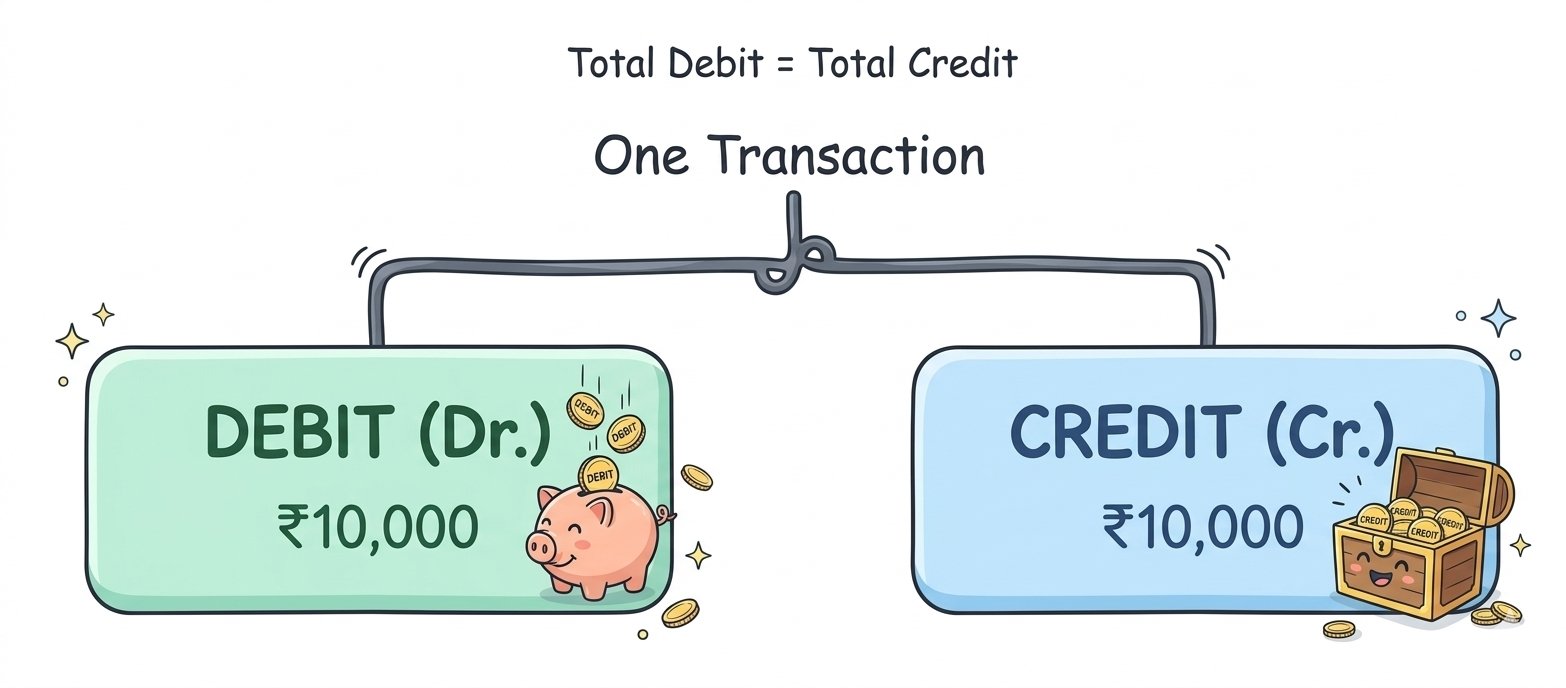
The Double Entry System is a system of accounting in which every business transaction affects at least two accounts.
For every transaction, one or more accounts are debited and one or more accounts are credited with equal total amounts.
Example
A business purchases furniture for ₹10,000 in cash.
Two accounts are affected:
Furniture Account — Debit ₹10,000 because furniture increases.
Cash Account — Credit ₹10,000 because cash decreases.
Journal Entry:
Particulars | Debit (₹) | Credit (₹) |
|---|---|---|
Furniture A/c Dr. | 10,000 | — |
To Cash A/c | — | 10,000 |
Features of Double Entry System
Every transaction affects at least two accounts.
Every debit has an equal credit.
It provides a complete record of transactions.
It follows accepted accounting rules.
It helps in preparing a trial balance.
It supports the preparation of financial statements.
Advantages
Provides accurate and systematic records.
Helps detect some accounting errors.
Helps determine profit or loss.
Helps determine the financial position.
Provides complete information about accounts.
Remember: Double Entry means equal debit and credit effects, not necessarily only two accounts.
5. Voucher
A Voucher is a document prepared to support and authorize the recording of a financial transaction.
In simple words, a voucher is documentary evidence used by the accountant to record a transaction.
Example: When a business pays office rent of ₹5,000, a payment voucher may be prepared with the supporting rent receipt.
Types of Vouchers
Voucher | Use |
|---|---|
Cash Voucher | Records cash transactions |
Debit Voucher | Supports transactions involving debits, usually payments |
Credit Voucher | Supports transactions involving credits, usually receipts |
Transfer Voucher | Records non-cash adjustments or transfers |
Vouchers may be classified differently depending on the accounting system.
Importance of Vouchers
Provide evidence of transactions.
Help prevent unauthorised entries.
Make accounting records reliable.
Help in auditing.
Help verify financial transactions.
6. Source of Transactions / Source Documents
Source Documents are original documents that provide proof that a business transaction has taken place.
They are used as the basis for preparing vouchers and accounting entries.
Difference Between Source Document and Voucher
Source Document | Voucher |
|---|---|
Original evidence of a transaction | Document supporting its accounting record |
Usually obtained or created when the transaction occurs | Often prepared for recording or authorisation |
Example: Invoice | Example: Payment Voucher |
7. Accounting Equation
The Accounting Equation explains the relationship between the assets, liabilities and capital of a business.
It is based on the principle that the resources of a business are financed either by the owner or by outsiders.
Basic Accounting Equation
Assets = Liabilities + Capital
8. Preparation of Accounting Equation
Let us understand this with a simple example.
Illustration
Rahul started a business and completed the following transactions:
Started business with cash ₹50,000.
Purchased furniture for cash ₹10,000.
Purchased goods on credit ₹15,000.
Paid creditors ₹5,000.
Received a bank loan of ₹20,000.
Step-by-Step Explanation
Transaction 1: Started business with ₹50,000.
Cash increases by ₹50,000 and capital increases by ₹50,000.
Assets = ₹50,000
Liabilities = ₹0
Capital = ₹50,000
Therefore, ₹50,000 = ₹0 + ₹50,000.
Transaction 2: Purchased furniture for ₹10,000 cash.
Furniture increases by ₹10,000 and cash decreases by ₹10,000. Total assets remain the same.
Transaction 3: Purchased goods on credit for ₹15,000.
Stock increases by ₹15,000 and creditors increase by ₹15,000.
Transaction 4: Paid creditors ₹5,000.
Cash decreases by ₹5,000 and creditors decrease by ₹5,000.
Transaction 5: Received a bank loan of ₹20,000.
Cash increases by ₹20,000 and bank loan liability increases by ₹20,000.
Accounting Equation Table
All amounts in ₹
Transaction | Assets | Liabilities | Capital |
|---|---|---|---|
1. Started business | 50,000 | 0 | 50,000 |
2. Purchased furniture | 50,000 | 0 | 50,000 |
3. Credit purchase | 65,000 | 15,000 | 50,000 |
4. Paid creditors | 60,000 | 10,000 | 50,000 |
5. Bank loan received | 80,000 | 30,000 | 50,000 |
Final Accounting Equation:
The equation remains balanced after every transaction.
9. Rules of Debit and Credit
Debit and Credit are the two sides of every account.
Debit (Dr.) means the left side of an account.
Credit (Cr.) means the right side of an account.
Debit does not always mean an increase, and credit does not always mean a decrease. Their effect depends on the type of account.
Traditional Classification of Accounts
Accounts are traditionally divided into three categories.
A. Personal Account
Accounts related to persons, firms, companies or other organizations.
Examples: Rahul A/c, Mohan A/c, Bank A/c.
Rule:
Debit the Receiver Credit the Giver
Example: Paid ₹5,000 to Mohan.
Mohan A/c Dr. ₹5,000
To Cash A/c ₹5,000
Mohan’s account is debited because he receives the payment.
B. Real Account
Accounts related to assets and property, such as cash, machinery, furniture and buildings.
Rule:
Debit What Comes In Credit What Goes Out
Example: Purchased machinery for ₹20,000 cash.
Machinery A/c Dr. ₹20,000
To Cash A/c ₹20,000
Machinery comes into the business, while cash goes out.
C. Nominal Account
Accounts related to expenses, losses, incomes and gains.
Examples: Salary, Rent, Commission Received, Interest Received.
Rule:
Debit All Expenses and Losses Credit All Incomes and Gains
Example: Paid salary ₹8,000.
Salary A/c Dr. ₹8,000
To Cash A/c ₹8,000
Salary is an expense, so it is debited.
Golden Rules of Accounting
Type of Account | Debit | Credit |
|---|---|---|
Personal | Receiver | Giver |
Real | What comes in | What goes out |
Nominal | Expenses and losses | Incomes and gains |
Modern Rules of Debit and Credit
Under the modern approach, accounts are classified into Assets, Liabilities, Capital, Expenses and Revenues.
Account | Increase | Decrease |
|---|---|---|
Assets | Debit | Credit |
Liabilities | Credit | Debit |
Capital | Credit | Debit |
Expenses | Debit | Credit |
Revenues | Credit | Debit |
10. Journal
A Journal is a book of original entry in which business transactions are recorded in chronological order (date-wise) using the double-entry system.
The process of recording transactions in a journal is called Journalising.
Format of Journal
Date | Particulars | L.F. | Debit (₹) | Credit (₹) |
|---|---|---|---|---|
1 Apr | Cash A/c Dr. | 50,000 | — | |
To Capital A/c | — | 50,000 | ||
(Being business started with cash) |
Explanation of Columns:
Date: Date of transaction.
Particulars: Names of accounts debited and credited.
L.F.: Ledger Folio, the reference to the ledger account.
Debit: Amount debited.
Credit: Amount credited.
Narration: A short explanation written below a journal entry.
Features of Journal
It is a book of original entry.
Transactions are recorded in date order.
It follows the double-entry system.
Every entry contains debit and credit amounts.
It provides a brief explanation through narration.
It serves as the basis for ledger posting.
Importance of Journal
Provides a systematic record of transactions.
Shows the complete accounting effect of transactions.
Makes posting to the ledger easier.
Helps identify and verify entries.
Provides a permanent chronological record.
11. Preparation of Journal Entries
Let us understand journal entries using some common transactions.
Example 1: Started Business with Cash
Rahul started a business with ₹1,00,000 cash.
Particulars | Debit (₹) | Credit (₹) |
|---|---|---|
Cash A/c Dr. | 1,00,000 | — |
To Capital A/c | — | 1,00,000 |
(Being business started with cash.)
Reason: Cash increases, so it is debited. Capital increases, so it is credited.
Example 2: Purchased Goods for Cash
Purchased goods for ₹20,000.
Particulars | Debit (₹) | Credit (₹) |
|---|---|---|
Purchases A/c Dr. | 20,000 | — |
To Cash A/c | — | 20,000 |
(Being goods purchased for cash.)
Reason: Purchases Account is debited and Cash Account is credited. This follows the traditional periodic inventory approach.
Example 3: Sold Goods for Cash
Sold goods for ₹30,000.
Particulars | Debit (₹) | Credit (₹) |
|---|---|---|
Cash A/c Dr. | 30,000 | — |
To Sales A/c | — | 30,000 |
(Being goods sold for cash.)
Reason: Cash increases and sales revenue is earned.
Example 4: Purchased Furniture
Purchased furniture for ₹10,000 in cash.
Particulars | Debit (₹) | Credit (₹) |
|---|---|---|
Furniture A/c Dr. | 10,000 | — |
To Cash A/c | — | 10,000 |
(Being furniture purchased for business use.)
Example 5: Paid Rent
Paid office rent ₹5,000.
Particulars | Debit (₹) | Credit (₹) |
|---|---|---|
Rent A/c Dr. | 5,000 | — |
To Cash A/c | — | 5,000 |
(Being office rent paid.)
Example 6: Received Commission
Received commission ₹3,000 in cash.
Particulars | Debit (₹) | Credit (₹) |
|---|---|---|
Cash A/c Dr. | 3,000 | — |
To Commission Received A/c | — | 3,000 |
(Being commission received in cash.)
Example 7: Goods Purchased on Credit
Purchased goods from Mohan for ₹15,000 on credit.
Particulars | Debit (₹) | Credit (₹) |
|---|---|---|
Purchases A/c Dr. | 15,000 | — |
To Mohan A/c | — | 15,000 |
(Being goods purchased from Mohan on credit.)
Example 8: Cash Withdrawn for Personal Use
Owner withdrew ₹2,000 cash for personal use.
Particulars | Debit (₹) | Credit (₹) |
|---|---|---|
Drawings A/c Dr. | 2,000 | — |
To Cash A/c | — | 2,000 |
(Being cash withdrawn by the owner for personal use.)
12. Ledger
A Ledger is the main book of accounts in which transactions recorded in journals are classified and posted into separate accounts.
In simple words, a ledger shows all transactions related to one particular account at one place.
For example, all transactions related to cash are recorded in the Cash Account, and all transactions related to rent are recorded in the Rent Account.
The Ledger is also known as the Principal Book of Accounts.
Features of Ledger
It is the principal book of accounts.
It contains separate accounts for different items.
Transactions are classified account-wise.
It provides debit and credit balances.
It helps in preparing the trial balance.
It is prepared using entries from journals and other books of original entry.
Importance / Utility of Ledger
1. Classified Information: All transactions related to one account are available in one place.
2. Knowledge of Balances: It helps determine the balance of each account.
3. Preparation of Trial Balance: Ledger balances are used to prepare the trial balance.
4. Preparation of Financial Statements: It provides information needed for final accounts.
5. Error Checking: Helps identify and investigate accounting mistakes.
6. Easy Comparison: Helps compare account balances across periods.
13. Format of Ledger Account
A ledger account is commonly shown in a T-shaped format.

Explanation:
Left side is called Debit (Dr.).
Right side is called Credit (Cr.).
Traditionally, the word “To” is written before the account name on the debit side.
The word “By” is written before the account name on the credit side.
14. Posting from Journal to Ledger
Posting is the process of transferring entries from the journal to their respective ledger accounts.
In simple words, posting means taking a transaction recorded in the journal and writing it in the correct accounts in the ledger.
Rules of Posting
Open separate ledger accounts for all accounts appearing in the journal.
Identify the account that has been debited.
Post the debit amount to the debit side of that account.
Identify the account that has been credited.
Post the credit amount to the credit side of that account.
Include the date and corresponding account name.
Enter appropriate reference numbers where required.
Example of Posting
Suppose Rahul records the following transactions:
Started business with ₹50,000 cash.
Purchased furniture for ₹10,000 cash.
Paid rent ₹5,000.
Step 1: Prepare Journal Entries
Date | Particulars | Debit (₹) | Credit (₹) |
|---|---|---|---|
Apr 1 | Cash A/c Dr. | 50,000 | — |
To Capital A/c | — | 50,000 | |
Apr 2 | Furniture A/c Dr. | 10,000 | — |
To Cash A/c | — | 10,000 | |
Apr 3 | Rent A/c Dr. | 5,000 | — |
To Cash A/c | — | 5,000 | |
Total | 65,000 | 65,000 |
Step 2: Post Transactions to Ledger
A. Cash Account
Debit Particulars | Amount (₹) | Credit Particulars | Amount (₹) |
|---|---|---|---|
To Capital A/c | 50,000 | By Furniture A/c | 10,000 |
By Rent A/c | 5,000 | ||
By Balance c/d | 35,000 | ||
Total | 50,000 | Total | 50,000 |
Cash Balance = ₹50,000 − ₹10,000 − ₹5,000 = ₹35,000 (Debit)
B. Capital Account
Debit Particulars | Amount (₹) | Credit Particulars | Amount (₹) |
|---|---|---|---|
To Balance c/d | 50,000 | By Cash A/c | 50,000 |
Total | 50,000 | Total | 50,000 |
Capital Balance = ₹50,000 (Credit)
C. Furniture Account
Debit Particulars | Amount (₹) | Credit Particulars | Amount (₹) |
|---|---|---|---|
To Cash A/c | 10,000 | By Balance c/d | 10,000 |
Total | 10,000 | Total | 10,000 |
Furniture Balance = ₹10,000 (Debit)
D. Rent Account
Debit Particulars | Amount (₹) | Credit Particulars | Amount (₹) |
|---|---|---|---|
To Cash A/c | 5,000 | By Balance c/d | 5,000 |
Total | 5,000 | Total | 5,000 |
Rent Balance = ₹5,000 (Debit)
Note: This is a teaching illustration of balancing. Nominal accounts such as Rent are normally closed to the appropriate final account at the end of the accounting period.
Step 3: Check Ledger Balances through Trial Balance
Account | Debit (₹) | Credit (₹) |
|---|---|---|
Cash | 35,000 | — |
Furniture | 10,000 | — |
Rent | 5,000 | — |
Capital | — | 50,000 |
Total | 50,000 | 50,000 |
Both sides are equal.
Important: Agreement of the trial balance does not guarantee that all accounting entries are error-free.
15. Difference Between Journal and Ledger
Basis | Journal | Ledger |
|---|---|---|
Meaning | Book of original entry | Principal book of accounts |
Purpose | Records transactions | Classifies transactions |
Order | Date-wise | Account-wise |
Process | Journalising | Posting |
Narration | Generally given | Normally not given |
Balancing | Not generally balanced | Accounts are balanced |
Use | Helps prepare ledger | Helps prepare trial balance |
16. Difference Between Single Entry and Double Entry System
Single Entry System | Double Entry System |
|---|---|
Incomplete recording system | Complete recording system |
Does not consistently record both aspects | Records equal debit and credit effects |
Trial balance generally cannot be prepared reliably | Trial balance can be prepared |
Less systematic | More systematic |
May be used for limited or informal records | Widely used in formal accounting |