Introduction to Accounting – Class 11 Accountancy Notes
Chapter – 1
Introduction to Accounting
1. Meaning and Concept of Accounting
Accounting is the process of identifying, measuring, recording, classifying, summarizing and communicating financial information to interested users.
In simple words, accounting means keeping a systematic record of all money-related activities of a business.
Example: A shopkeeper purchases goods for ₹20,000 and sells them for ₹25,000. Accounting helps record these transactions and calculate the profit.
Accounting Process
- Identifying Transactions
- Measuring in Money
- Recording in Books
- Classifying in Ledger
- Summarizing Accounts
- Analyzing & Interpreting
- Communicating Results
2. Features of Accounting
Identification: Only financial transactions are identified.
Measurement: Transactions are measured in monetary terms.
Recording: Transactions are recorded systematically.
Classification: Similar transactions are grouped together.
Summarization: Financial data is presented in a brief form through financial statements.
Analysis and Interpretation: Accounting information is studied to understand business performance.
Communication: Results are communicated to interested users.
Historical Nature: Accounting mainly records transactions that have already taken place.
Remember: Accounting records only those transactions that can be measured in money.
3. Objectives of Accounting
The main objectives are:
To maintain systematic records: Keeping proper records of all business transactions.
To calculate profit or loss: Finding whether the business has earned profit or suffered loss.
To know financial position: Finding the assets, liabilities and capital of the business.
To provide information: Giving useful financial information to owners, managers and other users.
To help in decision-making: Helping management make future business plans.
To meet legal requirements: Maintaining records required by applicable laws.
To protect business assets: Helping detect errors, fraud and misuse of resources.
Example:
Sales = ₹80,000
Expenses = ₹60,000
Profit = Sales − Expenses
Profit = ₹20,000
Assuming these are the total revenues and expenses for the period.
4. Advantages of Accounting
Maintains permanent records of transactions.
Helps calculate profit or loss.
Shows the financial position of a business.
Helps management in planning and decision-making.
Makes comparison between different years possible.
Provides useful evidence in legal matters.
Helps in calculating taxes.
Helps in obtaining loans from banks.
Helps detect mistakes and irregularities.
Provides financial information to interested parties.
5. Limitations of Accounting
Records monetary items only: Non-monetary factors such as employee honesty are not recorded.
Historical information: Most records relate to past transactions.
Ignores price-level changes: Traditional accounting generally does not adjust for inflation.
Based on estimates: Depreciation and provisions may involve estimates.
Possibility of manipulation: Financial results may be misrepresented.
Does not show exact market value: Book values may differ from current market values.
Not completely accurate: Some accounting figures depend on judgement and assumptions.
Exam point: Accounting provides useful information, but it does not always present the exact economic value of a business.
6. Users of Accounting Information
Users are people or organizations who use accounting information to make decisions.
They are divided into two groups:
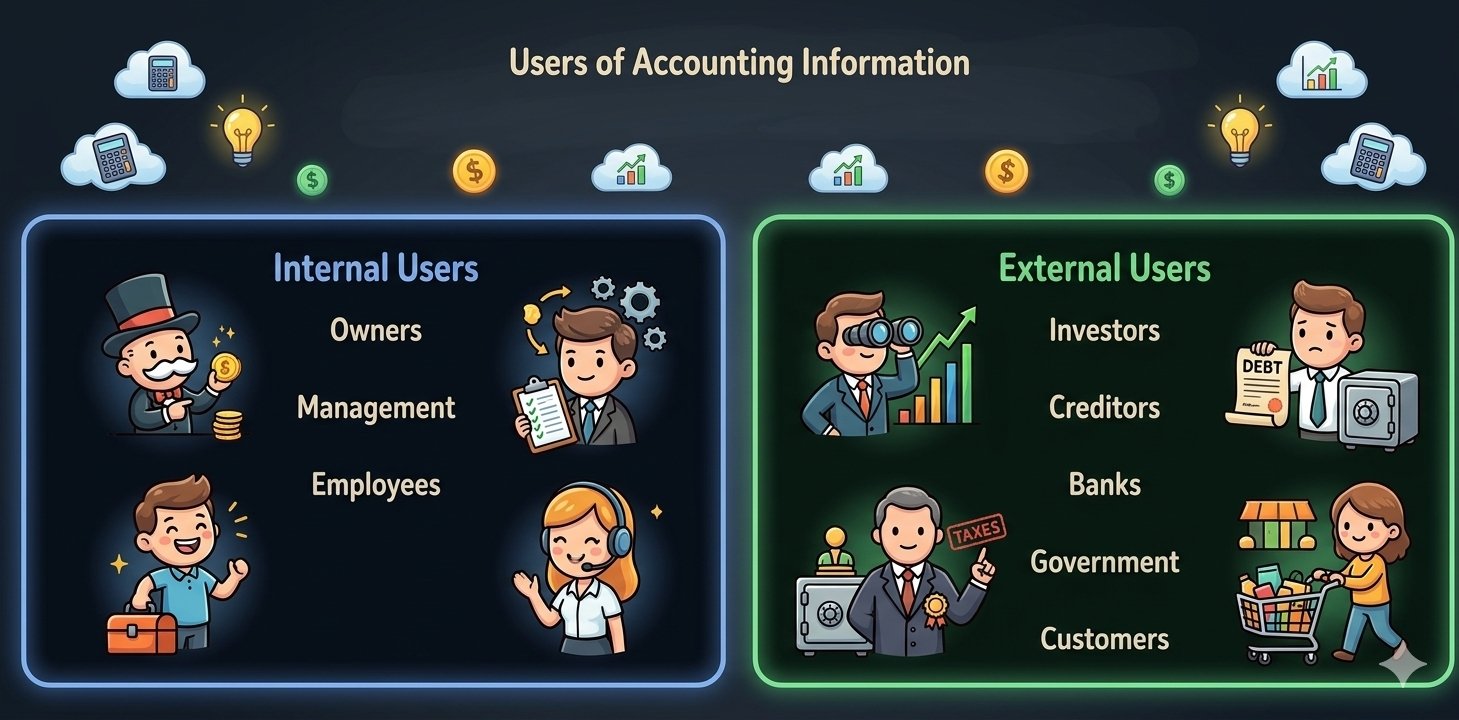
A. Internal Users
Internal users are people who are directly involved in running the business.
User | Purpose |
|---|---|
Owners | To know profit and financial position |
Management | To make business decisions |
Employees | To know stability, salary and bonus prospects |
B. External Users
External users are people or organizations outside the business.
User | Purpose |
|---|---|
Investors | To decide whether to invest |
Creditors | To know repayment capacity |
Banks | To decide whether to provide loans |
Government | To calculate taxes and ensure compliance |
Customers | To know business stability |
Researchers | To study financial performance |
Main Difference: Internal users work within the business, whereas external users are outside the business.
7. Qualitative Characteristics of Accounting Information
Good accounting information should have the following qualities:
1. Reliability
Information should be trustworthy, accurate and supported by proper evidence.
Example: Recording purchases using actual bills.
2. Relevance
Information should be useful for making decisions.
Example: Sales information helps management plan future production.
3. Understandability
Information should be presented clearly so users can understand it easily.
Example: Financial statements prepared in a simple and organised format.
4. Comparability
Information should help compare financial results of different years or businesses.
Example: Comparing the profit of 2025 with the profit of 2026.
Easy Memory Trick: R-R-U-C
R – Reliability
R – Relevance
U – Understandability
C – Comparability
8. Role of Accounting in Business
Accounting plays an important role in the successful operation of a business.
Record Keeping: Maintains systematic financial records.
Financial Planning: Helps prepare budgets and future plans.
Decision-Making: Helps owners and managers take correct decisions.
Profit Measurement: Calculates business profit or loss.
Financial Control: Helps control expenses and unnecessary spending.
Taxation: Provides information required for tax calculations.
Legal Compliance: Helps fulfil financial reporting requirements.
Business Growth: Helps assess business performance and expansion opportunities.
Conclusion: Accounting is called the language of business because it communicates financial information to different users.
9. BASIC ACCOUNTING TERMS
(1). Business Transaction
A transaction is a financial activity that changes the financial position of a business.
Examples:
Purchased goods for ₹10,000.
Paid salary ₹5,000.
Sold goods for ₹15,000.
Types of Transactions
A. Cash Transaction: Payment or receipt takes place immediately in cash or through a bank.
Example: Purchased furniture for ₹8,000 and paid immediately.
B. Credit Transaction: Payment or receipt takes place at a future date.
Example: Purchased goods worth ₹12,000 on credit.
(2). Capital
Capital is the amount of money or other assets invested by the owner in the business.
Example: Ram starts a business with ₹1,00,000. This amount is called capital.
Formula:
Capital = Assets − Liabilities
Capital represents the owner’s claim on the business.
(3). Drawings
Drawings refer to cash, goods or other assets withdrawn by the owner from the business for personal use.
Example: The owner withdraws ₹5,000 from the business for household expenses.
Important: Drawings reduce owner’s capital. They are not treated as business expenses.
(4). Assets
Assets are resources owned or controlled by a business from which future economic benefits are expected.
Examples: Cash, furniture, machinery, buildings, stock and debtors.
Types of Assets
A. Non-Current Assets: Assets used in the business for a long period.
Examples: Land, buildings, furniture, machinery.
B. Current Assets: Assets expected to be converted into cash, sold or used within the normal operating cycle or usually within one year.
Examples: Cash, stock, debtors.
C. Tangible Assets: Assets that have physical existence.
Examples: Machinery, furniture, buildings.
D. Intangible Assets: Assets without physical existence.
Examples: Goodwill, patents, trademarks.
(5). Liabilities
Liabilities are the financial obligations or debts of a business that are payable to outsiders.
Examples: Bank loans, creditors, outstanding salaries.
Types of Liabilities
A. Current Liabilities: Liabilities generally payable within one year or the normal operating cycle.
Examples: Creditors, bills payable, outstanding expenses.
B. Non-Current Liabilities: Liabilities payable over a longer period.
Examples: Long-term bank loans, debentures.
Accounting Equation
Assets = Capital + Liabilities
Example:
Assets = ₹1,50,000
Liabilities = ₹50,000
Capital = ₹1,00,000
₹1,50,000 = ₹1,00,000 + ₹50,000
(6). Revenue
Revenue is the income earned from the normal business activities of an organization.
Examples:
Sales revenue
Commission received
Fees earned
Service income
Example: Goods sold for ₹30,000. The sales revenue is ₹30,000.
Remember: Revenue is not the same as profit.
Profit = Total Revenue − Total Expenses
(7). Expenditure
Expenditure is the amount spent or liability incurred to purchase goods, acquire assets or obtain services.
Types of Expenditure
A. Capital Expenditure: Money spent to purchase or improve long-term assets.
Example: Purchase of machinery for ₹80,000.
B. Revenue Expenditure: Money spent on day-to-day business operations, benefiting the current accounting period.
Example: Rent ₹5,000, salary ₹10,000.
C. Deferred Revenue Expenditure: A traditional accounting term for certain revenue-type expenditures whose benefits are considered to extend over future periods. Its accounting treatment depends on applicable standards.
Example: A major advertising campaign may be described this way in traditional textbooks, although advertising costs are generally expensed under modern standards unless asset-recognition requirements are met.
(8). Stock
Stock refers to goods available with a business for sale or use in producing goods for sale. It is also called inventory.
Types of Stock
Opening Stock: Goods available at the beginning of the accounting period.
Closing Stock: Goods remaining unsold at the end of the accounting period.
Example:
A shopkeeper has goods worth ₹20,000 at the beginning of the year. This is opening stock.
At the end of the year, unsold goods worth ₹8,000 remain. This is closing stock.
(9). Debtors
Debtors are persons or organisations who owe money to the business, usually because goods or services were sold to them on credit.
Example: Goods worth ₹10,000 are sold to Rahul on credit.
Rahul is a debtor because he has to pay ₹10,000 to the business.
Remember: Debtors are generally current assets.
(10). Creditors
Creditors are persons or organisations to whom the business owes money, usually because goods or services were purchased on credit.
Example: Goods worth ₹15,000 are purchased from Mohan on credit.
Mohan is a creditor because the business has to pay ₹15,000 to him.
Remember: Creditors are generally current liabilities.
Difference Between Debtors and Creditors
Basis | Debtors | Creditors |
|---|---|---|
Meaning | Persons who owe money to the business | Persons to whom business owes money |
Arise from | Credit sales | Credit purchases |
Nature | Asset | Liability |
Money | To be received | To be paid |
Example | Rahul owes us ₹5,000 | We owe Mohan ₹5,000 |
(11). Voucher
A voucher is a document that provides evidence of a business transaction and supports its recording in the books of accounts.
Examples:
Cash memo
Invoice
Receipt
Payment voucher
Debit note
Credit note
Importance of Vouchers:
Provide proof of transactions.
Help in recording transactions correctly.
Reduce the possibility of errors and fraud.
Help during auditing.
(12). Discount
Discount is a reduction in the price or amount payable for goods or services.
There are mainly two types:
A. Trade Discount
Trade discount is a reduction in the list price of goods, generally offered to encourage bulk purchases or trade.
Example:
List Price = ₹10,000
Trade Discount = 10%
Discount = ₹1,000
Net Invoice Price = ₹9,000
Important: Trade discount is not recorded separately in the books of accounts. Only the net amount is recorded.
B. Cash Discount
Cash discount is a reduction in the amount payable, usually allowed for prompt or early payment.
Example:
Amount Due = ₹5,000
Cash Discount = 5%
Discount = ₹250
Amount Paid = ₹4,750
Important: Cash discount is recorded separately in the books of accounts.
Difference Between Trade Discount and Cash Discount
Basis | Trade Discount | Cash Discount |
|---|---|---|
Purpose | To encourage sales | To encourage quick payment |
Allowed on | List price | Amount due |
Time | At the time of sale | At the time of payment |
Recording | Not recorded separately | Recorded separately |
Shown in invoice | Usually deducted from list price | Usually not deducted from original sales invoice |