Chapter-3 : Liberalization, Privatization and Globalization: An Appraisal
Chapter 3: Liberalization, Privatization and Globalization – An Appraisal
1. Introduction
After independence, India followed a mixed economy with a major role for the public sector and many government controls over private businesses and foreign trade.
By the end of the 1980s, India faced serious economic problems such as:
- High fiscal deficit
- Rising external debt
- Inflationary pressure
- Balance of payments difficulties
- Low foreign exchange reserves
- Slow economic growth
In 1991, India faced a serious economic crisis. To overcome this crisis, the government introduced a new economic policy based on:
- Liberalization
- Privatization
- Globalization
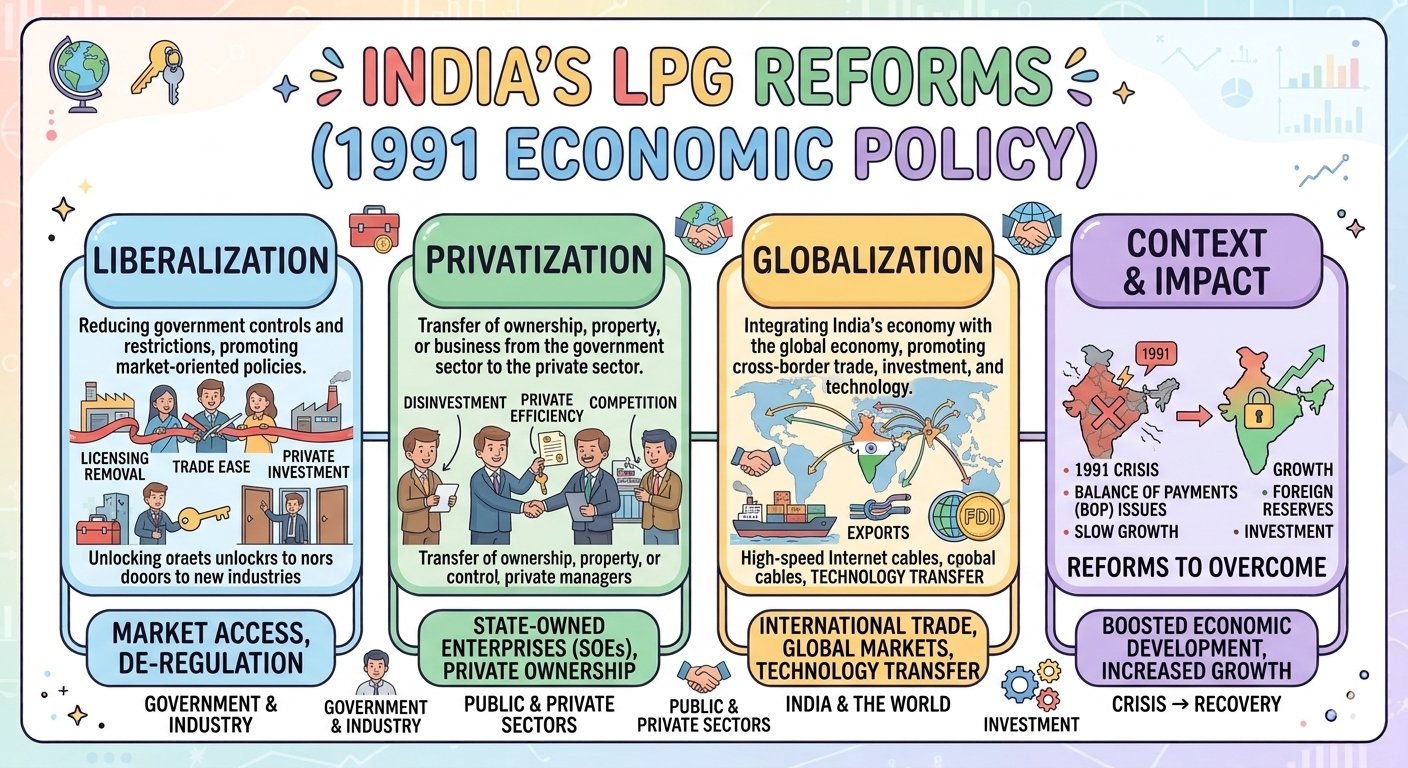
These three are commonly known as the LPG reforms.
2. Economic Crisis of 1991
In 1991, the Indian economy faced a severe crisis.
The major problems were:
- Rapid increase in government expenditure.
- Rising fiscal deficit.
- Increase in foreign debt.
- Decline in foreign exchange reserves.
- Increase in imports compared with exports.
- Rising prices.
- Difficulty in making international payments.
India’s foreign exchange reserves became so low that the country faced difficulty paying for essential imports.
Therefore, major economic reforms were introduced in 1991.
3. New Economic Policy, 1991
The New Economic Policy (NEP), 1991 introduced major changes in India’s economic system.
Its main objective was to:
- Increase economic efficiency.
- Encourage private investment.
- Increase competition.
- Attract foreign investment.
- Promote international trade.
- Reduce unnecessary government controls.
- Increase economic growth.
The three major components were:
Liberalization + Privatization + Globalization = LPG
4. Meaning of Liberalization
Liberalization means reducing or removing unnecessary government restrictions and controls on economic activities.
Before 1991, businesses faced many government regulations.
After liberalization, many restrictions were reduced to encourage:
- Private investment
- Competition
- Industrial growth
- Efficiency
- Innovation
5. Main Features of Liberalization
The major measures of liberalization included:
- Removal of industrial licensing for many industries.
- Reduction of restrictions on private businesses.
- Reduction of import restrictions.
- Reduction of tariffs and customs duties.
- Greater freedom for businesses.
- Financial sector reforms.
- Tax reforms.
- Reforms in the foreign exchange market.
6. Industrial Sector Reforms
Before 1991, many industries required government permission through the system of industrial licensing.
After 1991, industrial licensing was abolished for most industries, except for certain industries considered important for security, environmental or strategic reasons.
Objectives
- Encourage competition.
- Increase efficiency.
- Reduce unnecessary government interference.
- Encourage private investment.
- Improve productivity.
7. Financial Sector Reforms
The financial sector includes:
- Banks
- Financial institutions
- Stock markets
Financial sector reforms were introduced to make the financial system more efficient and competitive.
The Reserve Bank of India (RBI) continued to act as the central monetary authority, while reforms aimed to improve the functioning of banks and financial institutions.
8. Tax Reforms
Tax reforms were introduced to simplify the tax system and improve tax collection.
The main objectives were:
- Simplify tax rates.
- Reduce excessive tax burdens.
- Improve compliance.
- Increase government revenue.
- Encourage investment.
9. Foreign Exchange Reforms
Foreign exchange reforms were introduced to improve the management of India’s foreign exchange system.
The reforms gradually moved India towards a more market-oriented foreign exchange system.
This helped:
- Promote international trade.
- Improve foreign exchange management.
- Facilitate international transactions.
10. Meaning of Privatization
Privatization means increasing the role of the private sector and reducing the role or ownership of the government in economic activities.
It may involve transferring ownership or management of public enterprises to private companies.
The main idea is to improve efficiency, productivity and profitability.
11. Methods of Privatization
1. Disinvestment
Disinvestment means selling a part of the government’s ownership in a public sector enterprise.
The government may sell shares of a public enterprise to:
- Private investors
- Financial institutions
- The general public
2. Transfer of Ownership
In some cases, ownership or management of a public enterprise may be transferred to private organizations.
12. Objectives of Privatization
Privatization aims to:
- Improve efficiency.
- Increase productivity.
- Reduce financial burden on the government.
- Encourage private investment.
- Increase competition.
- Improve management.
- Reduce losses of public enterprises.
13. Meaning of Globalization
Globalization means greater integration of the domestic economy with the economies of other countries.
It involves increased movement of:
- Goods
- Services
- Capital
- Technology
- Information
across national borders.
Globalization has made economies more closely connected with each other.
14. Features of Globalization
Important features include:
- Increase in international trade.
- Increase in foreign investment.
- Greater movement of technology.
- Expansion of multinational companies.
- Greater competition.
- Integration of domestic markets with global markets.
15. Foreign Direct Investment (FDI)
Foreign Direct Investment (FDI) occurs when a company or investor from one country invests directly in a business or productive activity in another country.
Example
A foreign company establishing a manufacturing plant in India is an example of FDI.
FDI can bring:
- Capital
- Technology
- Management skills
- Employment opportunities
- New production methods
16. Multinational Corporations
A Multinational Corporation (MNC) is a company that operates in more than one country.
MNCs can contribute to the economy by bringing:
- Foreign capital
- New technology
- Management skills
- International marketing networks
- Employment opportunities
However, their operations may also create challenges for small domestic producers because of increased competition.
17. Role of World Trade Organization
The World Trade Organization (WTO) is an international organization that deals with rules governing international trade.
It was established in 1995, replacing the earlier General Agreement on Tariffs and Trade (GATT) framework.
Main functions
- Promote international trade.
- Provide a framework for trade negotiations.
- Establish rules for international trade.
- Help settle trade disputes between member countries.
India is a member of the WTO.
18. Outsourcing
Outsourcing means obtaining certain services or business activities from an outside organization instead of performing them within the organization itself.
India became an important destination for certain outsourced services because of factors such as:
- Availability of skilled workers
- Lower costs in some services
- Large English-speaking workforce
- Development of information technology
Examples
- Call centers
- Customer support
- Software services
- Data processing
- Accounting services
19. Appraisal of LPG Reforms
The LPG reforms have had both positive and negative effects.
Therefore, their impact should be evaluated from different perspectives.
20. Positive Effects of Liberalization
Liberalization helped in:
- Increasing competition.
- Encouraging private investment.
- Improving efficiency.
- Increasing consumer choice.
- Encouraging technological development.
- Reducing unnecessary government controls.
Businesses gained greater freedom to make production and investment decisions.
21. Positive Effects of Privatization
Privatization has helped in some areas by:
- Improving management.
- Increasing efficiency.
- Reducing government involvement in commercial activities.
- Encouraging competition.
- Mobilizing private investment.
Some public enterprises also became more commercially oriented.
22. Positive Effects of Globalization
Globalization contributed to:
1. Increase in foreign investment
India became more attractive to foreign investors.
2. Technology transfer
Indian industries gained access to modern technologies.
3. Growth in exports
Greater integration with world markets created opportunities for exports.
4. Greater consumer choice
Consumers gained access to a wider variety of goods and services.
5. Growth of service sector
Information technology and business services expanded significantly.
6. International competition
Indian firms faced greater competition, encouraging them to improve quality and efficiency.
23. Impact on Agriculture
The impact of economic reforms on agriculture has been mixed.
Some positive aspects
- Greater opportunities for agricultural exports.
- Increased access to global markets.
- Growth of commercial agriculture in some areas.
- Greater opportunities for diversification.
Some concerns
- Greater exposure to international price fluctuations.
- Increased competition.
- Benefits not equally distributed among farmers.
- Challenges for small farmers with limited resources.
24. Impact on Industry
The industrial sector experienced greater competition after liberalization.
Positive effects
- Greater access to technology.
- Increased investment.
- Better product quality.
- More competition.
- Greater export opportunities.
Negative effects
Some small and inefficient industries faced difficulties because they had to compete with larger domestic and foreign firms.
25. Impact on Service Sector
The service sector benefited significantly from the reforms.
Important areas of growth included:
- Information technology
- Software services
- Telecommunications
- Banking
- Insurance
- Business process outsourcing
- Tourism
- Financial services
India became an important global provider of several information technology and business services.
26. Impact on Consumers
Consumers generally benefited from increased competition and globalization.
They gained:
- Greater variety of products
- Better quality in many markets
- New technologies
- More choices
- Greater availability of international products
However, increased consumer choice does not necessarily mean that every consumer benefits equally.
27. Criticism of LPG Reforms
The reforms have also been criticized on several grounds.
1. Unequal distribution of benefits
The benefits of economic growth have not been distributed equally among all sections.
2. Pressure on small producers
Small-scale producers may face strong competition from large domestic and multinational companies.
3. Employment concerns
Economic growth does not always create sufficient employment for everyone.
4. Agricultural challenges
Farmers can be affected by international price fluctuations and competition.
5. Regional inequalities
Some states and regions have benefited more than others.
6. Social sector concerns
Greater emphasis on market forces may create concerns about access to essential services if public support is inadequate.
28. Globalization and Indian Economy
Globalization has made the Indian economy more connected with the rest of the world.
India has become more integrated into:
- Global trade
- International investment
- Global technology networks
- International service markets
The Indian IT and service industries have particularly benefited from globalization.
29. Role of Government After Reforms
Economic reforms did not mean that the government completely withdrew from the economy.
The role of government remained important in:
- Regulation
- Infrastructure
- Education
- Healthcare
- Social welfare
- Poverty reduction
- Environmental protection
- Maintaining economic stability
The government’s role shifted increasingly from direct control of economic activities towards regulation, facilitation and social development.
30. Before and After 1991
| Before 1991 | After 1991 |
|---|---|
| Greater government controls | Reduced controls |
| Industrial licensing was widespread | Licensing reduced for most industries |
| Greater protection from foreign competition | Greater international competition |
| Public sector had a dominant role | Greater role for private sector |
| Import restrictions were high | Import restrictions reduced |
| Limited foreign investment | Foreign investment encouraged |
| Greater emphasis on self-reliance through domestic production | Greater integration with global economy |
31. Advantages of LPG Reforms
The major advantages include:
- Higher competition
- Greater efficiency
- Increased foreign investment
- Better access to technology
- Expansion of exports
- Greater consumer choice
- Growth of the service sector
- Development of private enterprise
- Greater integration with the world economy
32. Limitations of LPG Reforms
The major limitations include:
- Increase in economic inequalities in some areas.
- Difficulties for some small producers.
- Unequal regional development.
- Employment concerns.
- Greater exposure to global economic fluctuations.
- Challenges faced by some agricultural producers.
- Benefits not equally distributed.