Chapter 1: Indian Economy on the Eve of Independence
1. Introduction
Before independence in 1947, India was under British colonial rule for about two centuries. During this period, the Indian economy was shaped mainly according to the economic interests of the British government.
The main objective of British economic policies was not to develop India’s economy but to serve British interests. As a result, at the time of independence, India had a weak and underdeveloped economy.
The major features of the Indian economy on the eve of independence were:
- Low level of economic development
- Low agricultural productivity
- Poor industrial development
- Limited foreign trade for India’s benefit
- Poor infrastructure
- Low standard of living
- High poverty and unemployment
- Poor health and education facilities
2. State of the Indian Economy Under British Rule
The Indian economy was mainly an agrarian economy, with a large part of the population dependent on agriculture.
However, agriculture was not sufficiently developed. Traditional methods of cultivation, low investment and poor irrigation resulted in low agricultural productivity.
The industrial sector was also weak because many traditional Indian handicrafts and industries declined during British rule.
3. Main Features of the Indian Economy on the Eve of Independence
1. Low Level of Economic Development
India had a very low level of economic development.
There was:
- Low per capita income
- Low productivity
- Poor living conditions
- High poverty
- Limited employment opportunities
The economy lacked modern industries and adequate productive infrastructure.
4. Agriculture Sector
Agriculture was the main occupation of the Indian population.
A large proportion of people depended directly or indirectly on agriculture for their livelihood.
However, the agricultural sector suffered from several problems.
Major problems
- Dependence on traditional methods
- Low productivity
- Lack of irrigation
- Lack of modern technology
- Limited use of fertilizers and improved seeds
- Poor investment
- Exploitation of farmers
- Frequent famines and food shortages in some periods
5. Land Revenue Systems
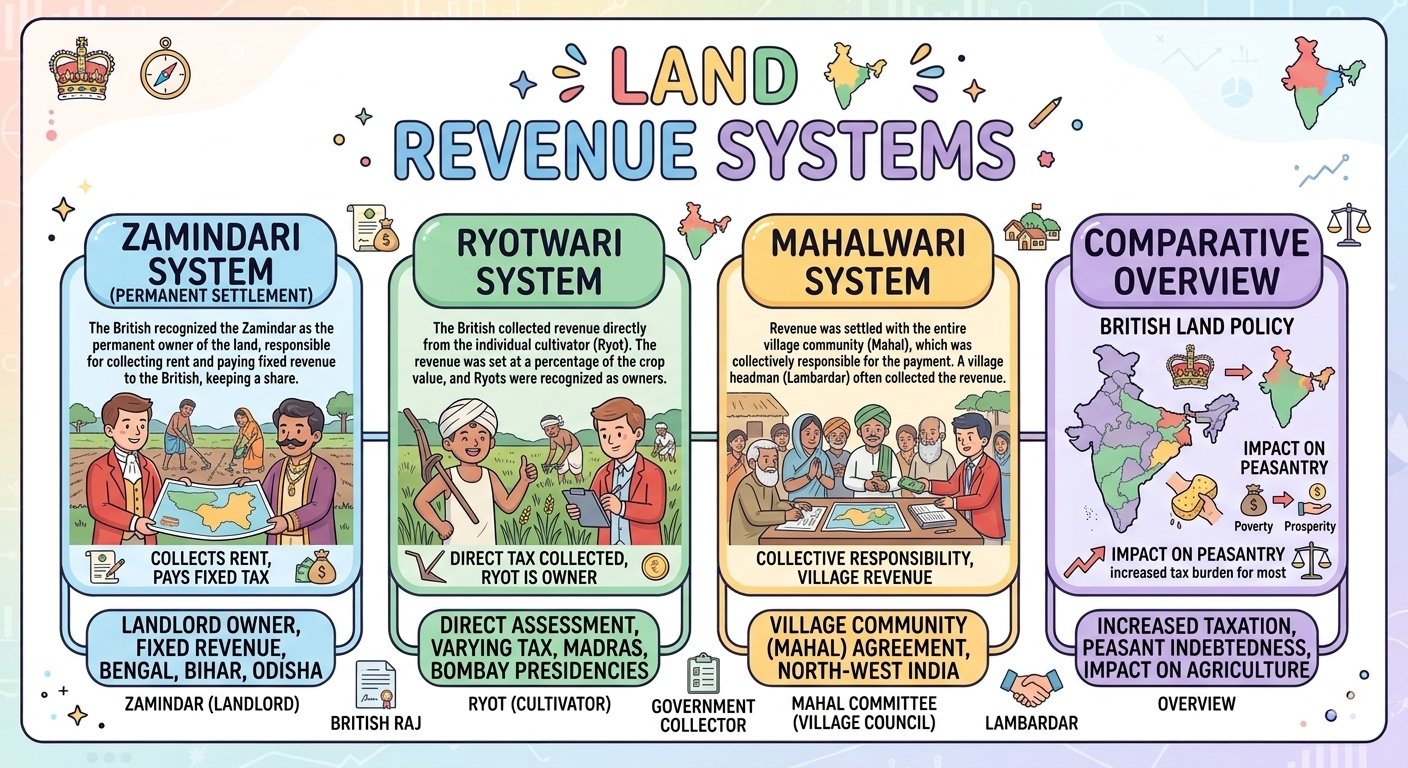
The British introduced different land revenue systems in different parts of India.
The major systems were:
- Zamindari System
- Ryotwari System
- Mahal Wari System
A. Zamindari System
Under the Zamindari System, zamindars were responsible for collecting land revenue from peasants and paying it to the government.
The zamindars generally had strong control over the cultivators.
This system often resulted in:
- High rents
- Exploitation of peasants
- Insecurity among cultivators
- Lack of incentives for agricultural improvement
B. Ryotwari System
Under the Ryotwari System, revenue was collected directly from the cultivators, known as ryots.
It was mainly introduced in parts of southern and western India.
C. Mahal Wari System
Under the Mahal Wari System, revenue was collected from a village or group of villages.
The village community or its representatives were responsible for paying the land revenue.
6. Commercialization of Agriculture
During British rule, farmers were encouraged or compelled in many regions to grow crops that could be sold in markets and used as raw materials for British industries.
Such crops included:
- Cotton
- Indigo
- Jute
- Sugarcane
- Tea
- Coffee
This process is known as commercialization of agriculture.
It reduced the emphasis on food crops in some areas and linked Indian agriculture more closely with international markets.
7. Industrial Sector
India had a rich tradition of handicrafts and handicraft industries before British rule.
However, many traditional industries declined during British rule.
At the same time, some modern industries developed gradually.
Important industries that developed
- Cotton textile industry
- Jute industry
- Iron and steel industry
- Sugar industry
- Cement industry
- Paper industry
8. Decline of Handicraft Industries
Indian handicrafts were well known for their quality and variety.
However, the growth of machine-made goods from Britain created strong competition for Indian handicraft products.
As a result:
- Demand for many Indian handicrafts declined.
- Many artisans lost their traditional employment.
- Traditional industries weakened.
- Many workers moved towards agriculture.
This process is often referred to as deindustrialization.
9. Development of Modern Industries
Although traditional industries declined, some modern industries developed during the colonial period.
The cotton textile industry developed particularly in cities such as Bombay and Ahmedabad.
The jute industry developed mainly in Bengal.
The iron and steel industry also emerged, with Tata Iron and Steel Company (TISCO) being established in 1907.
However, industrial development remained limited compared with the size of India’s population and economy.
10. Foreign Trade
India had been an important participant in international trade for centuries.
During British rule, however, India’s foreign trade was largely structured to serve British interests.
India mainly exported raw materials and agricultural products and imported many manufactured goods.
Major exports included:
- Raw cotton
- Jute
- Tea
- Indigo
- Opium
- Other agricultural products
Major imports included:
- Manufactured cotton goods
- Machinery
- Other manufactured products
11. Drain of Wealth
A significant portion of India’s economic resources was transferred to Britain without an equivalent return to India.
This was described by Indian nationalists as the Drain of Wealth.
The economic drain took place through various forms, including:
- Payments for administrative expenses
- Payments to British officials
- Interest and other payments
- Profits transferred abroad
The Drain Theory was strongly associated with Dadabhai Naoroji, who discussed the economic drain from India to Britain.
12. Demographic Condition
The demographic condition of India was poor at the time of independence.
The population experienced:
- High birth rate
- High death rate
- Low life expectancy
- High infant mortality
- Poor health conditions
The high death rate was associated with:
- Epidemics
- Famines
- Malnutrition
- Poor sanitation
- Limited medical facilities
13. Occupational Structure
The occupational structure refers to the distribution of working people among different economic activities.
At independence, a very large proportion of India’s working population depended on agriculture.
Only a relatively small proportion worked in:
- Manufacturing
- Mining
- Modern services
This showed the backward nature of the Indian economy.
14. Infrastructure
Infrastructure includes facilities and systems that support economic activities.
During British rule, some infrastructure was developed, such as:
- Railways
- Roads
- Ports
- Telegraph
- Post
- Communication systems
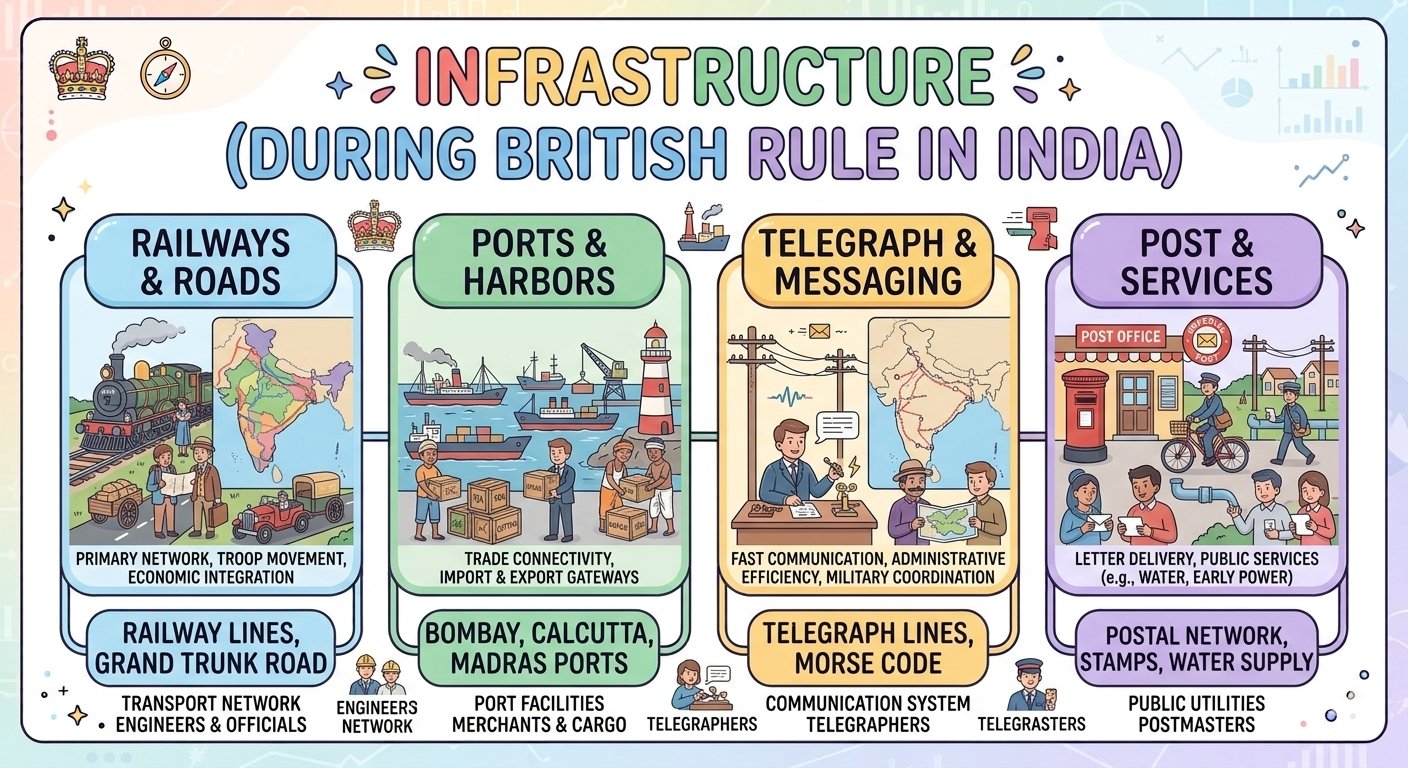
However, much of this infrastructure was developed primarily to serve colonial administrative, military and commercial interests.
15. Railways
The railway system was one of the major infrastructure developments during British rule.
The first railway line in India was introduced in 1853, connecting Bombay and Thane.
Railways helped in:
- Transporting goods
- Moving people
- Connecting different regions
- Expanding markets
However, the railway network was also useful to the British for moving raw materials from production areas to ports and distributing manufactured goods.
16. Education
The education system during British rule expanded to some extent, but overall educational development remained limited.
At independence:
- Literacy was very low.
- Access to education was limited.
- Female education was particularly neglected.
- Higher education was available to a relatively small section of society.
Low literacy restricted economic and social development.
17. Health
The health conditions of the population were poor.
Major problems included:
- Poor sanitation
- Malnutrition
- Lack of medical facilities
- Epidemics
- High mortality
- Low life expectancy
Health facilities were insufficient, particularly in rural areas.
18. Poverty
Poverty was widespread at the time of independence.
A large part of the population lacked adequate:
- Food
- Clothing
- Housing
- Education
- Healthcare
- Employment opportunities
Low productivity and limited economic opportunities contributed to widespread poverty.
19. Unemployment
Unemployment and underemployment were major economic problems.
Many people depended on agriculture even when agriculture could not provide sufficient employment throughout the year.
Traditional artisans who lost their occupations also had limited alternative employment opportunities.
20. Per Capita Income
The level of per capita income was very low.
Per capita income means:
Per Capita Income=National Income Population Per\ Capita\ Income = \frac{National\ Income}{Population}
Low per capita income reflected the generally poor economic condition of the population.
21. British Economic Policies
British economic policies affected almost every major sector of the Indian economy.
Their policies were mainly designed to:
- Obtain raw materials from India.
- Provide markets for British manufactured goods.
- Generate revenue.
- Support British trade and industry.
As a result, India’s economic development remained limited.
22. Positive Developments During British Rule
Although colonial rule had serious negative economic consequences, some developments also took place.
These included:
- Development of railways
- Expansion of ports
- Development of modern industries
- Expansion of postal and telegraph systems
- Introduction of modern banking and financial institutions
- Development of some modern educational institutions
However, these developments were limited and were often closely connected with colonial administrative and commercial requirements.
23. Overall Economic Condition at Independence
At the time of independence in 1947, India inherited an economy characterized by:
- Widespread poverty
- Low per capita income
- Low agricultural productivity
- Limited industrialization
- Poor infrastructure
- Low literacy
- Poor health facilities
- High unemployment and underemployment
- Heavy dependence on agriculture
Therefore, independent India faced the major challenge of rebuilding and developing the economy.